Category Archives: Marketing/Advertising/PR

Marketing, advertising and public relations

That’s no fun

About six months ago, San Francisco’s board of supervisors voted to ban the inclusion of toys in kids’ meals at fast food chains. So began the demise of the McDonald’s Happy Meal in that neck of the woods. I suggested an underground market to keep kids from melting down when their meals consisted of, well, meals.

This week, fast food chain Jack in the Box announced it would eliminate toys from its kids’ meals.

A company spokesman said the decision had more to do with the chain’s focus on food than on the matter of toys.

Luring children into fast food restaurants with colorful toys has become an issue of moral debate in our nation, fueled largely by food-policing advocacy groups.

One question becomes whether these kids are driving themselves to score the coveted toys and the fat laden lunches that accompany them. Another question is the company’s latest ad campaign that targets the stoner clientele Jack in the Box enjoys in its late-night hours and how that squares with JITB’s cute and bouncy persona.

But the question lurking in my mind is why a company bearing this name is turning against toys. Does anyone else see the perversity in that?

7 Comments

Filed under Food, Marketing/Advertising/PR

For real

The City of Buffalo has long been the butt of jokes. Even my father, who’s from there, used to say that Buffalo came into being when “they cloned Cleveland.”

This week, there are new jokes as Buffalo—The City of Good Neighbors, The Queen City, The City of No Illusions, The Nickel City, Queen City of the Lakes, City of Light—takes on a new motto: “Buffalo For Real.”

I learned about this not from the city’s own announcement, which includes a new tourism video, but from the swell of snickers and criticisms from within Western New York and around the country. The blogosphere bubbles with mockery while Twitter tee-hees abound.
Advertising Age slammed the slogan, calling it meaningless. (But do check out their map of the most absurd city slogans in the United States.) Buffalonians don’t appear to be crazy about it either, but they’ve been quick to come to the defense of their city, as they are often called to do, pointing to the depth of Buffalo’s history and culture. One commenter suggested “Buffalo: Leave for the weather, come back for everything else.” Commenters from other cities were cruel (“Denver: at least it’s not Buffalo”), while others were happy to be out of the spotlight for their own cities’ inane slogans.

But back to Buffalo For Real. If the city’s marketeers had consulted me, I’d have suggested some punctuation. Mabye a comma or a colon following Buffalo. On the surface, “Buffalo For Real” does sound a little meaningless. But if you look at the campaign, there’s a broader theme: Buffalo for art, Buffalo for architecture, Buffalo for families, Buffalo for food, for nature, for history, for shopping, for sports, for performing arts. The tourism video addresses the “real” part. The narration holds the city’s past troubles and blemishes up to the light and assures visitors of the vast rejuvenation taking place. “We’ve had our share of hard knocks.” “Some might say that time has left our town behind.” “Neighborhoods given up for dead are being given new life.” Even the snow has an honored place in the script.

Juxtaposed against tourist destinations in which weather is the draw, with little authenticity behind sun and spa, Buffalo stands out as real. Blue collar and white collar workers alike have withstood decades of economic devastation and year after year of bone-chilling temperatures. The people remain ever cheerful, trust me. The city by Niagara Falls has a lot to be proud of.

I like the new slogan. I just wish the video had been narrated by someone with a Buffalo accent.

Now that would be real.

3 Comments

Filed under All Things Wordish, Marketing/Advertising/PR, Technology and Social Media, Travel

Mother matters

Two of my favorite sitcoms this season are The Middle on ABC and Raising Hope on Fox. Perhaps it’s because they’re as real life as can be, especially when it comes to the mother roles. I also like ABC’s Modern Family and NBC’s Parenthood because they reflect the humorous imperfections alive in families.

This morning I pulled the Parade magazine out of the cellophaned supplements and smiled to find featured the four mothers on these shows. In “The Mom Squad,” the actresses playing popular TV mothers give their takes on motherhood.

Whether or not you’re a mother, I think you’ll see a little bit of yourself in one or more of the characters the actresses portray. I know I did.

“A type A anxious mother . . . a little nuts, a little stubborn.”

“She likes to eat. She likes to drink. She loves her kid, but she’s not focused on being the World’s Greatest Mom . . . She’s not reading the mommy blogs, but she has this gooey center.”

“Works because her family needs the money. But in other ways she’s a lot like Lucy in I Love Lucy—she freaks out about stuff, tries to overcontrol situations, and does harebrained things. And her husband is this calming, sensible force who says, ‘Let’s chill.’”

“A stay-at-home mom, but the kids are getting older and she’s trying to work out who she is now that they don’t need her so much.”

(Another favorite quote from the article is one in which actress Martha Plimpton describes the twins who play her granddaughter on Raising Hope. She says, “the little fat behind the neck is like a fine foie gras.”)

So which modern TV mother are you? Or maybe you’re more of a traditional TV mother like June Cleaver or Edith Bunker. Or a mod 1960s or ‘70s mother like Samantha Stevens or Shirley Partridge. Which one do you wish you were and why?

While we’re on the subject, notice I said TV “mother,” and not “mom.” I have a little peeve about this and what better day to air it than on the eve of Mother’s Day? Notice it’s not Mom’s Day. Mom is a name. Mom is not a noun. In my view, someone is not a mom. She’s a working mother, a stay-at-home mother, a single mother or simply, a mother. Madison Avenue is the worst offender, often producing ad copy that says a product is “preferred by moms.” (Such a claim is also backward for this day and age.)

Some dictionaries have acquiesced a bit, but most define “mom” as informal for “mother.”

In my opinion, it’s all right to refer to “my Mom,” but to use “mom” to refer to any woman with children is sloppy speech. Same goes for “dad.”

Why? Because I said so.

3 Comments

Filed under All Things Wordish, Holidays, Marketing/Advertising/PR, Movies, Television and Radio

Candy coating

There wasn’t as much time as I had hoped yesterday to read my new Euphemisms book; however, euphemisms continued to play in my mental background as I went about my business.

At one point during the day, my mind wandered back to my days working for a Fortune 100 company, employed in what my new dictionary calls “legislative advocacy leadership.” Large corporations are masters at euphemistic technique, a talent that serves them well when applied artfully. I am betting there are readers who have worked in corporate America who have examples to share. Please?

We had “resource realignment,” translation: layoffs. When competing for business that we didn’t win, we were “deselected.” When we made one of the cuts preceding final selection, we were “down selected.”  We also had an “appearance policy,” which was a dress code. Oh, the good old days.

It’s been a while since I worked directly for a corporate concern, but yesterday I received notice of a seminar on “Capture Management.” At the risk of revealing a pinhole in my skill set, I trust this has something to do with sales.

Government uses euphemisms too. They have “revenue enhancements” and “quantitative adjustments.” The financial industry refers to “correction” when the market falls. Every sector has its rose-colored lingo.

I’ll close today with a list excerpted from comments posted on an article on Education World’s website. It’s been around the block but never ceases to amuse me. I might award first prize to our nation’s hardworking teachers for euphemistically finding the bright spot in every trying situation:

Molly demonstrates problems with spatial relationships.
It’s November and she still hasn’t found her cubby.

Paul’s leadership qualities need to be more democratically directed.
He’s a bully.

Jonathan accomplishes tasks when his interest is stimulated.
He has the attention span of a gnat.

Alfred demonstrates some difficulty meeting the challenges of information retention.
He’d forget his name if it wasn’t taped to his desk.

Bunny needs encouragement in learning to form lasting friendships.
Nobody likes her.

Joel appears to be aware of all classroom activities.
He just can’t focus on the one we’re involved in.

David frequently appears bored and restless. You might want to consider placing him in a more challenging environment.
Prison, perhaps?

3 Comments

Filed under All Things Wordish, Marketing/Advertising/PR

Ape for annuities

Let’s see. How long is the list of companies whose commercials contain grammatical errors? I can count Boniva, Honey Bunches of Oats, Miller Genuine Draft and a few more I can’t recall at the moment. Today I am adding Honda for its recent tagline: “To each their own.” Sheesh.

Another one has been bugging me, not for its grammar but for its mixed metaphor. What has me puzzled is—as is often the case—how it escaped the smart and well paid execs who craft and place television ads.

Take a look at one of Axa Equitable Life Insurance Company’s most recent spots and tell me if you notice it.

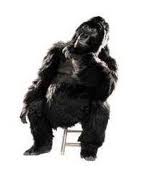
“What do I know? I’m just the 800-pound gorilla in the room.”

Pick one, guys. It’s either “the 800-pound gorilla” or “the elephant in the room.” These expressions mean two different things, the latter being more apt for Axa’s campaign. Perhaps the elephant failed the audition.


Just before Axa Equitable launched the campaign during the 2007 Super Bowl, the company said in a press release that it sought to encourage the approximately 77 million baby boomers in America to “stop ignoring the 800-pound gorilla in the  room” and buy their variable annuities.

 Four years later, the campaign continues. The commercials have won numerous industry awards and still, no one is challenging their metaphorical duplicity. Naturally, retirement planning and life insurance are important subjects that many prefer to ignore; in this vein, the commercials are hitting the intended demographic target. It’s just that Axa has picked the wrong spokesmammal.

Do we need a refresher?

“The elephant in the room” represents a sizeable subject that everyone is aware of but no one wants to talk about. It might be a looming crisis or a relative’s drinking problem. Everyone knows it’s there—it’s too big to ignore—but we pretend not to notice it. 

An “800-pound gorilla” is a bully, a goliath, a behemoth. Just think of the old riddle.

“Where does an 800-pound gorilla sleep?”
“Anywhere he wants.”

7 Comments

Filed under All Things Wordish, Marketing/Advertising/PR

Out of gas

A year or so ago, a run-down shopping center in our town gave itself a little facelift, and chose to illuminate its signage with neon. I considered it a good idea at the time—it suited the eclectic character of our commercial strip.

I did have one concern that indeed has come to pass. The risk of neon gas is that it runs out and, apparently, is an effort to refill or replace.

In my old D.C. neighborhood I shopped at “GIANT  OOD.” Recently, as I was driving home, I noticed that, after only a year after its facelift, at Kensington’s main intersection, stands “INGTON HOPPING CENTER.” (The S comes and goes, but how appropriate for Easter.)

It seems this neon gas shortage isn’t unique to my neck of the woods, as shown in photos others have posted.

How’s the neon supply in your ‘hood? 


1 Comment

Filed under All Things Wordish, Marketing/Advertising/PR

Night terror

Do you know those tests the sleep specialists show on television to demonstrate what happens to drivers when they’re sleep deprived? Poor judgment, slower response time, even hallucinations come into play when a human does not get sufficient sleep.

This morning, I am tipping orange cones all over the place.

Yesterday I flew to California, worked until almost midnight and went to bed after being up for 23 hours. Then I woke up three hours later, still in the West but with my rhythms in the East.

For the last two hours I’ve tried everything that usually works for me—reading, getting up and walking around, even having an informercial playing softly in the background. The latter usually works like a charm. Not this time. But I can tell you everything you’ve ever wanted to know about the P90X fitness program and something about the anti-aging magic of melon extract that keeps Cindy Crawford’s and Valerie Bertinelli’s faces frozen in time.

Looking back over this, I’ve counted more than a dozen typos and, I hope, corrected all of them. I’ll check back again after this afternoon’s nap.

Aside from sleep aids—which aren’t an option when you’re an hour and a half away from the alarm going off–what works for you when you’re wide awake, yet more tired than you’ve ever been, at 3:00 a.m.?  Other than blog–I’ve tried that.

7 Comments

Filed under Beauty and Fashion, Health, Marketing/Advertising/PR, Movies, Television and Radio, Travel

Any way you couch it

Over the past week I’ve solicited suggestions for topics to cover here. It’s my version of taking requests. While I chew on those having to do with synchronicity, semantic infiltration and the origin of “draconian,” I thought I’d start off with an easier one.

Sue wrote: “How about writing a blog on the use of couch, sofa, divan?”

I don’t know precisely what Sue would like to know, but I have two initial observations. One is that, while the proper name for this piece of furniture is “sofa,” many people call it–correctly or incorrectly–a couch. My other reaction is that there appear to be so many other names for this object. Immediately I thought of about half a dozen.

So, Sue, jump in and take this conversation wherever you like. In the meantime, I’ll follow the two threads.

I was brought up to say “sofa,” which doesn’t make it right, but it also happens to be what furniture stores call it. They would know. I could be wrong, but I don’t believe you would ever enter a store—in person or online—and see something called a couch.

Isn’t “couch” is just a sloppy way to refer to a “sofa?”

I suspect “couch” comes from the French verb, coucher, or to lie down (I think that’s what it means; It could mean more, as in “Voulez vous coucher…”) When I hear “couch,” I envision someone lying, not sitting. A couch is where you spend a Sunday afternoon, watching football or, in my case, working the Sunday crossword under a fuzzy blanket for a committed period of time. Otherwise, with or without someone sitting on it, it’s a sofa.

What else could it be? As Sue points out, it could be a divan. I had an aunt and uncle who called theirs a divan, a term I thought was perhaps unique to their generation. Apparently,” divan” is Turkish in origin; how it got from Turkey to my aunt and uncle is unknown to me. If memory serves, these same relatives might also have called it a Davenport, which I understand was a brand name (like the Norge).

I understand Canadians call theirs a chesterfield.

As far as I know, chesterfields, divans, Davenports, couches and sofas are pretty much alike structurally. Then you get into your settees, love seats, fainting couches and futons.

I can speculate about how these variations came about, whether they are separated by generations, by regions or by structural properties. Better yet, The Word Detective explores this matter in much more detail, so let’s benefit from his research. If that doesn’t do it for you, there are many more blogs that delve into all the nuances.

Or you can consult this sofa and living room furniture glossary. Notice, nowhere in the glossary will you find “couch.”