Tag Archives: word usage

Correctile dysfunction

When it comes to matters of grammar and pronunciation, I observe two kinds of people:  those who appreciate being corrected so they can learn from their mistakes and those who are offended by being corrected.

One might argue that it depends on the tone and context of the correction. Certainly, most people would not care to be schooled in a harsh or a humiliating manner. My experience is that some people are open to learning and some are not. Somewhere in between are those who say they appreciate being reminded of the correct way to write and speak, but turn around and resort to old habits. I guess that’s why they’re called habits.

I put myself in the first category. While it is never fun to learn I’ve committed a grammatical error or mispronunciation, especially as someone who claims to know a fair amount about such things, I desire to learn and improve. I admit there are rules I don’t understand. There are several I have trouble remembering. This is one reason for the Red Pen Invitation I extend on this blog’s About page and also why I confess to being on a lifelong journey to get it right. I admit it stings a bit when a reader calls me on an error or challenges a statement, but I’m grateful for the lesson.

When I choose to correct others—usually family members or close friends—I try to be judicious and kind. As much as I’d like, I don’t correct anyone’s children but my own. Believe me, for every time I hear or read a loved one’s error, I let slide another nine. Where I step on shaky ground is in assuming everyone is as enthusiastic as I am about getting it right.

What about those in the second category? Those who say, essentially, “I’ve pronounced it that way since I was seven and there’s no way I’m going to start changing now.” Or “I know that’s the rule but it doesn’t make sense to me, so I am going to keep saying it incorrectly.” Or “Frankly, I don’t care what the difference is between ‘who’ and ‘whom,’ ‘its’ and ‘it’s,’ or when to use ‘I’ and when to use ‘me.’” “I don’t care.”

What I’d ask readers to consider is:  which kind of person are you when it comes to being corrected? Provided the corrector is polite and judicious, are you open or are you offended?

If you’re in the former group, do you have a process for remembering what you’ve learned? Do you write it down or come up with a clever mnemonic? Create an occasion to use it in a sentence?

If you’re in the latter group, what’s your reasoning for closed ears? Do you consider critique a nuisance or a blow to the ego? Are you apathetic about such matters? Or do you believe correct grammar and proper speech are unimportant?

My eyes and ears are open. Tell me and maybe I’ll stand corrected.

9 Comments

Filed under All Things Wordish

Grammar grab bag

Throughout the week, bits of sloppy speaking have caught my ear. I thought maybe we’d have a little Friday review to set ourselves straight. We all could use a refresher now and then, right?

The examples that got my attention this week have to do mostly with words or phrases that many believe are interchangeable.

“Imply” versus “infer” – To imply something is to mean something or put a suggestion into a message. To infer is derive a suggestion from a message, often by reasoning or interpretation. A simple way to remember: The speaker implies; the listener infers.

“Due to” versus “because of” – “Due to” means “caused by.” For example, “The snow was due to a cold front moving eastward.” It is not interchangeable with “because of,” which means “by reason of.” For example, “Schools were cancelled because of snow.” It’s not “cancelled due to snow.” Use of “due to” as an introductory clause, such as “Due to circumstances beyond our control,” or “Due to inclement weather,” is also incorrect. The difference is subtle but distinct.

“More than” versus “over” – “More than” refers to a countable number of something. For example, “There are more than 30 children in the class.” McDonald’s should claim “More than 100 billion hamburgers sold” not “Over 100 billion.” “Over” pertains to spatial amounts or volumes. For example, “Over a gallon of water was in the jug.”

“United States” versus “U.S.”  “United States” should always be spelled out or pronounced, except when used as an adjective. When used as a noun, it is always “the United States,” not “the U.S.” The abbreviation is used only when preceding a noun, such as “U.S. residents,” U.S. Secretary of State,” or “U.S. exports.”  “I live in the U.S.” is incorrect. And when we are writing within the United States, periods are used. This differs from how it is done outside our borders, where United States is abbreviated US.

If you’d like to share your own tricks for remembering the rules, or if your stylebook differs, or if you have ideas for future grab bags, the door is always open. 

Otherwise, class dismissed. Thanks for being here.

11 Comments

Filed under All Things Wordish

Angular momentum

This post could be considered a part two of last week’s post about light bulbs going off. I heard something last night that reminded me of another commonly misused metaphor and thought it might be worth reviewing.

During the Screen Actors Guild Awards program, veteran comedic actor Tim Conway introduced SAG’s Lifetime Achievement Award, given to Ernest Borgnine, who has performed in some 160 films over his 60-year television and movie career.

In an awkward moment, Conway appeared to have trouble reading the teleprompter and winged the introduction. At first I thought he might be doing one of his classic bits. I don’t know whether he was able to access the prepared script or had to make it up on the fly. And unfortunately, I can’t find an exact quote of what he said. But what I heard was a misused geometric figure of speech.

In reviewing Borgnine’s acting career, Conway cited Borgnine’s first film or two and then said that his career took “a 360-degree turn.”

Now a 360-degree turn is quite likely; but it is a full turn. What it means is that there was no change in direction.

I’m sure you’ve heard it. Someone might say, “He was headed down the wrong road, but his life took a 360-degree turn.” Think about it. If that’s true, he is right back where he started.

The correct metaphor for a 100 percent change in direction is a 180-degree turn, a U-turn, if you will.

The point of this lesson is not to make fun of Tim Conway. He happens to be one of the most quick-witted actors on television. I’ve laughed with him since he co-starred with Borgnine in McHale’s Navy, during his many appearances on The Carol Burnett Show, a few years ago on Yes, Dear and now, on Hot in Cleveland. In another 12 years, he might just be the Betty White of his gender.

Maybe the SAG Award’s writers provided a lousy script, but he’s smart; he could have caught and corrected the angular reference. Or maybe he was just doing the gig as Mr. Tudball.

The lesson is:  If you find yourself about to use the wrong angular figure of speech and describe a complete change as a 360-degree turn, do a one-eighty.

5 Comments

Filed under All Things Wordish, Movies, Television and Radio

Off and on

Over the weekend, while watching television news, I heard two different people, in unrelated stories, describing realization processes. One said, “Suddenly a light bulb went off in my head.” (At least he didn’t say the light bulb literally went off in his head.) The other said, “All of a sudden, it was like a light bulb went off.”

Am I wrong or, when one has idea—or when something comes to light—the light bulb goes on?

This morning, I set out to research this. What I found upon searching “light bulb went off” were one or two blogs addressing this very subject, and a long list of entries comprising serious text in which the expression is used incorrectly.

There’s no mistaking the imagery. A light goes on, things become clear. One has an idea or, appropriate for the season, epiphany. This makes perfect sense, so why are light bulbs going off in so many heads?

Maybe we can remember it this way: Lights go on and sounds go off.

Sirens go off, alarms go off, firecrackers and explosives go off.

Or maybe it’s not so simple. When my alarm goes off in the morning, doesn’t it really go on?

Either way, if any of us is ever interviewed about a brilliant idea—and if we choose to use the light bulb image—let’s  remember how to use it in such a way that our audience still thinks we’re brilliant. And let’s remember that also means not saying “literally.”

7 Comments

Filed under All Things Wordish, Marketing/Advertising/PR, News, Technology and Social Media

Slippery salmonella

The Center for Science in the Public Interest, sometimes referred to as the “food police,” is the advocacy group we love to hate. In reality, they do mountains of good in heightening public awareness about healthy eating—by telling us the ugly truth about our favorite indulgences, from buttered popcorn to Mexican food.

Yesterday, the group released a study on food safety, showing how well each of our 50 states detects, investigates and combats food-borne illness. I am proud to say that my state was one of only seven to receive an “A.”
That’s neither here nor there.

Call it the curse of the word nymph, but what made me take notice was not the data but the delivery. A word nymph can detect a mixed metaphor faster than a wood nymph can spot a bull thistle.

In announcing the study, CSPI safety director Caroline Smith DeWaal said, “If a consumer calls and says they have a food-borne illness but there’s no one there to investigate the cause, then outbreaks are just slipping under the radar screen.”

Did she mean “slipping under the radar?” Or did she mean “slipping off the radar screen?”

I’d say, technically, the answer could be both, but not in the same sentence.

What’s the difference? The first originates from “flying below the radar,” which is to go undetected or unnoticed. To be on someone’s radar screen is to receive his or her attention. To be off a person’s radar screen means the person is unaware.

The difference in meaning is extremely subtle, so perhaps I niggle. And yet, hearing the mixed metaphor on the news last night left me with a messy mental image. When Ms. Smith DeWaal said that outbreaks are “slipping under the radar screen,” I immediately wanted to swab the radar screen, and the control panel below it, with an antibacterial wipe.

Did anyone else have the same gut reaction?

5 Comments

Filed under All Things Wordish, Food, Health, Marketing/Advertising/PR, News

Sentimental greeting

How long have you had your current voice mail greeting?

I just realized we have had the same greeting on our home phone for 15 years. Isn’t it about time we changed it?

There are three distinct and definitive reasons we should. One, it mentions Monica, Marty and Joseph. Joseph hasn’t lived here since 2006. Two, Joseph hasn’t been called Joseph since 1995. Three, the greeting contains a grammatical error.

It says, “You’ve almost reached Monica, Marty and Joseph but since you didn’t, leave us a message…” the word “since” is incorrect here. The correct word is “because.” I knew that but, as many are prone to doing, I continue to fall into sloppy habits. Guilty as charged.

“Since” is often used interchangeably with “because,” but not correctly. “Since” relates to the time passed from one period of time to another:  He has been chairman of the board since 1995. I have not seen him since Saturday.

Still, I am sentimental about the greeting. It’s the first greeting I recorded after getting voice mail service through the phone company, replacing the old fashioned answering machine.

Back when we had the old machine, we used to change our greeting often, tailoring it for the season or current events. Now, I just can’t do it.

There’s no way to preserve for posterity this greeting that served us well for 15 years, poor word choice and all. Plus, I can’t imagine representing our family any way but Monica, Marty and Joseph. Joseph is Joe and Joe is gone. No one leaves him messages at this number any longer.

I’d love your suggestions for a new greeting, since—er, because—I am facing a mental and emotional block.

4 Comments

Filed under All Things Wordish, Family and Friends, Hearth and Home, Technology and Social Media

Morpheme drip

On October 15, National Dictionary Day Eve, I came out with my confessions of being a dictionary dweeb. Since then I have received a variety of dictionaries from some thoughtful readers. One day soon, we will get into A Dictionary of Slang and Unconventional English, which I received from a reader in Alaska (make of that what you may; we’ll need to see if “refudiate” is listed).

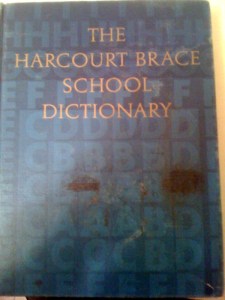
In the 10/15 post, I recalled the first dictionary I ever had, The Harcourt Brace School Dictionary, which I used in the fourth through sixth grades. I thought I had it around here somewhere but it was not be found among my childhood artifacts. I will say it again, I loved that dictionary. And yesterday I discovered that everything I know about grammar, spelling and word usage came from that primer. Which explains a lot.

My mother sent me the old dictionary for my birthday. It still smells the same as it did in 1970.

It seems that, when I went on to junior high, I passed the Harcourt Brace on to my younger brother, who wrote his name in it three times, along with a phone number and a note that said, “If not home, call back in 2 or 3 hours.”

Prior to that I had doodled all over the cover and inside pages. My friends had scribbled,  Monica loves XXX, several times, and I had crossed out all the XXXes. There were small illustrations near some of the definitions, where I had written the names of people I didn’t like. One illustration is of a peccary and, even today, I couldn’t have told you what a peccary is without consulting the definition: either of two wild animals of tropical America, like pigs with sharp tusks. I won’t say whose name I wrote under that.

The real nuggets are found on the first 65 pages, before the definitions of words beginning with A.

Pronunciation keys, spelling charts, abbreviations, basic dictionary skills, age-appropriate etymologies, parts of speech, idioms, they’re all in there, along with a section on Spotting the Troublemakers. There are sections on variant spellings and pronunciations, regional pronunciations and British and American spellings.

It’s good to know that during these years, I wasn’t spending all my time reading Tiger Beat and pinning Bobby Sherman and David Cassidy posters up on my walls.

So class, who can tell me what inflectional forms are? The inflectional forms of a word are forms changed by adding a morpheme. What’s a morpheme? I need a refresher myself. I can’t even make out Wikipedia’s explanation. Expect a post on morphemes soon. Perhaps you’d like to write it.

Leave a comment

Filed under All Things Wordish, Family and Friends, Reading

Who that?

Here’s a little quiz for anyone who is interested in relative pronouns.

Please jot down which sentence in the following sequence you believe is correct. 

1(a)  I am grateful for all the friends that came to my birthday party.
1(b)  I am grateful for all the friends who came to my birthday party.

2(a)  Thanks to all the veterans that served our country.
2(b)  Thanks to all the veterans who served our country.

3(a)  Everyone that has a pet should shop at PetSmart.
3(b)  Everyone who has a pet should shop at PetSmart.

4(a)  I know a lot of people that use “that” when “who” is the better choice.
4(b)  I know a lot of people who use “that” when “who” is the better choice.

If you chose (b) in each set of choices, you get an A. Perhaps I should say, you’d get an A if I were grading the quiz. It turns out that some authorities are more lax than others on this issue.

Before issuing a premature refresher, I did some research on relative pronouns and, in this case, restrictive relative pronouns, where the antecedent happens to be a person rather than a thing.

I was taught that people—and nouns that represent people—should be followed by “who” rather than “that.” In the examples above, friends, veterans and everyone refer to people.

However, a couple of sources maintain that both “that” and “who” are correct and are a matter of preference rather than rule.

But wouldn’t you agree that, in reference to a person, “who” is more polished, more personal and more exact?

Feel free to disagree; you can be the reader who stood up for “that.”

You’ll notice I haven’t yet addressed “that” versus “which.” Even though I know the rule on restrictive and non-restrictive clauses, it is one that trips me up frequently. Or is it which? I know, it’s that.

3 Comments

Filed under All Things Wordish

Empty phrases

Last spring, I wrote a couple of blog posts on useless words. One was on phrases that mean nothing in which I referenced a list of 10 Annoying Phrases That Serve No Purpose. The other was on verbal pauses, you know, words like, “you know” and “like.” Based on comments I received, I learned that some people have emotional or habitual attachments to certain phrases or verbal patterns and don’t share my opinion that, while some expressions may be clever upon their arrival on the language scene, it eventually becomes time to move on from them.

At the risk stepping out on another flimsy limb, I’d like to add two more to the list.

The first happens to occupy second place on the list of 10 Annoying Phrases That Serve No Purpose: “at the end of the day.”

I first took notice of “at the end of the day” in 1991. I was working with a Harvard-educated consultant who used it in just the perfect context:  when all is said and done, when everything else has been taken into consideration. I noted how descriptive—and original—it sounded. I may have even picked it up and used it a few times. Not too long after that, I heard about an industry executive from the Gulf Coast region who, when testifying on Capitol Hill, used the phrase to sum up his testimony. He had the creativity to follow it up with something even more descriptive:  “At the end of the day, when the gumbo boils down . . .”

Almost 20 years later, I believe “at the end of the day” has become stale and overused. It has lost its punch. Unless, of course, it is followed by a clever colloquialism.

The second phrase, while innocuous enough, has come to be spoken without thought. Still, it precedes a great preponderance of sentences these days. “You know what?” Pay attention and you will really begin to notice. Again, there’s technically nothing wrong with it, but it is way overused. “You know what? I am going to have eggs over easy.”

These two sayings hit me in the face yesterday morning as I watched former JetBlue flight attendant Steven Slater being interviewed on the major morning news programs—NBC’s Today, ABC’s Good Morning America and CBS’ The Early Show

As a refresher, Slater was the airline employee who had a colossal meltdown on a flight from Pittsburgh to New York, cursed out a plane full of passengers over the intercom and, when the plane landed at JFK, grabbed two beers, popped open the emergency exit door and slid down the escape ramp. He parted ways with JetBlue and pled guilty to two criminal charges.

In three network interviews, he told his side of the story, using “at the end of the day” and “you know what?” collectively at least 10 times. My favorite, though, was on GMA, when he was asked how his notoriety has affected him. He said, “At the end of the day, I still put my pants on one leg at a time.”

Don’t people usually take their pants off at the end of the day? Maybe he was referring to his PJs, in which he probably spends a lot of time these days.

6 Comments

Filed under All Things Wordish, Movies, Television and Radio, News, Travel

Anger management

As I was ranting yesterday about the careless Cadillac driver who hit my car and then lied about it, I realized I used a phrase that I didn’t fully understand.

I said that something stuck in my craw. I made a mental note to investigate the origin of the phrase and then never got back to it. I was so steaming mad at myself for being so steaming mad.

I don’t want to be an angry blogger. So I packaged up all the anger I’ve expressed on this blog and filed it under a new Category called “Rants and Raves.” This way, maybe my toxic tantrums can stay tucked tightly away where they can’t infect the other posts.

Eventually I looked up “stick in one’s craw” and confirmed that it meant what I thought: to cause one to feel abiding discontent and resentment.

One source said the phrase comes from something you can’t swallow, based on the literal meaning of craw, which refers to the throat of a bird.

Another source claims “sticks in my craw” is incorrect. She said, “The correct phrase is ‘sticks in my crow.’ ‘Craw’ is a modern corruption of the word ‘crow,’ as in the frequent use of ‘craw’ as verb to describe the sound of crows.” She cited the Oxford English Dictionary.

A blog called Phrase Finder also likened the phrase to having difficulty swallowing something, but elaborated. Citing the Encyclopedia of Word and Phrase Origins by Robert Hendrickson, the site explained that “The craw is the crop or preliminary stomach of a fowl, where food is predigested. Hunters centuries ago noticed that some birds swallowed bits of stone that were too large to pass through the craw and into the digestive tract. These stones, unlike the sand and pebbles needed by birds to help grind food in the pouch, literally stuck in the craw, couldn’t go down any farther. This oddity became part of the language of hunters and the phrase was soon used figuratively.” 

So many blogs, so many perspectives on one issue.

Then of course, the Urban Dictionary contained an entry or two that aren’t suitable for polite company.

I got to thinking of other sayings that express anger. For example, “This really steams my clams.” “That really burns my biscuits.” “This really grinds my gears.”

Do you have any good ones? Once I rant a good litany, we can move on. I can move on.

Tomorrow I’ll clear my craw and be so cheerful you won’t even recognize me.

5 Comments

Filed under All Things Wordish, Reading, Technology and Social Media