
Language has a way of enticing even the smartest of speakers to succumb to sloppiness, prompting misuses to spin out of control. Inspired by one too many examples, I offer today’s friendly reminder.
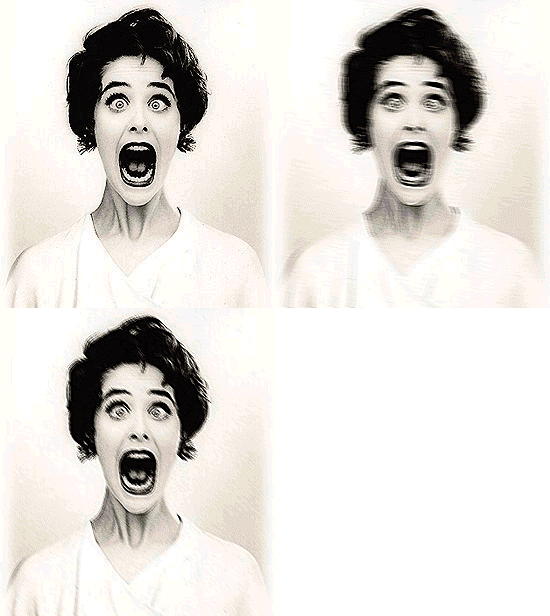 A rule of thumb:
Hilarious – good.
Hysterical – bad.
Perhaps that’s oversimplifying things a bit, but it serves as a helpful reminder that each word has its own distinctive meaning.
With common misuse, the distinction has grown more subtle.
“Hysterical” and “hilarious” are not interchangeable. Yes, online dictionaries have added one as a synonym of the other in recent times, but I’m not buying it.
As a matter of instruction, “hysterical” means to be in emotional shock. Some of its most common synonyms include: irrational, panic-stricken, jumpy, nervous and anxious.
People often describe movies or books or television shows or comedians as hysterical; therein lies the danger.
I suppose it could be accurate to describe a movie as hysterical. That is, if hysteria is a predominant theme. Theoretically, Titanic could be called hysterical, but it certainly is not hilarious.
One might call a comedian hysterical. He might be funny, hilarious, in fact, but is he shrieking uncontrollably? Ben Stein, for example, can be hilarious, but he is never hysterical.
When something is extremely funny, it is hilarious. Full of hilarity. When a person is extremely funny, she is hilarious. If she is having a hissy fit, she is hysterical. Remember, hissy derives from hysteria.
I could say that I found something so hilarious that I became hysterical. But it is I who was hysterical, not the thing that I found hilarious.
There’s the lesson for today. Your homework: Keep an ear out for one week and report back on how often you hear hysterical misused. Extra credit: Correct the offenders and hope they take it in good spirit and don’t become hysterical.
 Only recently have I thought about the words I learned in my adolescent years as a radio junkie. One day last week, while in the car, I remembered the first time I ever heard the word invincible. I wonder if you learned it from the same source.
 Word Girl is a 10-year-old super-powered alien who apprehends villains in her quest to educate her following of 6-to 12-year olds to “power up with power words.” From what I gather, she also likes to ask kids what their favorite words are. What’s not to like?
 As Yulia points out, it’s possible to learn the fundamentals of grammar and sentence structure from a book, but pronunciation is more difficult to learn in isolation. We need to hear words pronounced, we need to practice our pronunciation in the presence of others. Tapes can be helpful, but digital media don’t converse. It is in conversing that we learn.
 This said, I tread lightly into the language of wine. This might be because I have not been exposed to the business of wine.
 Word Nymph