Tag Archives: grammar

A[n] honorary language convention

A few days ago, a reader asked me to address the subject of indefinite articles preceding words beginning with the letter “h.”

I reviewed my understanding of the rules pertaining to the subject and set it aside pending consultation of a few sources. At the same time, I suspected this might be one of those rules that vary by region and knew I’d have to take that into account as I addressed it.

The timing is apt, as we already have a rousing international debate going, following my comments yesterday about whether periods and commas go inside or outside quotation marks, another issue lacking global agreement.

I was tickled to hear from readers yesterday, who wrote in from such exotic places as Belo Horizonte, Brisbane, Canberra, Jakarta, Lima, Manila, Ontario, Oxford, Vancouver and Tucson on the matter of inside-versus-outside-the-quotes issue, even if they didn’t agree with me. Especially if they didn’t agree with me.

So let’s look at indefinite articles and see if we can keep this global dialogue going.

The question before us: Which indefinite article, “a” or “an,” precedes a word beginning with “h?”

The consensus I glean from U.S. and international sources is that “a” is used before words beginning with “h” unless the “h” is silent, in which case “an” is used.

Many have noticed, as have I, that “an” has come to precede words in which the “h” is pronounced; for example, historic, as “an historic event.”

I’d be inclined to give a little latitude where regional pronunciations vary with regard to the “h.” In the United States, we’d likely say, “an herb,” though Martha Stewart and select others opt for the European pronunciation and, therefore, would use a different indefinite article: “a herb.”

I’d welcome comments by my fellow wordies from around the globe. Better yet, wouldn’t it be fun to convene a global summit on language differences? Unlike the World Trade Organization or the World Health Organization or the International Standards Organization, which strive for international standardization, the goal of the GSLD could be  to understand and celebrate regional approaches to language.

Don’t get me wrong. I am not for linguistic anarchy. While there are more than one authoritative style guide, I prefer to choose one and stick to it. Moreover, where style guides agree, I advocate for consistent adherence, at least within U.S. borders. But if we Yankees prefer to keep our punctuation tucked neatly within our quotation marks, and use “an” preceding an “h,” and you English speakers abroad adhere to your own national standards, then I applaud you. I’d also like to sit across a table from you and continue the conversation, maybe sink our teeth in to the Oxford comma, because we obviously share a passion for words.

Does Geneva have room for one more international organization? Is there an honorific (or a honorific?) who’s willing to serve as chair?
3 Comments

Filed under All Things Wordish, Politics, Travel

Sentimental greeting

How long have you had your current voice mail greeting?

I just realized we have had the same greeting on our home phone for 15 years. Isn’t it about time we changed it?

There are three distinct and definitive reasons we should. One, it mentions Monica, Marty and Joseph. Joseph hasn’t lived here since 2006. Two, Joseph hasn’t been called Joseph since 1995. Three, the greeting contains a grammatical error.

It says, “You’ve almost reached Monica, Marty and Joseph but since you didn’t, leave us a message…” the word “since” is incorrect here. The correct word is “because.” I knew that but, as many are prone to doing, I continue to fall into sloppy habits. Guilty as charged.

“Since” is often used interchangeably with “because,” but not correctly. “Since” relates to the time passed from one period of time to another:  He has been chairman of the board since 1995. I have not seen him since Saturday.

Still, I am sentimental about the greeting. It’s the first greeting I recorded after getting voice mail service through the phone company, replacing the old fashioned answering machine.

Back when we had the old machine, we used to change our greeting often, tailoring it for the season or current events. Now, I just can’t do it.

There’s no way to preserve for posterity this greeting that served us well for 15 years, poor word choice and all. Plus, I can’t imagine representing our family any way but Monica, Marty and Joseph. Joseph is Joe and Joe is gone. No one leaves him messages at this number any longer.

I’d love your suggestions for a new greeting, since—er, because—I am facing a mental and emotional block.

4 Comments

Filed under All Things Wordish, Family and Friends, Hearth and Home, Technology and Social Media

So…what’s your grievance?

It was reassuring to read comments on yesterday’s Word Nymph post about “so” versus “as,” showing that I am not enacting grammatical laws in my sleep.

One comment in particular conjured up another peeve of mine. In this season of Festivus, during which we air our grievances, I thought it might be apt to share it.

 The commenter said: “Where ‘so’ so annoys is its use as a filler word to begin a conversation, as if the subject were already under discussion. This dandy device is headed for trouble. It’s the next ‘like.’”

I agree. I can also relate. My husband often begins a conversation with “But.”

This got me thinking of an emerging pattern of speech I’ve noticed in recent years, stemming from what I’d call stopaphobia, or fear of ending a sentence definitively. Whereas the commenter notices “so” in the beginning of a conversation, I notice “so” at the end of a sentence. I haven’t seen this in written form, but it’s becoming common in spoken sentences. People just don’t want to finish a sentence with a firm period, opting to end instead with an ellipsis. Here’s an example:  “I work as a manager at IBM, so…” 

The trailing  “so” seems to go hand in hand with the trailing “or” at the end of a question. Listen for it and I swear you’ll hear it everywhere. “Are you staying in town for the holidays or…?” Meredith Vieira does this in interviews a lot. It’s not just the teeny-boppers.

Let me know if you notice this, but don’t hate me if it then drives you crazy. It’s just the plight of the wordie.

Finally, in the spirit of Festivus, and because this time of year might have us tied up in knots with excess fury to burn, feel free to lay your peeves here. Get them off your hyperventilating chests. It’s safe, so…

13 Comments

Filed under All Things Wordish, Holidays

Say it’s so

There is a rule of grammar I learned long ago and practiced for years. Now I am doubting its existence because I can’t locate it anywhere. It has to do with comparative adjectives, using the word “as.”

For example: “She is as nice as her sister.”

I was taught—or so I thought—that, when the sentence is stated in the negative, “as” becomes “so.” For example, “She is not so tall as her brother.”

It seems either I dreamt this rule or it has disappeared from modern language. I am away from home, so I don’t have my arsenal of style guides and manuals handy. A cursory search of online sources appears to prove me wrong.

Can anyone verify whether “so” was ever correct when used in the negative? I heard a host of 60 Minutes use  “so” comparatively just last Sunday. The interview was on in the background, but my ears perked up because I had been contemplating this issue lately. I’d be grateful if someone could set me straight or at least bring me up to date.

Contemplating the comparative does stir two peeves within me.

The first is when a speaker follows the comparative with an objective, rather than a subjective pronoun:  “She is old as us,” rather than “she is as old as we.” The “are” is implied. The night before last, I was comforted to hear Tony Bennett use the subjective pronoun correctly, through the speakers of a restaurant:  “I wanna be around to pick up the pieces when somebody breaks your heart, somebody twice as smart as I.”

The second has to do with comparing two or more persons or objects. It’s fundamental, but perhaps calls for a refresher. When comparing two, the suffix “er” is used. Here, if a modifying adjective precedes the comparative adjective, “more” is used.  For example: “John is the taller of the two boys.” Or “John has more children.”

When three or more nouns are being compared, the superlative comes into play. In this case, “est” is the suffix. “Mary is the eldest of the three sisters.” Or “Mary has the most freckles.”

If you have two children, you don’t refer to one as your oldest or youngest.

Notice I ended with the comparative rules about which I am most certain. In the meantime, the first—“so” versus “as”—will continue to gnaw at me. Anyone?

4 Comments

Filed under All Things Wordish

Morpheme drip

On October 15, National Dictionary Day Eve, I came out with my confessions of being a dictionary dweeb. Since then I have received a variety of dictionaries from some thoughtful readers. One day soon, we will get into A Dictionary of Slang and Unconventional English, which I received from a reader in Alaska (make of that what you may; we’ll need to see if “refudiate” is listed).

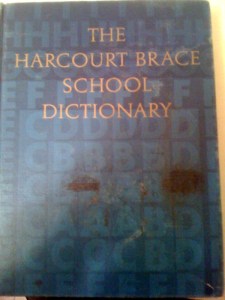
In the 10/15 post, I recalled the first dictionary I ever had, The Harcourt Brace School Dictionary, which I used in the fourth through sixth grades. I thought I had it around here somewhere but it was not be found among my childhood artifacts. I will say it again, I loved that dictionary. And yesterday I discovered that everything I know about grammar, spelling and word usage came from that primer. Which explains a lot.

My mother sent me the old dictionary for my birthday. It still smells the same as it did in 1970.

It seems that, when I went on to junior high, I passed the Harcourt Brace on to my younger brother, who wrote his name in it three times, along with a phone number and a note that said, “If not home, call back in 2 or 3 hours.”

Prior to that I had doodled all over the cover and inside pages. My friends had scribbled,  Monica loves XXX, several times, and I had crossed out all the XXXes. There were small illustrations near some of the definitions, where I had written the names of people I didn’t like. One illustration is of a peccary and, even today, I couldn’t have told you what a peccary is without consulting the definition: either of two wild animals of tropical America, like pigs with sharp tusks. I won’t say whose name I wrote under that.

The real nuggets are found on the first 65 pages, before the definitions of words beginning with A.

Pronunciation keys, spelling charts, abbreviations, basic dictionary skills, age-appropriate etymologies, parts of speech, idioms, they’re all in there, along with a section on Spotting the Troublemakers. There are sections on variant spellings and pronunciations, regional pronunciations and British and American spellings.

It’s good to know that during these years, I wasn’t spending all my time reading Tiger Beat and pinning Bobby Sherman and David Cassidy posters up on my walls.

So class, who can tell me what inflectional forms are? The inflectional forms of a word are forms changed by adding a morpheme. What’s a morpheme? I need a refresher myself. I can’t even make out Wikipedia’s explanation. Expect a post on morphemes soon. Perhaps you’d like to write it.

Leave a comment

Filed under All Things Wordish, Family and Friends, Reading

Who that?

Here’s a little quiz for anyone who is interested in relative pronouns.

Please jot down which sentence in the following sequence you believe is correct. 

1(a)  I am grateful for all the friends that came to my birthday party.
1(b)  I am grateful for all the friends who came to my birthday party.

2(a)  Thanks to all the veterans that served our country.
2(b)  Thanks to all the veterans who served our country.

3(a)  Everyone that has a pet should shop at PetSmart.
3(b)  Everyone who has a pet should shop at PetSmart.

4(a)  I know a lot of people that use “that” when “who” is the better choice.
4(b)  I know a lot of people who use “that” when “who” is the better choice.

If you chose (b) in each set of choices, you get an A. Perhaps I should say, you’d get an A if I were grading the quiz. It turns out that some authorities are more lax than others on this issue.

Before issuing a premature refresher, I did some research on relative pronouns and, in this case, restrictive relative pronouns, where the antecedent happens to be a person rather than a thing.

I was taught that people—and nouns that represent people—should be followed by “who” rather than “that.” In the examples above, friends, veterans and everyone refer to people.

However, a couple of sources maintain that both “that” and “who” are correct and are a matter of preference rather than rule.

But wouldn’t you agree that, in reference to a person, “who” is more polished, more personal and more exact?

Feel free to disagree; you can be the reader who stood up for “that.”

You’ll notice I haven’t yet addressed “that” versus “which.” Even though I know the rule on restrictive and non-restrictive clauses, it is one that trips me up frequently. Or is it which? I know, it’s that.

3 Comments

Filed under All Things Wordish

Punctuation is FUNdamental

Most major national news outlets covered the leaked angry e-mail from Alaska’s former First Dude Todd Palin to Joe Miller, Alaska Republican Senate candidate, and Tim Crawford, treasurer of SarahPAC, regarding Sarah Palin’s presidential aspirations, qualifications and possible support of Miller. But The Washington Post’s Dana Milbank got my attention, in a recent column in which he poked His-and-Hers fun at Ms. Palin’s made up word and Mr. Palin’s gross misuse of punctuation: “Will somebody please refudiate our fear that there is a serious punctuation problem in the Palin household?”

Here’s the e-mail and here’s your challenge. How many punctuation errors can you count?

Joe and Tim,

Hold off on any letter for Joe. Sarah put her ass on the line for Joe and yet he can’t answer a simple question ” is Sarah Palin Qualified to be President”. I DON’T KNOW IF SHE IS.

Joe, please explain how this endorsement stuff works, is it to be completely one sided.

Sarah spent all morning working on a Facebook post for Joe, she won’t use it, not now.

Put yourself in her shoe’s Joe for one day.

Todd

In the 80-word body of the e-mail, I count eight.

Occasionally, when I notice errors, friends and colleagues advise me to go easy on people, especially if they were not fortunate enough to go to college.

First, I am quick to volley back with the fact that some of the most articulate and punctuation-savvy people I know did not go to college. Second, I’d be the first to acquiesce to this advice if I were pointing out errors pertaining to material taught in college.

But didn’t we all learn basic grammar and punctuation long before college? Spelling certainly isn’t a university level course. Didn’t we have to master these fundamentals in order to get into college?

So, out of Todd’s eight errors, I am going to give him the benefit of the doubt on half, because it was an e-mail he thought no one but its addressees would see and also because I know as well as anyone that some errors might simply be typos.

I’ll ask the English teachers (and English students) who read this blog if they agree. Would you grade Todd on the curve? How many points off for apostrophe abuse, semicolon deficit and misplaced quotation marks? (Notice, Todd, dear, I ended my question with a question mark.)

5 Comments

Filed under All Things Wordish, News, Politics

Word Nymph’s ’nym words

Yesterday’s auto-antonym is just one in a large class. We already know about synonyms, homonyms, antonyms, pseudonyms, and acronyms. As of yesterday, we can also name a few auto-antonyms, or contranyms.

Did you know there are literally dozens of other ’nyms?

Just a few examples:

Aptronym. An aptronym is a name that describes or aptly suits its owner. German Psychiatry Professor Jules Angst. BBC Meteorologist Sara Blizzard. Here in the Washington area we have a podiatrist named Dr. Ronald Footer and, believe it or not, an OB/GYN, Dr. Harry Beaver.

Capitonym. A capitonym is a word that changes meanings when it is capitalized—Lent and lent, Polish and polish, Job and job, May and may and on and on.

Toponym. Toponyms take on their names based on where they originated. Examples include champagne, cashmere, and perhaps the two most famous, hamburger and frankfurter.

There’s another one I plan to share another time because it’s just too fun to lump in with other ’nyms. It’s the oronym. I’d describe the oronym as a cross between a homonym and a mondegreen. I’ll show you why later.

In the meantime, are there other ’nyms you’d like to explore or share?

2 Comments

Filed under All Things Wordish

A reaching offense

Adding to the growing commentary on the steady decline of the English language as we once knew it, The Washington Post Magazine’s Gene Weingarten has written one of the cleverest pieces to date.

Please read “Goodbye, Cruel Words” for yourself because I will most certainly fail to do it justice here. Readers, this figurative obituary of the language is right up our alley with real-life examples of ridiculous errors in grammar, usage and syntax committed by some of the most highly regarded newspapers.

Please note: the piece calls attention to a once-trendy, now overused phrase to which I ashamedly plead “Guilty.”

I probably picked it up 10 years ago in my corporate days; my dealings with corporate clients since that time have etched it ever more deeply into my lexicon. And, truthfully, I’ve always liked it.

As Weingarten introduces it, “[no] development contributed more dramatically to the death of the language than the sudden and startling ubiquity of the vomitous verbal construction ‘reach out to’ as a synonym  for ‘call on the phone,’ or ‘attempt to contact.’” He calls it “a jargony phrase bloated with bogus compassion – once the province only of 12-step programs and sensitivity training seminars…”

Bingo.

I wonder if “reach out” started with AT&T’s tear-inducing television commercials of the 1980s, “Reach out and touch someone.” As Weingarten points out, reaching out was a gesture of sensitivity or support. It probably derived from “outreach.”

Looking back on the countless meetings I’ve attended in the last 25 years, I can almost trace the phrase’s road to ubiquity, including a U-turn in its meaning. Reaching out has gone from a gesture of good will to one of asking a favor or, in the extreme, groveling.

Come to think of it, I have “reached out” quite a bit over the years.

“We need to get Sen. Smith on board with this.” “I’ll reach out to him.”

“I’ll reach out to XYZ Corp. for a $50,000 sponsorship.”

“I’ll reach out to Mary to see if she’ll be the closing speaker for the conference.”

Guilty as charged. Not because I’ve spent my career calling people to ask them for things, but because I’ve done so using a vomitous verbal construction.

2 Comments

Filed under All Things Wordish, Marketing/Advertising/PR, News

Edwin Newman

It has been said one can find anything on YouTube. I beg to differ. That is, unless, I am not so adept at searching the ‘net as I thought.

Once the news broke this week of the passing of famed broadcaster, author and grammarian Edwin Newman, I wanted to do a personal tribute, if for no other reason than his devotion to the English language.

This has proven difficult because everything that can be said about Mr. Newman has already been said, by individuals far more knowledgeable and eloquent than I. (If you haven’t read the stories this week, or are too young to have seen him on the air, I encourage you to read about him. Or pick up one of several books he wrote about language.)

I even pulled out my yellowed copy of Strictly Speaking, but even that has already been mined for the best excerpts.

During the earlier half of Edwin Newman’s career as a television journalist, I was too young to appreciate his work. Still, in order to write a meaningful tribute, I wanted to acknowledge his later work as what one paper called him, “a prickly grammarian.”

In poring over volumes of obituaries and tributes, I did come across something I felt illustrated the blend of seriousness and humor for which he was known.

On February 25, 1984, Newman hosted Saturday Night Live. On this show he performed a skit with Julia Louis-Dreyfus in which he manned a suicide hotline; she was the desperate caller. As he heard her plea for help, he interrupted her repeatedly to correct her grammar.

I don’t recall seeing this particular skit, though I would have remembered because I too have been ridiculed for putting grammar ahead of substance, even in serious situations. So I’d really like to see the skit for myself.

For three hours yesterday, I looked for a video clip or transcript, so that I could share it with you. I came up empty.

So I issue this challenge. The first reader who can send in a link to a video clip of this skit—or can produce a transcript—wins a prize. Those of you who participated in and won my Aug. 14 Joint Marketing contest can attest that I make good on my promises.

In the meantime, let us bid farewell to Edwin Newman, a man who served his profession with excellence and integrity, who stood up against the decline and abuse of the English language as he saw it. And who didn’t take himself too seriously to appear on SNL.

3 Comments

Filed under All Things Wordish, Movies, Television and Radio, News, Politics, Reading, Technology and Social Media