Vulgarity N through Z

…continued from yesterday

The following words and phrases have been picked from the second half of A Classical Dictionary of the Vulgar Tongue, published in 1787, for your amusement and use.

Nicknackatory:  a toy shop

Nick ninny:  a simpleton

Old Roger:  the devil

Oliver’s skull:  a chamber pot

Peppered:  infected with the venereal disease

Queer rooster:  an informer who pretends to be sleeping, and thereby overhears the conversation of thieves in night cellars

Rabbit catcher:  a midwife

Roast meat clothes:  Sunday clothes

Scotch fiddle:  the itch (Scrubado has the same definition)

Slush bucket:  one who eats much greasy food

Smicket:  a woman’s smock or shift

Stallion:  a man kept by an old lady for secret services

Stewed Quaker:  burned rum with a piece of butter, an American remedy for a cold

Timber toe:  a man with a wooden leg

Uphills:  false dice that run high

Wife in water colours:  a mistress or concubine

There you have it. Thirty-three words and phrases from the days S’s looked like F’s.

Now go out there and confuse your friends and colleagues with your new vulgar tongue.

2 Comments

Filed under All Things Wordish, Reading

Vulgarity A through M

Some time back, while researching for a blog post, I became aware of a book that I later ordered but didn’t read until now. I might have mentioned it. It’s called A Classical Dictionary of the Vulgar Tongue by Francis Grose.

The book itself was published for the first time in 1787, and there is text within that is much older.

One reason I didn’t read this book in earnest until now is that the print quality is so poor that it’s hard on the eye. But the content is so intriguing that I decided to adjust my glasses and give it some focus.

I’m glad I did.

It was written to compile, according to the preface, “the vulgar allusions and cant expressions that so frequently occur in our conversation and periodical publications…”  The entries are also described as “Pedlar’s French” and “burlesque phrases.” Well, I wasn’t around in the 18th century, but I can’t imagine some phrases ever appearing  in common language or publications. I can tell you a good number of the so-called “quaint allusions” used in that period are as shockingly vulgar as anything one would hear or read today. If you want to read these, you are going to have to purchase the book. But be aware–there obviously was limitless tolerance for certain varieties of ethnic and gender slurs 223 years ago.

It also struck me how many terms that I thought were fairly modern were common so long ago. I’d be too embarrassed to cite examples. 

The dictionary entries aren’t all dirty; some truly are quaint.

So I thought I’d share a few with you. Wouldn’t it be fun to drop one or two into ordinary conversation at work today and see what kind of reaction you get?

Today I’ll be giving the highlights from the first half of the alphabet. If you like them, join me tomorrow for the second half.

Brisket beater:  a Roman Catholic

Clicker:  one who proportions out the different shares of the booty among thieves

Cock-a-whoop:  elevated, in high spirits, transported with joy

Dot and go one:  to waddle, generally applied to persons who have one leg shorter than the other

Flesh-broker:  matchmaker

Frosty face: one pitted with the smallpox

Gollumpus:  a large, clumsy fellow

Hang an arse:  to hang back or hesitate

Hop the twig:  to run away

Huckle my butt:  a hot drink made with beer, egg and brandy (Five dollars to the first person I hear order that at Applebee’s)

Humdurgeon:  an imaginary illness

Irish legs:  thick legs. It is said of the Irish women that they have a dispensation from the Pope to wear the thick end of their legs downwards.

Join giblets:  said of a man and woman who cohabitate

Kickerpoo:  dead

Leaky:  about to blab, as one who cannot keep a secret

Liquor one’s boots:  drink before a journey

Moon-eyed hen:  a squinting wench

To be continued…

2 Comments

Filed under All Things Wordish, Reading

A reaching offense

Adding to the growing commentary on the steady decline of the English language as we once knew it, The Washington Post Magazine’s Gene Weingarten has written one of the cleverest pieces to date.

Please read “Goodbye, Cruel Words” for yourself because I will most certainly fail to do it justice here. Readers, this figurative obituary of the language is right up our alley with real-life examples of ridiculous errors in grammar, usage and syntax committed by some of the most highly regarded newspapers.

Please note: the piece calls attention to a once-trendy, now overused phrase to which I ashamedly plead “Guilty.”

I probably picked it up 10 years ago in my corporate days; my dealings with corporate clients since that time have etched it ever more deeply into my lexicon. And, truthfully, I’ve always liked it.

As Weingarten introduces it, “[no] development contributed more dramatically to the death of the language than the sudden and startling ubiquity of the vomitous verbal construction ‘reach out to’ as a synonym  for ‘call on the phone,’ or ‘attempt to contact.’” He calls it “a jargony phrase bloated with bogus compassion – once the province only of 12-step programs and sensitivity training seminars…”

Bingo.

I wonder if “reach out” started with AT&T’s tear-inducing television commercials of the 1980s, “Reach out and touch someone.” As Weingarten points out, reaching out was a gesture of sensitivity or support. It probably derived from “outreach.”

Looking back on the countless meetings I’ve attended in the last 25 years, I can almost trace the phrase’s road to ubiquity, including a U-turn in its meaning. Reaching out has gone from a gesture of good will to one of asking a favor or, in the extreme, groveling.

Come to think of it, I have “reached out” quite a bit over the years.

“We need to get Sen. Smith on board with this.” “I’ll reach out to him.”

“I’ll reach out to XYZ Corp. for a $50,000 sponsorship.”

“I’ll reach out to Mary to see if she’ll be the closing speaker for the conference.”

Guilty as charged. Not because I’ve spent my career calling people to ask them for things, but because I’ve done so using a vomitous verbal construction.

2 Comments

Filed under All Things Wordish, Marketing/Advertising/PR, News

Clean by the numbers

Today’s might seem like a mundane topic. I chose it for several reasons. For one, this blog is about language and life and sometimes life is, well, mundane. Thank goodness. The second reason is that it gives me a chance to mix a few numbers in with the words for a change.

We have been in our house 20 years this month. Our house was built in 1912. Much like a 98-year-old person, a 98-year-old house needs a lot of care and attention, even if the results aren’t readily visible.

The big news for us is that, after two homes and almost 25 years of marriage—including 25 sweltering summers in the swampy Washington, D.C. area—we are soon going to get central air conditioning. We will also be waterproofing our damp basement. Big dollars, little aesthetic value, but a welcome change.

Those of you who know me personally know I am a clean freak. My fastidiousness is outdone only by my germophobia. Even so, there are areas within this 98-year-old house that get neglected.

Saturday I spent six hours cleaning the basement, five of which were spent scrubbing the cement floor.

As I view all unpleasant tasks as learning experiences, I thought I would share with you what I learned on Saturday.

  1. Five hours of basement mopping burn as many calories, and yield as many sore muscles, as three months of Jazzercise.
  2. A new sponge mop is good for two to three basement cleanings. When you haven’t cleaned the basement in three years, the equation is: 1 mop = 3/4 of a  cleaning.
  3. Eradicating visible mold from concrete walls takes one-half of a large bottle of Tilex and two gallons of elbow grease.
  4. The drip pan of a dehumidifier should be cleaned more often than once every 20 years.
  5. When a husband comes downstairs to “help,” his patience with your goals and methods lasts approximately 15 minutes, fewer if you have been off coffee for 15 days. Never mind how I know this.
  6. Even though we had only one child, we will have enough toys, books, games, puzzles, art supplies and Pez dispensers for 12 grandchildren.
  7. The moment you empty two litter boxes is the same moment in which two cats hear a call of nature.
  8. Finally, if you “accidentally” suck crickets into a vacuum cleaner, they will continue to chirp for up to 45 minutes.

3 Comments

Filed under Family and Friends, Foibles and Faux Pas

Edwin Newman

It has been said one can find anything on YouTube. I beg to differ. That is, unless, I am not so adept at searching the ‘net as I thought.

Once the news broke this week of the passing of famed broadcaster, author and grammarian Edwin Newman, I wanted to do a personal tribute, if for no other reason than his devotion to the English language.

This has proven difficult because everything that can be said about Mr. Newman has already been said, by individuals far more knowledgeable and eloquent than I. (If you haven’t read the stories this week, or are too young to have seen him on the air, I encourage you to read about him. Or pick up one of several books he wrote about language.)

I even pulled out my yellowed copy of Strictly Speaking, but even that has already been mined for the best excerpts.

During the earlier half of Edwin Newman’s career as a television journalist, I was too young to appreciate his work. Still, in order to write a meaningful tribute, I wanted to acknowledge his later work as what one paper called him, “a prickly grammarian.”

In poring over volumes of obituaries and tributes, I did come across something I felt illustrated the blend of seriousness and humor for which he was known.

On February 25, 1984, Newman hosted Saturday Night Live. On this show he performed a skit with Julia Louis-Dreyfus in which he manned a suicide hotline; she was the desperate caller. As he heard her plea for help, he interrupted her repeatedly to correct her grammar.

I don’t recall seeing this particular skit, though I would have remembered because I too have been ridiculed for putting grammar ahead of substance, even in serious situations. So I’d really like to see the skit for myself.

For three hours yesterday, I looked for a video clip or transcript, so that I could share it with you. I came up empty.

So I issue this challenge. The first reader who can send in a link to a video clip of this skit—or can produce a transcript—wins a prize. Those of you who participated in and won my Aug. 14 Joint Marketing contest can attest that I make good on my promises.

In the meantime, let us bid farewell to Edwin Newman, a man who served his profession with excellence and integrity, who stood up against the decline and abuse of the English language as he saw it. And who didn’t take himself too seriously to appear on SNL.

3 Comments

Filed under All Things Wordish, Movies, Television and Radio, News, Politics, Reading, Technology and Social Media

What’s your sign?

Pardon me, but I have a lot of questions today.

Do you have any bumper stickers or magnets on your car? Perhaps an emblem of your favorite sports team, your child’s school or your alma mater? An American flag? Or one of those trendy oval black-and-white, initialed stickers from your favorite vacation spot? Or do you prefer to wear your political beliefs on your bumper?

I’m just glad we live in a country where we’re free to express ourselves without persecution. I appreciate the price we pay for these freedoms. I am happy to be living in the United States and consider myself patriotic.

But you wouldn’t know it from some reactions I get to the one embellishment I have on my car. 

It’s a peace symbol.

My husband has a theory that I was stopped and treated rudely by that North Carolina trooper back in April because my peace sign provoked him. Since then I have noticed dirty looks from strangers. Then recently someone very close to me made a comment implying that my magnet was unpatriotic—that it runs counter to supporting our troops.

Am I being naïve or do some people actually consider the peace sign offensive? Is peace not something we all desire for our nation and our world? Or do some Americans perceive it as symbol of military surrender or un-Americanism?

I placed this magnet on my car for two reasons.

First, it was made by a company that promotes positive images in communities and schools and donates part of its proceeds to world hunger relief. With the bumper sticker sphere becoming so mean spirited these days, I thought a nice, happy, peace-ful image would be a refreshing change.

Second, if I had one simple message to convey from my rear bumper, it would be “peace.” Inner peace, world peace, peace within families. Peace on earth, good will toward men.

My peace sign is not intended to make a political statement.

Do I wish our country were not at war? Yes. Do the parents of our fallen wish for peace? I don’t know. I’d like to think so. Do I wish there were peace in the Middle East and in the Sudan and in Congo? Very much so. Do I display my peace sign as a message that the United States should wave the white flag all over the world? Heavens, no.

Are there patriotic Americans who do not wish for peace? I am starting to wonder.

For now, until someone beats me up over it, or convinces me how it is offensive, I’ll leave my little magnet right where it is.

7 Comments

Filed under All Things Wordish, Family and Friends, Politics, Travel

Validation at last

I cracked open the new issue of Vanity Fair, which was fresh from the mailbox. I got as far as page 96, the October 60 Minutes/Vanity Fair Poll, and found a teensy ray of sunshine. Which, by the way, I needed after reading Graydon Carter’s unusually grim editor’s letter.

If you’re a regular VF reader, then you know it shows how Americans weigh in on the poll’s 10 or so issues each month.

This time, 847 people answered questions on topics ranging from the war in Afghanistan to the likelihood that Sarah Palin would make an effective president; whether tanning salon services should be taxed and the extent to which Mel Gibson’s bad behavior would influence moviegoers’ seeing his latest movie.

Only 37 percent of those responding to the poll said they knew who Emily Post was and what she was known for. As sad as I am about the downward spiraling of etiquette awareness, I am not going to dwell on that here.

Why? Because I am so darned encouraged by the answers to another poll question.

The third question of the poll asked participants, “Of the following, which one do you think is the most overused word in the English language today?” The choices were “like,” “awesome,” “tweet,” “organic” and “hope.”

The top choice was [drumroll] “like.” Finally, it’s not just I being critical and whiny. Others’ ears are aching too.

As if I were not pleased enough to see acknowledgement that this nothingness word has run amok, here’s the cherry on top. Among those who said “like” is the most overused word in the English language, more than twice as many respondents were ages 18 to 44 as were 45 or older. Way to go, young people. Awesome. There is hope. Organic hope. Like, I’m so going to tweet it from the rooftops.

I’ll be optimistic that all of us who believe “like” is overused will stand up and take immediate steps to curb it. Let’s begin with not using “I’m like” in lieu of “I said,” shall we? Then maybe we can aim for good stats from the under 18 crowd.

Now please don’t go and burst my bubble by telling me that 42.7 percent of all statistics are made up.

5 Comments

Filed under All Things Wordish, Beauty and Fashion, Movies, Television and Radio, News, Politics, Reading, Technology and Social Media

Loopy lyrics

In 1991, my husband, our toddler and I rented a beach cottage in Kill Devil Hills, N.C. It’s the same cottage we still get almost every summer.

Over the years, the owners have upgraded the cottage with assorted amenities but, in 1991, it was pretty rustic. No dishwasher, no microwave, no air conditioning. Worst of all, no TV. There was, however, a cassette tape player.

When we arrived with our two-and-a-half-year-old, we thought the absence of a television would be a plus. That is, until we realized we had one cassette tape. For the whole week.

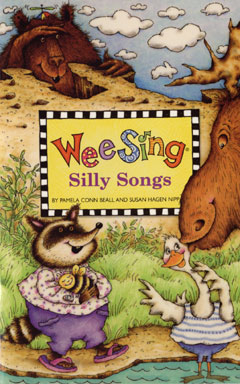
It was Wee Sing Silly Songs. The three of us must have played that tape—and sung along, with hand motions—20 times or more that week. Got to know all the silly songs by heart.

Who can forget the classic “John Brown’s Baby?” Or as our son sang it, “John’s brown baby.” He had a cold upon his chest, and they rubbed it with camphorated oil.

Oh, what did Delaware, boys? What did Delaware? She wore her New Jersey, boys. She wore her New Jersey.

Good times.

I know that, in years to come, when we are in The Home, drooling in the corner and unable to remember our own names, we’ll still remember the lyrics of the great children’s songs. I’ll have to be sure my son has a copy of “Silly Songs,” in whatever format it will be then, to play for me when I’m old.

My brothers and I grew up on Irish drinking songs and versions of children’s songs that weren’t yet scrubbed of their political incorrectness. Didn’t we all? 

I went to the animal fair, the birds and beasts were there
(we thought it was bees)
The big baboon, by the light of the moon, was combing his auburn hair.
The monkey he got drunk. He fell on the elephant’s trunk.
The elephant sneezed and fell on his knees,
And what became of the monk? 

Then there were the songs we learned on the playground, such as “Miss Lucy Had a Steamboat.” We thought we were so cool because the lyrics allowed us to curse without cursing. 

Or this:

Tra la la boom di-ay, there was no school today.
Our teacher passed away; she died of tooth decay.
We threw her in the bay; she scared the fish away.
And when we pulled her out, she smelled like sauerkraut!

What songs comprised the soundtrack of your childhood?

5 Comments

Filed under Family and Friends, Music, Travel

Absolute adjectives confound absolutely

Someone recently took me up on my Red Pen Invitation, which encourages readers to point out my mistakes if they choose. By the way, she wasn’t the first.

Commenting on last Friday’s post about first jobs, the reader questioned my use of “very first,” suggesting the phrase was redundant. She was right to challenge me. There can be only one first.

After giving this some thought, I concluded that my error wasn’t necessarily one of redundancy. Redundancy occurs when both words mean the same thing, e.g., “sum total.” Rather, I was guilty of  inappropriately modifying an absolute adjective.

I should have known better. After all, I’m the first to preach about “very unique.” Something is unique or it isn’t. There’s no “very” about it. 

An absolute adjective cannot be intensified or compared. It can’t be more. It can’t be less. It can’t be very or extremely or somewhat or a little. It just is.

The problem is that there doesn’t appear to be an authoritative list of absolute adjectives, at least that I can find. Maybe it’s an abstract better left as the late U.S. Supreme Court Justice Potter Stewart characterized obscenity (and the late Sen. Jesse Helms said about pornography), “I know it when I see it.” 

The obvious ones are: unique, pregnant, perfect, true and, of course, dead. Which won’t keep me from singing the famed lyrics of the Wizard of Oz when, upon the demise of the Wicked Witch of the West, the Munchkin coroner pronounces her “not only merely dead. She’s really, most sincerely dead.”

How well do you know your absolute adjectives? Take this quiz and find out. After you have finished that, maybe you can help me find an absolute list of absolute adjectives. Maybe it doesn’t exist.

Perhaps Theodore M. Bernstein was onto something when he wrote in Miss Thistlebottom’s Hobgoblins: The Careful Writer’s Guide to the Taboos, Bugbears, and Outmoded Rules of English Usage, “If one wishes to niggle, almost any adjective can be regarded as an absolute. But common sense tells us to avoid any such binding position.”

All niggling aside, I will add “first” to my list of absolutes.

4 Comments

Filed under All Things Wordish, Movies, Television and Radio, Politics, Reading

The great outdoors

Every year, as the crispness of autumn begins to creep around the bend, my husband’s thoughts turn to camping.

He goes several times a year with friends and loves it. He even cooks. I used to go occasionally, and our friends always went out of their way to make sure I had a pleasant time. But honestly, camping isn’t my idea of vacation time well spent. For one thing, all that sitting around gives me the jitters. And did you ever try to go shopping in a campground store?

It’s cliché to say that my idea of camping is a Holiday Inn, but I will say that comfort and cleanliness rank fairly high.

I do appreciate that camping is a valid low-cost vacation option, especially in this economic climate.

It seems that another popular way Americans save money is by taking a—pardon the portmanteau—staycation. You know, it’s where you take time off from work but don’t leave town. Instead, you might lie by the pool or visit attractions near your home.

I opened the Travel section of The Washington Post yesterday and learned of yet another increasingly popular, affordable—and portmanteau-named—getaway option. This one might just bring my husband and me a little closer to agreement, and fit within our budget at the same time.

The Post called it “glamping.” The article takes readers to so-called adventure resorts that offer relief from cumbersome equipment and flimsy tents, as well as clean, comfy beds, natural scenery and, in some cases, amenities galore. One place apparently has lockable French doors, which I want if the storied Son of Ratman is still on the loose.

Just imagine, you’ll enjoy the aroma of a crackling campfire without splinters. And roll over in your sleep without hitting a tree root or falling off your cot.

I wonder how the shopping is.

1 Comment

Filed under All Things Wordish, Family and Friends, Travel