Famed phobia

Do other Vanity Fair readers out there read the last page first? As soon as VF comes in the mail, I flip to the back, to the Proust Questionnaire, a regular feature in which celebrities are asked to reveal their true selves–even if their true selves drive them to provide flip answers.

The questionnaire is fashioned after a list of queries developed by French writer Marcel Proust, who believed that, in order to know others, we must first know ourselves. It asks things like “What is your idea pf perfect happiness?” and “What is your greatest achievement?” as well as “What do you consider the most overrated virtue?” and “How would you like to die?” Every month I read the responses of the featured celebrity and imagine what my own might be.

When asked which talent they’d most like to have, it’s surprising to me how many would like to play the piano. I would too, though being smarter and being able to sing would be higher on my list.

One of my favorites—an example of a flip response—was, when asked “What do you value most in your friends,” Dustin Hoffman replied, “private planes.”

We all relate to those who deplore cruelty in others and admire hard work. I’ve never related more to any answer than I did to one this month by New York Yankees captain Derek Jeter. To the question, “What is your greatest fear,” he said “Being unprepared.” Bingo.

We’ve all had that dream about going into a final exam after forgetting to go to class for a whole semester. Or being out in public without a stitch of clothing. I also have one in which I’ve neglected a pet too long. Gruesome, I know, but it reflects the depth of this fear I share with Jeter.

Perhaps it comes from showing up at Catholic school without my homework or permission slip, or not taking some of my college courses seriously enough. Somewhere along the way, these experiences of my youth led to some pretty compulsive behavior in my later years: packing three pairs of pantyhose for a one-night trip or leaving the house in perfect order, just in case something happens to me while I’m at 7-Eleven. Never running out of milk or floor wax or Q-tips. Reading the whole paper in the morning, not necessarily because I want to but because someone might ask me about a column or an obituary or the Dow. Getting my car inspected before it’s due and filing my taxes three weeks early. I can’t sleep at night if I don’t have at least an inkling of what I’ll blog about the next morning.

I know nothing whatsoever about Derek Jeter, or the New York Yankees or baseball for that matter. I do know, though, that Jeter’s favorite hero is The Incredible Hulk, that he would come back as an elephant, that he thinks he overuses the word “obviously” and that he hates bullies and his own skinny legs. I’d like to know how he overcomes that fear we both share and if he’s anywhere near as neurotic as I am in compensating for it.

What’s your greatest fear and, just to make me feel normal, what quirky compulsions do you throw at it?
2 Comments

Filed under Foibles and Faux Pas, Reading, Sports and Recreation

Them’s fightin’ words

A recent piece in the Chicago Tribune caught my attention online. Columnist Heidi Stevens asked readers which words they believe are most likely to start a fight. This wasn’t about let’s-step-outside kinds of  words. She wanted to know: Over which words will people go to the grammatical mat?

It’s probably a safe bet that anyone reading this blog has, at one time or another, gone fist to cuffs, in the verbal sense, over proper word usage.

What got my attention about the piece is that it began with a word over which I once lost a bet. I’m fairly sure I’ve told you this story. I once bet my husband that “irregardless” could not be found in the dictionary. It can. The way I should have phrased the bet was that “irregardless” is an incorrect form of “regardless.” Foolish me.

Stevens cited other examples I’d seen cause disagreements, including “adverse” versus “averse” as well as another one I had to have hammered into me long ago by an editor. I should have known better, but I learned my lesson and never forgot it. As an editor myself, I’ve turned around and taught it to quite a few writers. But not before going to the mat on it. It has to do with the word “comprise.” A whole is not “comprised of” its parts. The whole “comprises its parts” or it “is composed of” its parts. “Comprised of” is incorrect. I was 30 before that one sank in.

Arguing about grammar and word usage can be thorny. Many of us are accustomed to correcting people, especially if we are editors. It’s our job. We aren’t always accustomed to having our edits challenged. I’m not sure I’ve ever argued with an editor, but I have learned good lessons from several.  (I did have a manager once who hated the word “it” and edited it out of everything I wrote.)  It’s interesting to see how arguments progress until one party produces hard proof. (I used “it” four times in that paragraph. So there.)

I tell you, many of the subjects we’ve addressed here have sprung from disagreements. Being proven wrong is one of the best ways to learn; I know.

My advice: Don’t hesitate to engage in debate about words. Just be sure your argument is phrased in such a way that your position can be supported by a source you and your opponent both trust. Irregardless.

Note: Earlier I wrote “fist to cuffs.” I looked it up and found several alternate spellings, including “fisticuffs,” “fisticuff” and “fist-a-cuffs. Anyone?

Another note: This is a tricky week for Word Nymph. If, among the planes, trains, automobiles, weddings, funerals and business trips, an entry isn’t posted promptly, please be patient. Today’s is my 300th post. Surely there are one or two in here you haven’t read yet.

11 Comments

Filed under All Things Wordish

The big tournament

All eyes are on the big tournament. That great American competition that captures national attention this time every year. It’s time to see how your predictions will play out.

No, not the run-up to the Sweet Sixteen. It’s the official American Crossword Puzzle Tournament, held this weekend at the Brooklyn Bridge Marriott. If only Word Nymph had the forethought to apply for press credentials.

Following opening ceremonies last night (not exactly the Olympics, but a nice wine and cheese reception), the bloodfest begins this morning at 11:00.
Throughout the day today, contestants will complete a series of six crossword puzzles against a ticking clock. Then tonight, look out! It’s Games and Quizzes Night, featuring “The ACPT-zing Race,” a puzzle version of television’s “The Amazing Race.” Then it’s “Life Is Shortz,” a one-act crossword play named for New York Times crossword editor Will Shortz.

Tomorrow morning, there’s a talent show by Tournament contestants and officials, followed by the championship playoffs, in which the top three contestants in three divisions compete in sudden-death rounds on giant grids. NPR’s Neal Conan and Washington Post crossword editor Merl Reagle will give live, play-by-play commentary on the final rounds. I’m all aquiver.

The top prize is $5,000 but the real thrill has got to be just being there for it all. Or even getting to meet  Shortz or Reagle in person. You can compete online for $20, but then you miss the excitement and pageantry of the event.

Yesterday I decided that, if I can’t get a press pass for next year, maybe I’ll try out as an amateur. On the ACPT website, there’s a sample puzzle that’s supposed to give prospective competitors a sense of  their worthiness. Apparently, if you are able to complete it in 15 minutes, you would be competitive at the tournament. A time of under 10 minutes would be excellent.

As part of my usual bedtime ritual, I set out to work that very puzzle, timing myself, to gauge my aptitude. After the pretend starting buzzer sounded, I sped through the clues, surprised to find them so easy. Alas, I stopped after 18 minutes, after answering only 68 of the 74 clues.

Truly, I am a faithful amateur. There hasn’t been day in the last 10 years that I haven’t worked a puzzle, though I’m years away from being an expert. There are certain rivers and playwrights whose names I’ll never commit to memory. But I love good wordplay and find nothing more satisfying than breaking the code on a Sunday grid and laughing out loud at the cleverness of the masters.

How cool would it be to cover the tournament live for this blog next year?

Leave a comment

Filed under All Things Wordish, Sports and Recreation

Wilde night out

While many Washingtonians were reveling in the spirit of St. Patrick or cheering on their NCAA picks at the Verizon Center, I was at the Shakespeare Theatre having just as much fun. 

It was quite early this morning when I finally got home. The Shakespeare is right across the street from Verizon and both events let out at the same time. It was March madness on the subway and, from what I could tell, there were only two of us on the train who had not come from a basketball game or an Irish bar—one of the cast members and I.

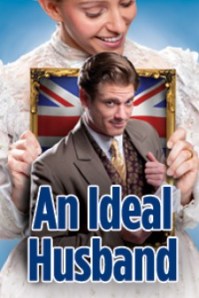
Thanks to a generous friend—the same one who took me to see George Bernard Shaw’s Mrs. Warren’s Profession there last summer—I enjoyed a delightful performance of Oscar Wilde’s An Ideal Husband, a clever comedy about integrity, political pressures, sky-high expectations and misunderstood relationships. The play had some plot similarities to Mrs. Warren’s Profession, including discovery that one’s wealth sprang from shady beginnings. I also noticed that, after writing their plays in the late 19th century, both Shaw and Wilde were reprimanded for indecency, Shaw for his theme of prostitution and Wilde for personal behavior.

In a review appearing yesterday, The Washington Post criticized the play; not the production or the acting or the directing or the sets or the costumes. The Post just didn’t like the play. The Baltimore Sun was more favorable. I found it beautifully written and superbly funny.

As I was waiting on the train platform to catch the subway home, I noticed among the throngs of revelers, the young man who had played Prinz Frederich von Glücksburg in the play, standing alone with the earbuds of his iPod tucked into place, waiting for the same train. In the time it took me to exit the theatre and walk to the subway, he had exited the stage, shed white tie and tails, pulled on skinny jeans and skate shoes and walked to the subway.

We boarded the crowded car and, a couple of stops later, much of the crowd exited. Prinz Friedrich found a seat and I sat down next to him. I wanted to compliment his performance and the way he delivered all of his lines in impeccable German.

I had met this young actor, Logan DalBello, a couple of times before. I know he’s a high school senior who is thoughtfully planning his next move. He has great drive and ambition for an acting career and immense talent to match. For the last several months, in addition to applying to colleges and auditioning for university theater programs, he has gone to school at 7 a.m. and rehearsed at the Shakespeare from noon to midnight. While his friends no doubt are expressing senioritis and spring fever, he is doing eight performances a week.

Sitting on the train, where he probably wanted to decompress and collect his thoughts for the next day, he graciously indulged my compliments and questions. He even asked me what I liked best about the play.

I loved the play, of course, but what I liked best was sitting next to him on the ride home.

2 Comments

Filed under Theater

Three little words

A new trend has just popped up on Twitter and it’s popping so fast I’m having trouble tracing its path. I believe it originated with Maria Shriver. At first I thought it was corny but, once I dug down, I struck treasure.

Tweeters all over are each sharing three words by which they live. It’s called “threewordstoliveby” and is intended to get people thinking about how they would capture their personal philosophies in just three words.

I took a scroll through about a hundred of them and tried to decide what mine would be.

To be sure, there were plenty of clichés: Live, laugh, love. Eat, pray love. Family, friends, faith. Those are nice, but they’ve been done. After all, the point is for them to be uniquely individual.

Some were raunchy. Some were extremely raunchy. Some were hedonistic: Scotch rocks now.  Bacon or die. Some were narcissistic.

Some folks couldn’t do it in three words: Lock the back door. Be concise.

First I thought mine would be Laugh yourself silly. Not very original, but it suits me.

Unable to come up with a meaningful and unique string, I found several that I wish I had:

  1. Peace, love, panic
  2. Failure isn’t permanent
  3. I ignore ignorance
  4. Know your role
  5. Think then talk
  6. Duck fat hashbrowns

Yes, the triquetrous credos are supposed to reflect our individuality. If that’s the case, I just found myself half a dozen new Doppelgängers.

By what three words do you live?

17 Comments

Filed under All Things Wordish, Technology and Social Media

Say what?

You gotta love Paula Deen. She’s a word nymph’s dream, blessherheart.

As a celebrity chef, she’s not my favorite. She lays it on a little thick for my taste—everything from the abundance of saturated fat to the exaggerated drawl. (Please let it be known I appreciate the difference between an accent and a drawl.)

I try to love her, really I do. Largely, it’s that I have trouble getting past her mispronunciations and speech gaffes.

For the record, “vinaigrette” has three syllables. It’s vin-ai-grette. Not vin-e-gar-ette. She’s not alone; restaurant servers aplenty mispronounce the salad dressing. Actually, Paula stretches it to five syllables, splitting the last one in two, like a generous slice of her pink lemonade cake.

But another goof in the same episode as vinaigrette got me thinking of another common mistake that we haven’t talked about here. She said she greases the pan to “assure it doesn’t stick.”

Shall we go over “assure” versus “ensure” versus “insure?” It must be confusing to some, so let’s give it a shot. Those who already know this can skip ahead to today’s assignment.*

Insure: to guarantee against loss or harm. The diamond is insured against theft. Think “insurance.”

Ensure: to make sure. I will grease the pan to ensure the cake doesn’t stick. Think: I drink Ensure to ensure I get enough nutrients.

Assure:  to inform [someone] positively. “Assure” almost always, if not always, precedes an object. I assure you, it will not happen again. The doctor assured him the drug was safe. Think: Rest assured. (you, implied, are the object)

Pretty simple.

*What, besides vinaigrette, do you find to be the most common food mispronunciations? In the meantime, here’s one person’s take. Note another Paula citation, for stretching “paprika” to four syllables. Good, I’m not the only one who counts.

7 Comments

Filed under All Things Wordish, Food, Movies, Television and Radio

Double trouble

Exactly when, or how, did Doppelgänger spring into popular consciousness?

For a word that originated as early as the 17th century, hovering below the radar for hundreds of years, it seems to have crashed back in to popular language quite suddenly.

When I first noticed people on Facebook putting up pictures of their celebrity doubles a year or so ago, I should have picked up on the Doppelgänger phenomenon, but didn’t. I sat that one out anyway, not because I was unfamiliar with the Doppelgänger (which I was), but because I don’t think I have a celebrity double necessarily. I’ve been told I look like Mary Crosby (She shot J.R.), Marsha Mason, Helen Hunt, Laura Linney and Stockard Channing, none of whom look at all like each other.

Since the time Celebrity Doppelgänger Week was last celebrated on Facebook, I’ve been hearing this quirky word all over the place. It was kind of like kerfuffle, which seemed to lie low for years before becoming a fad.

Doppelgänger has come to be synonymous with evil twin, alter ego and clone. But where did it come from? It’s not easy to say exactly, because there are many meanings and, as best I can tell, many origins. In fact, it seems even the Doppelgänger has a Doppelgänger.

It can mean an omen of danger or death; a hallucination of one’s own image out of the corner of one’s eye, sometimes as a result of electromagnetic stimulation of the brain; looking in the mirror and seeing two faces; a mythological apparition of evil or just someone who looks very much like someone else.

There are references to Doppelgänger in poetry and literature, as well as historical references going back hundreds of years in the United States and Europe.

If you’re interested, I encourage you to go out and learn about each culture’s interpretation. Or perhaps you already know all this and I am the one who is late to the party.

Make mine a party of six—my five Doppelgängers and me.


5 Comments

Filed under All Things Wordish, Movies, Television and Radio, Reading, Technology and Social Media

As luck would have it

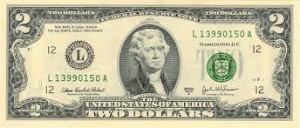
Over the weekend, I caught a television interview with NASCAR driver and owner Tony Stewart in which Stewart showed off a vast collection of two-dollar bills, which he displays in his trailer for good luck. If you are to believe him, it works. I know nothing about NASCAR and can’t vouch for the validity of his claim, but I did do some snooping and learned a bit more about the extent of this belief. I read that Stewart and other drivers believe very seriously in the two-dollar bill’s powers, to the extent that some have taken out their winnings in the denomination.

As I said, I have little interest in car racing, but I do find superstitions intriguing. After years and years of not even seeing a two-dollar bill, it happens that I received two in change for cash transactions in just over a week’s time; one the night before the Tony Stewart interview.

I remember when the bills were reintroduced into circulation in 1976. Their popularity lasted about as long as the Pet Rock. When that first two-noter was passed to me a week or so ago, I was eager to get rid of it. It just didn’t seem like real money, and was awkwardly out of place between the five and the ones in my wallet. Better to pass it on to some other poor sucker. Then the second one came my way, and then the interview, and then the curiosity that maybe there’s something to this silliness.

I plan to ignore Snopes, a rumor-busting website for which I have little regard, which states that two-dollar bills are actually believed to attract bad luck. No, I plan to keep this bill, maybe hang it on my office wall as seed money to attract good fortune. If I receive a third deuce, then I’ll know I’ve struck gold. Or at least four dollars that have gone unsquandered.

As the late Senator Everett Dirksen once observed, “a billion here, a billion there, pretty soon you’re talking real money.” Gotta start somewhere.

3 Comments

Filed under Movies, Television and Radio, News, Sports and Recreation

Equal time for the man

Who knew, as we fêted Barbie on her 52nd birthday, that Ken’s 50th was the same day? Poor guy, always in the shadow of the diva.

In 1961, when Mattel decided that Barbie should not be alone and needed a companion, it created Ken.

Ken, you've come a long way, Baby.

I learned that Ken turned 50 when I opened Sunday’s Parade magazine, which arrives at my house on Saturday. So watch for it tomorrow and open it to Page 5, where you’ll see half a dozen Ken hair styles from the early sixties, when his hair was painted on, to the modern metrosexual do of 2010. For a sneak preview, visit Parade for a click down Memory Lane.

It should come as no surprise that, just as Barbie has eluded the texture of middle age, so has her younger man. While his coif and togs have changed with the times, he’s still as smooth as ever. Would that we all be composed of soft vinyl rather than mottled human flesh. In 50 years, Ken sprouted nary a hair from the neck down and remains as hairless as ever, even on his back and the insides of his ears and nose.

The end of the brief article asks, “Who knows what the next 50 years will bring?”

Anyone?

Leave a comment

Filed under Beauty and Fashion, Marketing/Advertising/PR

Name that car

People have no doubt written about this before, but it has only recently gotten my attention enough to give it more thought.

Lately, I’ve spent a lot of time on highways, where there tend to be a lot of cars, and have realized something.

It used to be that cars had words for names. Many were named for real or mythical creatures. Falcon. Jaguar. Cougar. Beetle. Viper. Thunderbird. Firebird. My first car was a Mustang.

For a while, car names symbolized strong human types: Cavalier. Maverick. Ranger.

Cars were also named for exciting places, like Daytona and Malibu.

Then came a time when inserting a French article made a car seem more exotic: LeSabre. Le Car. LeBaron.

Dodge has been keen on naming cars for objects that represent speed (Dart), fearlessness (Intrepid) and forcefulness (Ram Charger).

I love my car, but wish it had a real name. I drive an Altima. Before that I drove a Sentra. Nissan also makes the Maxima. I’d prefer these be real words: Ultimate, Sentry and Maximum. I don’t know if the Japanese are the ones who first came up with made-up names; they were the ones who also invented Camry, Prius, Yaris and Integra, and introduced the alternatively spelled Infiniti. Honda has done quite well with the Civic and Accord, both nice names and real words with positive associations. Hyundai has the Tucson and Santa Fe, both nice places. Still, made-up names seem to be on the rise. Increasingly, humans are giving their offspring made-up names.

Maybe carmakers have something there. Surely there were countless focus groups that confirmed the appeal of certain made-up words, and it appears from my observations on the road, that these are the cars people are buying. Most luxury car models are beyond words, simply using combinations of letters and digits.

Not one for made-up names for cars or humans, I had to get past buying a car with a nonsense name. I passed up the Accord for the Altima, which I liked far better in the test drive. If I had test driven names alone, I’d have bought the Accord.

How about you? Did your first car have a real word for a name? To what extent did the name factor into the selection of your current car model?

5 Comments

Filed under All Things Wordish, Marketing/Advertising/PR, Travel