Candy coating

There wasn’t as much time as I had hoped yesterday to read my new Euphemisms book; however, euphemisms continued to play in my mental background as I went about my business.

At one point during the day, my mind wandered back to my days working for a Fortune 100 company, employed in what my new dictionary calls “legislative advocacy leadership.” Large corporations are masters at euphemistic technique, a talent that serves them well when applied artfully. I am betting there are readers who have worked in corporate America who have examples to share. Please?

We had “resource realignment,” translation: layoffs. When competing for business that we didn’t win, we were “deselected.” When we made one of the cuts preceding final selection, we were “down selected.”  We also had an “appearance policy,” which was a dress code. Oh, the good old days.

It’s been a while since I worked directly for a corporate concern, but yesterday I received notice of a seminar on “Capture Management.” At the risk of revealing a pinhole in my skill set, I trust this has something to do with sales.

Government uses euphemisms too. They have “revenue enhancements” and “quantitative adjustments.” The financial industry refers to “correction” when the market falls. Every sector has its rose-colored lingo.

I’ll close today with a list excerpted from comments posted on an article on Education World’s website. It’s been around the block but never ceases to amuse me. I might award first prize to our nation’s hardworking teachers for euphemistically finding the bright spot in every trying situation:

Molly demonstrates problems with spatial relationships.
It’s November and she still hasn’t found her cubby.

Paul’s leadership qualities need to be more democratically directed.
He’s a bully.

Jonathan accomplishes tasks when his interest is stimulated.
He has the attention span of a gnat.

Alfred demonstrates some difficulty meeting the challenges of information retention.
He’d forget his name if it wasn’t taped to his desk.

Bunny needs encouragement in learning to form lasting friendships.
Nobody likes her.

Joel appears to be aware of all classroom activities.
He just can’t focus on the one we’re involved in.

David frequently appears bored and restless. You might want to consider placing him in a more challenging environment.
Prison, perhaps?
3 Comments

Filed under All Things Wordish, Marketing/Advertising/PR

Pretty it up

Call me one lucky word nymph. I say how much I love words and how they’re used and people send give me their treasured dictionaries. I say how I much I love SweeTarts and people think of me when they see the candies in stores. I publicly fear coming up dry and people send me suggestions for topics.

I received many blessings this Easter, including SweeTarts and other goodies. One gift is something you and I will be able to enjoy together in weeks and months to come.

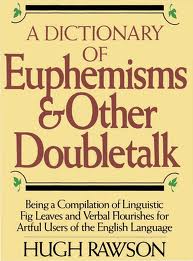
Get ready to enjoy picks from Hugh Rawson’s A Dictionary of Euphemisms & Other Doubletalk: Being a Compilation of Linguistic Fig Leaves and Verbal Flourishes for Artful Users of the English Language, a treasure that came my way thanks to a very special Easter Bunny.

I’ve wanted to write about euphemisms for some time; in fact, I noticed that I had jotted it down on a pad where I park blog ideas, just before I received the book. I had been separating euphemisms from political correctness in my mind in hopes of sharing some subtleties. I’ll do this later, after I’ve had time to delve into 312 pages of euphemisms A to Z. Already I’ve come upon some gems. Doubletalk merits its own discussion altogether. It’s an art often disparagingly attributed to politicians but made famous by comedic greats Carl Reiner and Sid Caesar. Or maybe that’s doublespeak. I’ll look into that.

This dictionary might be my favorite yet; I see great utility. There’s another one out there that looks interesting: A Dictionary of Euphemisms: How Not To Say What You Mean by R.W. Holder, which could be of value to those practicing in the field of crisis communications.

While I’m at work on this, what are some of your favorite euphemisms?

(So far, mine might be “embroider the truth.”)

Leave a comment

Filed under All Things Wordish, Reading

Ape for annuities

Let’s see. How long is the list of companies whose commercials contain grammatical errors? I can count Boniva, Honey Bunches of Oats, Miller Genuine Draft and a few more I can’t recall at the moment. Today I am adding Honda for its recent tagline: “To each their own.” Sheesh.

Another one has been bugging me, not for its grammar but for its mixed metaphor. What has me puzzled is—as is often the case—how it escaped the smart and well paid execs who craft and place television ads.

Take a look at one of Axa Equitable Life Insurance Company’s most recent spots and tell me if you notice it.

“What do I know? I’m just the 800-pound gorilla in the room.”

Pick one, guys. It’s either “the 800-pound gorilla” or “the elephant in the room.” These expressions mean two different things, the latter being more apt for Axa’s campaign. Perhaps the elephant failed the audition.

Just before Axa Equitable launched the campaign during the 2007 Super Bowl, the company said in a press release that it sought to encourage the approximately 77 million baby boomers in America to “stop ignoring the 800-pound gorilla in the  room” and buy their variable annuities.

 Four years later, the campaign continues. The commercials have won numerous industry awards and still, no one is challenging their metaphorical duplicity. Naturally, retirement planning and life insurance are important subjects that many prefer to ignore; in this vein, the commercials are hitting the intended demographic target. It’s just that Axa has picked the wrong spokesmammal.

Do we need a refresher?

“The elephant in the room” represents a sizeable subject that everyone is aware of but no one wants to talk about. It might be a looming crisis or a relative’s drinking problem. Everyone knows it’s there—it’s too big to ignore—but we pretend not to notice it. 

An “800-pound gorilla” is a bully, a goliath, a behemoth. Just think of the old riddle.

“Where does an 800-pound gorilla sleep?”
“Anywhere he wants.”

7 Comments

Filed under All Things Wordish, Marketing/Advertising/PR

Runaway bunnies

We’re still working on our kitchen. Yesterday we—well, not “we” exactly—moved two large book cases out in anticipation of painting. These hadn’t been moved since 1991.

Once the book cases were moved out, left behind were:

  • 1 pilgrim hat, made of construction paper and hand painted by a pre-schooler
  • 1 metal end from a bolo tie (owned by same preschooler)
  • 1 birthday party goodie bag with some contents remaining
  • 1 Ziploc bag containing two Tootsie Pops, a mini box of raisins and a large plastic eyeball
  • 19 years’ worth of dust bunnies

How seasonal.

2 Comments

Filed under Hearth and Home, Holidays

Good Friday, good times

When my son was young, he and I used to have a traditional way of observing Good Friday. My employer gave us the day off every year, so I welcomed the chance for a mother-and-son day.

It wasn’t all solemn. We often played in the yard or at the park, visited the local pet store where they had baby bunnies available for petting, we visited the cheesy Easter Bunny at the mall and had a picture taken. Then we went to church in the evening, often counting daffodils and forsythia blossoms along the way.

 In those days, our church’s Good Friday service incorporated a solo liturgical dance performance, which my son called “the dancing man in the black pajamas.” Before the service was over, my son almost always fell asleep in the pew.

Good times.

11 Comments

Filed under Family and Friends, Holidays

Let the Triduum begin

Six weeks ago, I wrote about eating pancakes before the beginning of the Christian season of Lent.

Some 40 days have passed and we are now at the Holy Triduum—the three days preceding Easter, beginning today with Maundy Thursday, which commemorates, among other significant happenings, the Last Supper.


Our Jewish friends and family are in their season of Passover. It is indeed a holy week for those of Judeo-Christian faiths.

I thought about refraining from writing during this period so that I could fully observe the holy days, and I might still.

As I mentioned on Shrove Tuesday, I am following a daily devotional (On the Cross Road by Joan Trusty Moore) and  I have fallen about a week behind, so I hope to do some catching up. Also, I plan to be in church every day for the next four days–Maundy Thursday, Good Friday, the Great Vigil of Easter and Easter Sunday. If something strikes me, I’ll write. If not, I’ll be back soon.

In the meantime, whether your tradition involves observing holy days, taking your kids to Disney or on college tours for spring break or, if you live in the nation’s capital, enjoying having the roads to yourself, I invite you to share your comments on what this time means to you.

Happy days.

Leave a comment

Filed under Family and Friends, Holidays, Reading

Out of gas

A year or so ago, a run-down shopping center in our town gave itself a little facelift, and chose to illuminate its signage with neon. I considered it a good idea at the time—it suited the eclectic character of our commercial strip.

I did have one concern that indeed has come to pass. The risk of neon gas is that it runs out and, apparently, is an effort to refill or replace.

In my old D.C. neighborhood I shopped at “GIANT  OOD.” Recently, as I was driving home, I noticed that, after only a year after its facelift, at Kensington’s main intersection, stands “INGTON HOPPING CENTER.” (The S comes and goes, but how appropriate for Easter.)

It seems this neon gas shortage isn’t unique to my neck of the woods, as shown in photos others have posted.

How’s the neon supply in your ‘hood? 


1 Comment

Filed under All Things Wordish, Marketing/Advertising/PR

Trash talk

You may have seen the Johnson family of Mill Valley, Calif., on Today or read about them in Sunset magazine though, if you’re like the Johnsons, you might not have any magazines in your house.

The Johnsons have come to be known as a zero-waste family. They generate no trash and very little recycling. You can read for yourself how this family’s desire to live simply and cleanly has decreased their contribution of refuse to our planet. Admirable, I’d say. And guilt-provoking.

I’m a little ashamed of our household’s size 16 carbon footprint. We are the antithesis of the Johnsons. I’m not sure exactly how two humans and two felines can generate enough weekly waste to fill the Johnsons’ bins for more than a year. See for yourself. Not counting the bags of yard waste that already await pick-up at the curb, we’ve filled a 20-gallon can and an even larger sized Hefty bag in less than a week. Plus this large recycling bin and a paper bag’s worth of newspapers joining the yard waste at the curb as we speak.

Granted, we did a little spring cleaning over the weekend. For example, in preparation for our kitchen project, I decided to thin out our spice collection. “They” say kitchen spices go bad after six months and that we should discard them after that time. “They” would probably also say that the bottles should be recycled and the spices themselves composted or trashed, but that presumes the spices aren’t permanently adhered to their receptacles after years of neglect.

As someone who keeps her spices in alphabetical order, I’d appear to have a good grip on this. Over the weekend, I went through all my spices, A to Z. I discarded four bottles of curry powder, while being hard pressed to remember when I’d ever used curry powder in my life. Maybe they were part of my husband’s trousseau. Cream of Tartar? I’m not sure I even know what that is.

I swear there was a bottle of whole cloves that came from the house I grew up in, which we vacated in 1976. Somehow I manage to go through several bottles of chili powder a year, and yet can barely twist off the gummed up lids of nearly a quarter of these fastidiously filed spices. I had samples of every Spice Islands and McCormick’s label design of the last 30 years. Never mind all the other relics I came across while cleaning out my kitchen for the first time in 20 years.

Perhaps the Today show would like to interview me.

9 Comments

Filed under Food, Hearth and Home, Movies, Television and Radio

A crack in the idiom

My parents schooled me well on matters of language. Often they told me preemptively about common errors, so that I might avoid them later on. I’ve told you about some of these before (e.g., “waiting on” versus “waiting for”).

Coincidentally, as I was remembering another erroneous expression about which my father warned me long ago, I came across a column on the same subject.

Here we’ve covered malapropisms and funny mixed metaphors. We’ve even discussed useless phrases. But there is another category–expressions that are commonly accepted though, when examined more closely, make no sense. That’s what the column I read on Johnson, The Economist’s language blog, was all about.

I love the way Johnson describes it: “a reasonably common starter phrase that can evolve into a variant catchy enough to take root but close enough to the original and wrong in a subtle enough way for most people not to notice.”

There’s no name for such a thing, as best I know, but there are some examples to consider.

The one my father brought to my attention oh, so long ago: “It fell between the cracks.” Think about it. “Between the cracks.” To fall between the cracks, or slip between the cracks, has come to mean that something was lost—by slipping into a tiny space. Say you drop a small object on the floor. If it slips between the cracks, it’s not lost at all. Why?  Because what’s between the cracks? The wood. Even though “between the cracks” is commonly accepted, what we mean to say—and should say—is “through the cracks.”

By the way, the Johnson column begins by observing that, in British English, the words “between” and “among” do not necessarily have two different meanings, as they do in American English. I am going to assume my American readers know the difference. See me after class if you don’t.

The piece also discusses “head over heels,” another common expression that should really be “heels over head.” Visualize it and you’ll see why.

What other faulty idioms—English or American—can you think of, based on Johnson’s description? Is there a chance we can start a movement?

First, we need to come up with a name for it.

3 Comments

Filed under All Things Wordish, Family and Friends

By the book

About 10 years ago I realized that, as a society, we parents read way too many books about pregnancy and infancy and not enough about parenting. It was much longer ago that I marveled at the amount of energy and money we pour into infants, equipping ourselves and them with nursery furniture and fixtures, clothes and equipment, when everything is outgrown in the blink of an eye—and, in our case, occupies space in the attic for another 20 years.

As I glance at my bookcase, I count more than a dozen books about the first years of life. Were those really needed, when what we focused on at that stage was putting food in one end and cleaning up at the other? The loving came naturally.

By the time our children are adolescents, we are too busy pulling our hair out to read books. I did have one or two that helped in a pinch, but wouldn’t it have made better sense to read those in advance of onset?

Then came the dreaded Empty Nest Syndrome, for which I was completely unprepared—most likely because I was consumed with the here and now of the high school years. Then came the college years, during which parenting happens long distance. And then, the post college era.

Just weeks after our son graduated from college last spring, I struggled with identifying my role as a parent. You’d think your work is done, but isn’t your role just being redefined yet again? As the parent of an only child, I am the very model of the modern helicopter parent, always hovering. When is it time to fly out of the picture? How is my adult child going to navigate the adult world? Where are the books for this stage?

Well, it turns out there are plenty of books on parenting your adult child. I just never thought to look. I spent some time on Amazon.com this morning, when my son and his girlfriend went back to North Carolina after spending a week here, exploring possible relocation. Yes, we are inviting him back to the nest, so that he might have a better pad from which to launch the second year of his adult career. And I see there are nearly a dozen books on the subject.

Again, we contemplate our role as parents. We taught him what the cow says and where his nose is. Surely, 20 years later we can be of help in punching up a resume, crafting an elevator pitch, sharing advice on networking techniques, working up sample budgets and helping in the clarification of goals. But whose goals, his or ours?

I know the answer is this: we have an adult son who has matured into an outstanding man, caring and talented, in spite of us.

Now what?

6 Comments

Filed under Family and Friends, Reading