
The question of the day: Where were you when President Kennedy was shot?
Perhaps more important, what did it mean to you at the time? For me, it all boils down to one word.
On November 22, 1963, I was three weeks away from turning four years old. As young as I was, I can still remember it well. It was late afternoon, getting dark, and I was playing on a swing set with a neighbor boy across the street. His older brother came out of the house and yelled, “The president was shot!” My playmate responded with something like “Oh, no; that’s terrible!” We all ran inside to find their mother in front of the television, hysterical.
Without paying much attention to the TV news story, I probably toddled home for dinner as almost-four-year-olds did in early-1960s suburbia.
I hadn’t grasped what had just happened; still, I was upset. There was only one meaning of “shot” in my young consciousness. And it was indeed horrific.
For me, “shot” was what the nurse gave you when you were sick. On every drive to my pediatrician, Dr. Bunce, I’d ask my mother, “Will I have to get a shot?” I’d tremble with fear and anxiety until the appointment was finished and I was sucking on my good-job-being-brave lollipop. Getting a shot was the worst possible thing to come from a doctor visit (next to spending Christmas in the hospital, which is what I did later that year, but that’s a story for another day).
So, on November 22, as far as I was concerned, the anguish I witnessed in the neighbor’s back yard, in their living room and, most likely, in my own house was a result of the President of the United States being injected with a needle. I probably wondered if he got a lollipop.
Yesterday’s Washington Post ran an article on how parents can help their young children understand clips of Abraham Zapruder’s footage they’d see in the news coverage of today’s 50th anniversary. Sadly, gunfire isn’t new to today’s youngsters. I’m just glad I made it almost to age four oblivious to anyone being killed with a gun.
On a brighter note, I’m reminded of a scene in the 1989 movie, When Harry Met Sally in which Harry is out with a much younger woman. Attempting to make conversation, he asked her where she was when Kennedy was shot. The date replied, “Ted Kennedy was shot?” Out of the mouths of bimbos.
 If you and I travel in the same social media sphere, then you may recently have witnessed my (very polite) outburst over the way people speak about one another online. While I’ve since made peace with a number of my offenders, this provides occasion to reinforce a simple courtesy: Never say (or mime) anything from behind a wall that you wouldn’t say to someone’s face.
 The predominant adjective was stupid, with a few “idiots” sprinkled in. “How can people be so stupid?” “Well, that just proves you can’t fix stupid.” “50 percent of the country just showed us that stupid is as stupid does.” “The idiots who re-elected our current president…”
 My parents were none too pleased with this self-mutilation; I might even have been punished for it. But punishment came anyway as it started to grow out – into a stiff vertical geyser, much like Martin Short’s Ed Grimley.
 After Chief Medical Correspondent Dr. Nancy Snyderman rebuffed the congressman’s theory, the panel’s legal analyst, Star Jones, cautioned that the congressman’s gaffe could harm GOP candidate Mitt Romney, whose campaign could be “tarred with the same feather.”
 I’d take him. In a Fletch-off, that is. I’m not proud of this, but I’ve got the whole movie memorized. I even have an autograph that Chevy Chase wrote to me in 1988, suggesting I name my unborn baby Fletch. No kidding.
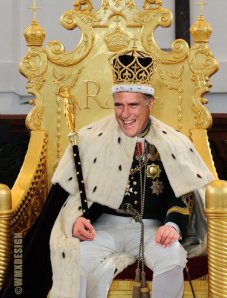 Did you spot it?
 Today, all mankind is on my nerves.
 After having met and admired former Texas Governor Ann Richards, Taylor was inspired to memorialize Richards in a play about her life, à la Hal Holbrook’s portrayal of Mark Twain. She began the endeavor following Richards’ death in 2006.
 Word Nymph