Eighty-six the peppers

We’re about to undertake a modest kitchen re-do and, as part of a larger initiative to reduce the number of belongings in our household, we are having to make some difficult decisions.

When we moved into our 1912 Victorian almost 21 years ago, we started filling it up with “collectibles,” a word I use loosely. Once word got out that we were collecting certain items, our friends thoughtfully and generously added to these.

My husband brought into our marriage several really neat collections, including antique framed portraits, antique vegetable cans, antique snuff cans, antique cameras, varied forms of “cheesecake” (a.k.a. antique porn), old Coca-Cola memorabilia, old cigarette memorabilia and old glass pinball machine backs. Over the years, he amassed a matchbook collection and a collection of “miscellaneous,” most of which has been displayed in our Pussycat Lounge. We also have the cork from every bottle of wine we’ve opened since 1990.

After we got married, we began collecting coffee mugs and refrigerator magnets and any and all things chili pepper. We have a chili pepper napkin holder and spoon rest, strings of chili peppers hanging on the walls, chili wreaths and wall hangings, pepper platters and pepper pitchers, table linens and tiki lights, canisters and candles, salt and pepper shakers and switch plates, mugs and magnets. It’s been fun, but it’s time for a thinning of the crop.

You know how it is. I have a friend who started collecting elephants in 1978 and, thanks to the generosity of friends, likely has more than a thousand. With my son, it’s tree frogs; my sister-in-law, it’s apples. The hard part is knowing when–and how–to get the word out politely that we’re full.

I’d like to assure our loved ones that we’re keeping a few chili treasures that we just can’t part with. The other 75 percent are being packed away to pass on to someone who will give them a loving home. Applications are now being accepted.

My husband has slowly and methodically been finding adoptive homes for a select few of his treasured collections. Don’t panic; much will remain with us, and our only child will decide the final cuts once we’ve moved on to the big flea market in the sky.

For now, our kitchen will get a mini facelift and a fresh theme. Shhh, it’s a secret; even we don’t know what it is.

5 Comments

Filed under Family and Friends, Hearth and Home

It’s been real

Yesterday, the one-year anniversary of Word Nymph, I shared that I’ve been discerning the future of this blog.

As you might imagine, coming up with new ideas, researching them and writing fresh and thoughtful content six days a week requires a tremendous amount of time and energy.

Therefore, it is with a heavy heart that I announce today that I am calling it quits. It’s just too much.  I’m out of ideas. I’m out of stories, observations and opinions. There’s nothing left to write about.

Besides, after some deep soul searching, I no longer feel it is my place to correct the world’s grammar, punctuation, pronunciation and spelling. Maybe those things aren’t that important after all.

It’s been fun but it’s over. Good bye.

APRIL FOOL!!

17 Comments

Filed under Holidays, Technology and Social Media

Year of the Nymph

On March 31, 2010, I wrote my first blog post, questioning the value of blogs. My premise was that no one wants to read anyone else’s innermost thoughts—and blogging seemed to be the place where innermost feelings become outermost feelings. But I went ahead and started Word Nymph anyway.

My one-year anniversary post isn’t going to be anything spectacular, so if you’re reading this blog for the first time today, please dig deeper into the archives before you form a first impression.

If you’re among the small but potent community of regular readers and commenters, thank you. Thank you for your faithfulness, even on days when your basket is brimming with reading matter. Thank you also to the four or five people who advised me in the beginning of this undertaking. And thank you to my husband, who kisses me good night as I sit in the late hours staring at a blank screen and panicking about what I will write about the next day. Three hundred nine times, so far.

Over the course of the year, I’ve heard from people that they want more personal stories of my childhood or of the careless foibles of my adulthood. Others believe I should stick to my knitting; one reader said he was going to unsubscribe because I wasn’t doing enough on language and grammar. At times I’ve wondered how I might satisfy everyone in this regard. But, as Ricky Nelson once sang, “You can’t please everyone, so you’ve got to please yourself.”

Some readers tell me they can’t keep up with my six-days-a-week schedule,  that they get behind and struggle to catch up. I don’t want people feeling like they’re drinking from a fire hose, so maybe I should slow down, pace myself so I don’t run out of ideas, or worse, generate forced content for the sake of adhering to a self-imposed schedule. On the other hand, some readers call me when I’ve posted late or missed a day, wondering where their Word Nymph is.

As I struggled with these questions, a friend and supporter sent me a link to another blogger’s ideas. These very usefully address my very conundrums. If you’re contemplating starting a blog yourself, or if you’d like to join me in contemplating Word Nymph’s future, you’ll find these thought-provoking—and a good read all around.

I know one thing for certain. Your comments–good or bad, serious or funny–are what make it worth the effort.

That’s it for today. Still thinking about the future. I welcome your ideas.

Thanks again for reading. Must find cake.

20 Comments

Filed under All Things Wordish, Family and Friends, Foibles and Faux Pas, Reading, Technology and Social Media

Grammar on the Acela Express

Yesterday I was on an Amtrak train rolling along the East Coast. Compulsive public eavesdropper that I am, I tuned into a loud conversation among three gentlemen in the row in front of me. One, a well-groomed young man in a good suit, was obviously auditioning for the approval of the other two, perhaps as a job applicant or an eager salesman. He said, “Yeah, I coulda went to Boston University.” Then he proceeded to begin several sentences with “Me and him…”

I’ll never know the outcome of the meeting, as the gentlemen disembarked before I did.

Boarding the train and taking the place of the three gentlemen were two ladies. Neither was a native English-speaker, but one was a bit more fluent and confident than the other. However, in contrast to Sir Brags-a-lot, both women spoke impeccable English. One looked up at the sign above the seat and asked her friend, “how is that word pronounced?” I was impressed that she cared enough to ask. Her friend responded, “aisle,” like “‘I’ll,’ as in ‘I’ll be back in a moment.”’ There was conversation about not pronouncing the “s,” as with “island.” The woman more in the know assured her friend, “English can be confusing.” Her friend said, “Yes, but it is such a beautiful language.”

I’ve never thought of English as being a beautiful language necessarily. I find the romance languages more pleasing to the ear, even if I don’t understand everything. Perhaps the rhythms and intonations of a foreign language are what make it beautiful to our ears.

I do believe English is one of the most difficult languages to learn as second language, with all of its exceptions and varied pronunciations. English also poses challenges for us native speakers, which may be why I still enjoy studying it. That said, perhaps I should have been less judgmental of the fellow who could have went to BU.

Oh, whom am I kidding?

8 Comments

Filed under All Things Wordish, Travel

H&R block party

In my mind, there are jobs we can do ourselves and others we should employ others to do.

I happen to be a big fan of outsourcing. Not that I have excess funds to throw around, but when I can hire someone to do something I’d do poorly, such as practicing medicine or doing home repairs, then it’s a win-win for both of us.

Today’s example: preparing taxes. If I had to let go of all the people I pay to help me get through life and keep only one, for the moment, it would be Helen at H&R Block.

Is there a more dreaded chore with even more dreaded consequences if left undone? I can’t think of any. Maybe trash collection.

Our son just did his taxes himself for the first time. For a parent, that’s right up there with tying his shoes and riding a bike. I might ask for a copy of his 1040EZ to put in the baby album.

Yesterday, we had our annual appointment with Helen. We walked out hundreds of dollars in fees poorer but with a refund on the way and a peace of mind guarantee.

It took a lot less time this year than in the past. For one thing, we have fewer funds to deal with after four years of college tuition payments. For another, both my husband, for our household, and I, for my business, have become so accustomed to the process that we have perfected our dance with Helen to a highly synchronized mambo. I wanted to high five everyone in the place on our way out.

I suppose I’m feeling a little smug today, having wrapped things up 17 days early. 

I  might even do a little dance all by myself.

2 Comments

Filed under Family and Friends

Leading nowhere

It’s Monday and presumably we’re all rested up and ready to face the work week. While you’re enjoying that first cup of coffee and reviewing your calendar, maybe before you step into the Monday staff meeting, how about a word challenge?

Who plans to write at least one press release this week? As the first quarter draws to a close, corporate communications types will be busy crafting earnings releases to be issued in early April. Maybe you’re working on your organization’s annual report. Whether you’re a one-person shop or member of a sales team, sometime this week you will likely tell someone what your organization does, for whom and how.

Sadly but necessarily, we’ll all use the same tired words we’ve been using for decades. In all the years I’ve been involved in helping organizations describe what they do, I haven’t managed to climb completely out of the word rut.

Think for a moment about how you would say, in two sentences, who your organization is and what it does. Say it out loud or write it down. Or look at your company’s mission or boilerplate statement.

Notice whether what you wrote—or what your employer has already written—uses any of the following words: “leading” (or “leader”), “solution,” “innovative,” “premier” or “state of the art?”

If so, then the good news is that you’re not alone. The bad news is that you’re not alone. This basically means everyone else is making the same claims you are. I do it too, and I can honestly say that I’ve written or repeated all of these words for the organizations I’ve represented.

Last week, Ragan’s PR Daily reported the 25 words most commonly used in press releases. These were culled by PR strategist Adam Sherk, using an aggregation tool that, from what I could gather, did not pick up boilerplate language.

The list won’t surprise you, but perhaps it will get us all thinking of how we might choose better words to express what we do and why we do it better than anyone else.

For example, if we all say we’re leading, then is anyone really leading? What is premier, exactly? Whether we make wireless routers or nose hair clippers, peddle consulting services or plumbing services, how innovative or state-of-the-art are we, really?

“Solution” topped the list, appearing 776 times in a 24-hour period.  I once worked for a computer services company that once told its tens of thousands of employees to refrain from using the word “solution” because it implied that its customers had “problems.” It makes you wonder how many problem-free customers comprise the target market for any service provider.

I’m not here to offer magic synonyms, at least not today. I’ve not even sure synonyms are the answer. Otherwise, we’re going only as far as “foremost,” and “ground-breaking.”

Are there more meaningful words, or expressions of ideas, from which to choose, or do we need a whole new vocabulary for this young decade altogether?

I plan to give this additional thought and I encourage you to do the same.

Who can produce a compelling lead paragraph or boilerplate statement, for a real or fictitious press release, that does not contain any of Sherk’s top 25 words? There might be a prize for the most ground-breaking entry.

2 Comments

Filed under All Things Wordish, Marketing/Advertising/PR

Sweet surrender

I’ve hit bottom.

I started with a pack a day, which turned into two packs a day. Within weeks, I was inhaling up to four or five. For so recent an addiction, this one has taken hold with quite a grip. Today I did something of which I am not proud.

It started last October, about a month after I had given up alcohol, coffee and chocolate. At Halloween, when there were pounds of candy in the house, I turned away from chocolate and turned on to SweeTarts–and the powder form, Pixy Stix. We had such a large supply that I was able to make it last until Christmas, when I became distracted by other forms of sugar. The loneliness of January turned to the darkness of February and I missed my old pastel-hued habit. For Valentine’s Day I asked my husband to substitute my traditional box of chocolates with SweeTarts. He gave me a big bag of individually packaged heart-shaped ‘Tarts, five to eight to a pack. When they ran out about three weeks ago, I got the shakes.

It turns out that no grocery or drug store in my area carries them. The ones my husband found were available for a limited time for the holiday. I started making special trips out to find them and with each failure to score came worsening withdrawal. A friend gave me a tip that they’re available at the movies, which was going to be my next tactic.

This afternoon I went to the mall to drop off some watches for repair. The clerk said the repairs would take 20 minutes. My first thought was to check to see if Target stocked my substance. Sure enough, my newly expanded Target had two boxes. I grabbed both of them and resisted opening one while I waited in the checkout line.

I had 15 minutes left to kill. Ordinarily at the mall, I’m tempted to try on clothes or shoes or costume jewelry. Those didn’t interest me one iota. All I wanted was to break into the SweeTarts.

I found a bench where I pretended to check my e-mail. I pulled out a box and began to tear at the corner. I imagined what I would look like, a desperate 51-year-old woman, sitting alone on a bench at the mall on a Saturday afternoon eating Willy Wonka SweeTarts. Sheepishly, I placed the unopened box back in the bag. I picked up my watches from the repair store.

Slowly, I walked to my car. My pace quickened. I ran the rest of the way, got in the car, ripped open a box and devoured half of it. That’s more than five servings. I was fulfilled.

I know I have an addiction. I’d like to break it, truly I would. Dr. Andrew Weil, whom I follow on Twitter, just within the last day or two, tweeted advice about breaking the sugar addiction. I had considered that divine intervention and pledged to myself to confront it like an adult. But today I caved.

The remaining SweeTarts are now in a covered candy dish in the dining room, with the spare box tucked away in a drawer. I’ll try to make them last, maybe I’ll even have the courage to give the spare box to a deserving child. Maybe I’ll overcome the habit and get to where I no longer feel like a herion addict without them. Or will I just be back on the street the next day, trying to score Pixy Stix?

12 Comments

Filed under Foibles and Faux Pas, Food, Health, Holidays

Southern hospital-ity

The universe has a way of teaching us valuable lessons, often despite our attempts to block our learning pathways.

The obstacles I put up often are erected by my own impatience, anxiety and desire for control. The lessons I learn, despite these obstacles, often come to light as a result of my foibles and faux pas. In other words, I go through life with a mission, a strategy, profound organization and planning and compulsion for making sure things go right. For example, when I am on a business trip, I am always triple checking that I have everything I need, that I am running on schedule and that all the pieces come together precisely according to plan. Then, occasionally, I do something really flaky that throws my planetary orbit completely awry.

Yesterday, I facilitated a medical meeting at a hospital in Mississippi. When it was over, I knew I had time, with a nice cushion built in, to drive 95 miles to the Memphis airport in time to catch my flight home. I packed the trunk of my rental car and reorganized my materials and belongings efficiently for the flight. I triple checked everything: meeting materials organized, boarding pass and ID accessible, car and house keys where I could access them when I got home, phone in hand in case of emergency.

In a nanosecond of flakiness, I closed the trunk of the rental car. With the keys inside.

Everything was in the trunk of the locked car, except my purse, the contents of which I had emptied into my computer bag, also locked in the trunk. Fortunately, I had my phone and my wallet.

Let me first say that all prior moments of anxiety on this trip were assuaged by the exceptional niceness of Mississippians. From Internet and printing problems at the hotel to the logistics during the meeting, everyone who crossed my path bent over backward, not only to help but to care for me in the process. At the risk of generalizing, there really is something to the notion of Southern hospitality. It’s like having a mother everywhere you go. People really care about you and will go to whatever lengths it takes to get you what you need. This was the first lesson: no matter how impatient you are with people, they can beat you down with kindness.

After a moment of panic, I called the car rental company to see what they could do. I naively thought they could flip a switch and unlock the car remotely. The Southern gentleman rental agent apologized that this was not the case and offered to send someone out, for a fee and perhaps not in time for me to make my flight. He suggested AAA might be a better option but assured me he was there if I needed him.

I called AAA. By this time, I was in a fair tizzy. I was connected to the Northern Mississippi agent, whose name, aptly, was Mr. Nice. I could tell he felt my pain. He would send someone immediately if I gave him the address. The address was locked in my car. He remained on the phone with me patiently while I walked back to the hospital reception desk. While he waited for me to give him the address, he gave me a callback phone number and a confirmation number. I grabbed a pen from my purse but had nothing to write on, except a tea bag. I jotted lots of information down on the paper wrapping of the tea bag and, when the receptionist finally became free, I asked her for the hospital address, gave it to Mr. Nice and hung up. She asked me why I needed it, if I was already in the hospital. I told her of my foible and that I had called AAA.

She said, “Honey, why didn’t you just call hospital security?” I admit, I had thought of that, but I didn’t want to detract critical hospital resources from the business of saving lives and thought I could handle this on my own. Another lady came over and joined in the chorus of “Now, you call and cancel your triple-A right this minute and let us help you.” I hesitated. She called security herself and set up the rescue. I still hesitated. She insisted. I cancelled AAA and hoped for the best. Time to catch my flight was running short.

She said, “Honey you best get out to your car so they can help you,” and said a security agent would be out, shielding her mouth and whispering, “just as soon as he tends to an urgent matter over in Behavioral Health.” Who knows how long that could take? Plus, I already had observed (from the fact that no one in Mississippi seemed to drive faster than 10 miles per hour below the speed limit) that “urgent” to this city girl and “urgent” to others have two different definitions.

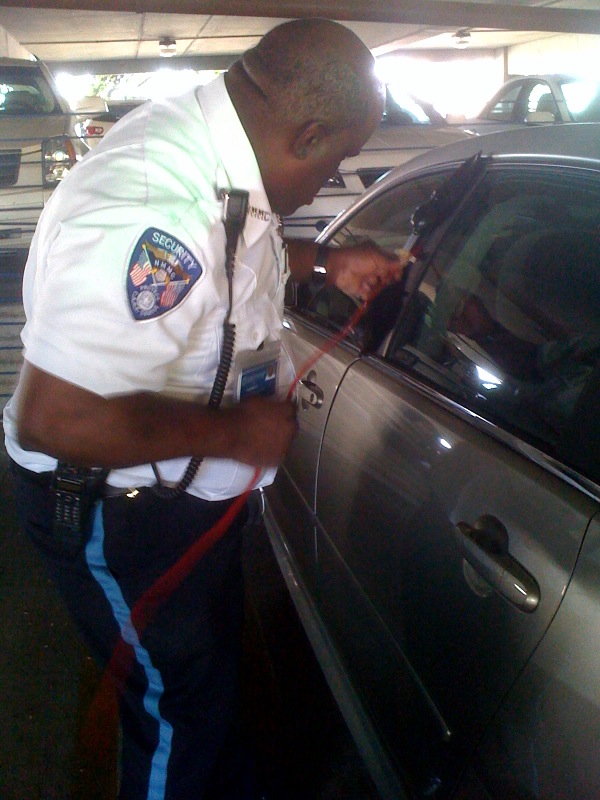
The security agent arrived within 20 minutes, then took an additional five just to get out of his car. It was then I learned that breaking into a locked car is a manual process. My second lesson: The Chevrolet Impala is an extremely secure, tamper-resistant machine. The very warm and friendly man, who assured me he unlocks several cars a day, could not crack this nut. After trying every instrument in his arsenal—including something that looked like a blood pressure cuff—I decided to help. I pressed my face up against the window of the passenger door and navigated him to the well hidden and protected (for a reason) unlock switch: half an inch to the right, an inch down, back up, almost there, bingo! Actually, “Alleluia!” was what I shouted (even in Lent, when the word is taboo). I broke into tears and thanked him profusely. He apologized profusely to taking so long. The third lesson, much like the first lesson, so simple yet so compelling, being nice can change someone’s world.

A genuine Tupelo angel

I won’t bore you with the how the rest of the adventure played out; it’s better to end here.

When I said my bedtime prayers at three o’clock this morning, I gave thanks for Southern hospitality and the many souls—Courtyard Marriott desk clerks, AAA’s Mr. Nice, the two ladies at hospital reception (one of whom ran after me as I was leaving, to give me a hospital note pad) and the security guard, whose name I have already forgotten. May we all take a lesson that we can change the world just by being nice.

2 Comments

Filed under Foibles and Faux Pas, Travel

Jingle warfare

The last two days’ posts were all about phobias and crisis, so maybe it’s time to brighten things up.

Being that I’m one of the few people left on the planet who doesn’t DVR, I still see a fair number of television commercials, or at least hear the jingles in the background. Then I hear the jingles while I’m trying to fall asleep at night.

There was a time when jingles used to be clever and snappy. It didn’t matter if they got stuck in your head. Advertisers ensured the ditties equaled product appeal. We remember that Choo Choo Charlie was an engineer. Good & Plenty candies made his train run. I’m betting you can remember the intervening rhymes. We also knew that if I were an Oscar Mayer wiener, everyone would be in love with me.

In an 2010 interview for Forbes.com, Linda Kaplan Thaler, CEO and chief creative officer of advertising agency Kaplan Thaler Group, said, “A jingle is not successful if you listen to it once and like it. You have to listen to it and want to sing it. Essentially you become the advertiser for the brand.” She’s right.

Lately, though, it seems that ad jingles are spectacularly annoying. I’d bet they clank in the average consumer’s head more persistently than the clever ones. And the fact that the quality of the singing is so much worse makes us want to dig Melanie’s “Brand New Key” out of our record crypts, just so we can find a more grating song to replace the obnoxious jingles echoing in our brains. By the way, “Brand New Key” has always been my nomination for the song most likely to power a psychological warfare campaign to induce surrender by the most stubborn of enemies. But the U.S. military doesn’t consult me on such matters.

I’ll nominate four modern-day jingles for your consideration and you can decide for yourself which would win the Most-Worthy-of-Psycho-Warfare award.

Cast your vote today:

  1. Bisquick
  2. Xfinity
  3. Truvia
  4. NAPA
  5. Other; please specify.

6 Comments

Filed under Marketing/Advertising/PR, Movies, Television and Radio, Music

Comforting words

The Today show yesterday ran a segment on a subject dear to my heart. Entitled “What Do You Say?”, the piece focused on selecting the right words to say to someone experiencing a crisis.

There is no question that it can be awkward to be on the receiving end of bad news from a friend or colleague who has just lost a job or a loved one or is facing a frightening diagnosis or a failing marriage, and then be expected to respond with the right words.

We all mean well, but sometimes we misstep. Many people are natural-born fixers, so they want to say something to fix the problem, make it go away or distract the person from his or her troubles. Others are minimizers; they want to show the person that the problem is minor in the overall scheme of things. Some people find a way to make it about them. We all want to be helpful, but we all don’t have the guidance we need from the experts. Therefore, I applaud Today for getting the subject out in the open.

I began thinking about this 20 years ago, after experiencing a series of personal losses. At my lowest point, one of my closest friends, meaning well, responded, “I guess it just wasn’t meant to be.” That was the last thing I wanted to hear, and yet, she meant to offer comfort. I’m sure I’ve made similar blunders.

That’s when I began paying attention to how we console the ailing. Six years ago, I received training to become a hospice and bereavement caregiver, which turned out to be the most valuable education I’ve received.

If I had to boil all I’ve learned over the years into a few tips, I’d offer the following.

DO say “I’m sorry,” but try to avoid too many other sentences that begin with “I.” In other words, don’t tell the person how hard the news is on you. It might be better to say, “This must be very difficult for you.” It’s about the person in crisis, not about us.

DO offer help, if you are sincere, but be willing to back up your offer with action. If possible, be specific. Perhaps offer to take one’s children for an afternoon, fold a load of laundry or pick up a few things at the store.

DO offer a sympathetic ear, and make yourself available for a visit. Offer to take the person out, but make sure it’s not for the purpose of getting his or her mind off the problem necessarily. A distraction might be welcome, but so might the opportunity to talk. Let the person set the agenda and don’t invite other people who might inhibit candid conversation about the crisis at hand. It can be painful for the person to sit there and pretend nothing’s wrong.

DO listen. Let the person talk and don’t feel that you must always respond with words. Sometimes silence is the best gift.

DON’T say, “I know how you feel.” You might have been in a similar situation, but each person’s circumstances and feelings are different–and deeply personal.

DON’T respond immediately with stories of others you know who have gone through difficulties. If you do, try to avoid sharing outcomes.

DON’T trivialize the person’s troubles. To him or her, it’s everything right now. Don’t point out how things could be worse or that it must be happening for a reason or is part of a plan.

DON’T say any anything that begins with “At least…”

Anyway, these are just a few tips I’ve gathered. Perhaps you have more?

8 Comments

Filed under All Things Wordish, Family and Friends, Health, Movies, Television and Radio