Category Archives: All Things Wordish

grammar, punctuation, usage, spelling, speech

Trivia Wednesday

Welcome to Trivia Wednesday.

Word Nymph has declared this Language Trivia week. Every day of this week, Monday through Saturday, I’m  throwing out a question. If you know the answer or would like to take a guess, do so as a Comment to that day’s post or simply wait until next Monday, when all answers will be revealed. Good luck!

Today’s question:

What is the typographically correct term for the pound sign, or the number sign?

3 Comments

Filed under All Things Wordish

Trivia Tuesday

Welcome to Trivia Tuesday.

Word Nymph has declared this Language Trivia week. Every day of this week, Monday through Saturday, I’ll throw out a question. If you know the answer or would like to take a guess, do so as a Comment to that day’s post or simply wait until next Monday, when all answers will be revealed. Good luck!

Today’s question:

What is the term for the dot placed over the lower case i and lower case j?

5 Comments

Filed under All Things Wordish

Trivia Monday

Welcome to Trivia Monday.

Word Nymph has declared this Language Trivia week. Every day of this week, Monday through Saturday, I’ll throw out a question. If you know the answer or would like to take a guess, do so as a Comment to that day’s post or simply wait until next Monday, when all answers will be revealed. Good luck!

Today’s question:

What two-letter word in English has more meanings than any other two-letter word?

4 Comments

Filed under All Things Wordish

It’s a mad, mad, mad, mad lib

When I was a kid, they didn’t make cars with DVD players in them. Even when my son was little, we never had such a thing in the car.

When we went on long trips, we played games like Twenty Questions, “I went to the supermarket” and a word game called Ghost.

Often when we got to our vacation destinations, and there was no television, we played games. I recall many seasons as a kid in Ocean City, playing Mad Libs. I cut my little word nymph teeth on Mad Libs.

For those who don’t remember, Mad Libs were–still are, I guess–short stories written with blanks in them. The blanks call for certain parts of speech to be inserted in various places in sentences within the story. The person who holds the book asks his or her play mates for nouns, verbs, adjectives, adverbs and exclamations, and occasionally, names of body parts or famous people, which, of course, are provided arbitrarily and without context. After all the blanks are filled, the holder of the book reads the story aloud. Hilarity ensues.

This past Monday, Leonard Stern, co-creator of Mad Libs, died at the age of 88. Amusingly, his Washington Post obituary was written in Mad Lib form:

“As a writer, director and producer, Leonard Stern was a legendary (noun) in show business. He had an (adjective) career that took him to (geographic place) with (celebrity name). Fond of (article of clothing), standing (a number) feet tall with a gray (body part), he (verb) more than a share of (noun), including (liquid).”

I was interested to learn also that Stern was a writer and producer of “The Honeymooners,”  “Get Smart” and a few other classic sitcoms. Apparently, Stern got the idea for Mad Libs when looking for an adjective for a Honeymooners script. He and a friend then began writing stories with blanks in them and took them to cocktail parties; the rest is history.

Yesterday I discovered a website that allows you to play Mad Libs online.*

Maybe on your next family trip to the shore—or at your next cocktail party—you can pull out your iPhone, log in and have a rip-roaring good time.

Rest in peace, Leonard Stern. You were a (adjective) (noun).

*By the way, I tested the Mad Lib-generating website. You can only imagine what I did to Hamlet’s third soliloquy.

4 Comments

Filed under All Things Wordish, Family and Friends, Sports and Recreation

Speaking from the heart

It seems that lately, Mondays are difficult days on which to blog. I imagine they’re also difficult days on which to read blogs. So perhaps I’ve done us all a favor.

My excuse this week? I got in from a trip in the wee hours of Monday morning, after missing a connecting flight and being fortunate to have secured the last standby slot in the last flight back to Washington late Sunday. It was a grueling day following a lovely business-with-pleasure trip, so I tried to keep my spirits high.

Sure, I shot dirty looks to a young mother who smacked her infant for squealing in a gate area. I sighed audibly and walked away when I overheard a couple engaging in senseless political rants. I even snapped just a bit at a gate agent, but later thanked her warmly when she found me that last seat on the plane back home.

That last seat happened to be beside a woman whose husband was in another row. When she asked if I might be willing trade my aisle seat for her husband’s middle seat so they could sit together, I obliged.

I was glad I did. The conversation I had with a gentleman in my row turned out to be so enjoyable that it made nearly three hours pass in a flash. We discovered much in common, including that we both think a lot about words.

He shared that he is making a concerted effort to avoid beginning sentences with “but;” not so much as a matter of grammar, but as a matter of harmony. “But” can erect a wall in a conversation. It can minimize someone else’s point. I found that interesting.

Then he shared a challenge that had been on his mind. I am not sure if he’ll ever read this and, if so, I hope he won’t mind my putting his dilemma out for discussion.

 His stepdaughter is getting married soon and has asked him to give her away, in place of her late father. This man will undoubtedly be called upon, formally or informally, to speak about his role at this occasion, and he wants to have just the right words at hand.

My fellow passenger never met his stepdaughter’s father, but thinks that, based on what he knows of the man, that they might have been good friends. There were even some interesting coincidences. I got the sense he is honored to be asked to step into the role.

I told him about How to Say It, a book that suggests the right words for almost any occasion. I suggested that he simply speak from his heart, express his affection for his stepdaughter and go from there.  I had told him that I have a wide circle of creative and sensitive readers, from whom I learn much nearly every day. While we didn’t exchange contact information, I did give him my blog address.

Based on knowing him for three hours, I have no doubt that John Q. Passenger could speak from his heart quite beautifully on this occasion. Still, I’d love to help him out.

So, on the off chance he finds his way here (and provided he didn’t give up after seeing no post yesterday), may I ask you to share your advice about what he might say, in conversation or perhaps in a toast during the wedding festivities—again, as the stepfather of the bride, who has the honor of walking her down the aisle?

I know you’ll have some good ideas.  Thanks!

4 Comments

Filed under All Things Wordish, Travel

Glaring cast of characters

We’ve talked before about collective nouns. Recently I got thinking about the vast variety of verbiage assigned to collections of animals and insects.

We know that there are herds of cattle, elephants, caribou, antelope (or is it antelopes?) and zebras. We know that are prides of lions.

Did you that a group of rhinos is a crash? How about a troop of baboons, a sleuth of bears or a pod of walruses?

I didn’t know it at the time, but I’ve seen grists of bees and, appropriately, intrusions of cockroaches.

My son sees rafters of turkeys and bales of turtles on the roads where he lives.

I hope that I shall never encounter an ambush of tigers. But while we’re talking felines: What got me thinking about these words was a recent episode of one of my favorite TV shows, The Big Bang Theory. In fact, this whole blog post was a pretext for sharing a clip from this video, the first 50 seconds of which focus on the collective nouns pertaining to large numbers of my favorite domestic creature.

Because I currently have most of my faculties, I have only two, Lucy and Ricky. Who knows, one day I might assemble a full cast: Fred, Ethel, Little Ricky, Carolyn Applebee and Mrs. Trumbull.

4 Comments

Filed under All Things Wordish, Hearth and Home, Movies, Television and Radio

Bedlam

Often when I return from a trip to the grocery store, I report to my husband that the store was “Bedlam.” Bedlam is the most apt descriptor on a Saturday morning, which often is when parents give their spouses a break by taking the kids to the supermarket, parking their carts in the middle of the aisles, ignoring the indoor traffic conventions and letting their young kids run around in circles and climb the cereal shelves. It’s Bedlam, I tell you.

It wasn’t until I reviewed the origins of food names for yesterday’s blog post that I realized how appropriate the term is for the supermarket. Okay, that might be a stretch. But maybe for the bakery.

According to Martha Barnette’s book,  Ladyfingers & Nun’s Tummies: A Lighthearted Look at How Foods Got Their Names, Bedlam has its roots in food; specifically, in bread.

She tells the story in the chapter on Places Named for Foods, right after how Topeka, Kansas, takes its name from “good place to dig potatoes.”

She explains:

From the Hebrew words beth, “house,” and lechem, “bread,” comes from the name of the little town of Bethlehem, or “house of bread,” which, in turn, eventually gave rise to an English word for “crazed confusion and uproar.” In medieval London, the Hospital of Saint Mary of Bethlehem was converted into an asylum for the insane. Over time this grim institution came to be known simply as Bethlehem, then Bethlem and Bedlem, and eventually, Bedlam, which in turn led to today’s term for crazed noisiness and clamor.

She then explains how the word marathon comes from the ancient Greek word for fennel, but I’ve got to end this somewhere.

2 Comments

Filed under All Things Wordish, Food, Reading

Who’s hungry?

Wow, I have this craving for some good bird’s tongue. How about you?

This post is another in the series in which I pull a book out of the stacks and write about it. I hope you’re game.

Fourteen years ago, long before the word nymph in me emerged, or so I thought, a friend and former colleague gave me a book entitled Ladyfingers & Nun’s Tummies: A Lighthearted Look at How Foods Got Their Names, by Martha Barnette, who was once a reporter with The Washington Post. I remember my friend saying he thought the book suited me because of my love of food and words.

Barnette grabs readers of my type with the first sentence of the introduction: “Sometimes the very name of a food tickles our taste buds before a bite of it ever reaches our mouths. Saltimbocca, tiramisu, teriyaki, shabu-shabu, passion fruit, angel hair, soubise, bubble and squeak, chimichanga, couscous – rolling any of these words around on our tongues is a sensory experience all its own.”

Bubble and squeak? Come again? Bubble and squeak comes from the chapter on foods named for what they do while cooking. It’s a potato and cabbage dish that apparently makes noise when it’s frying.

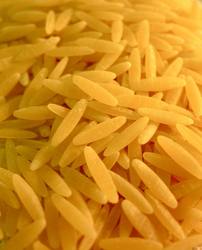
Bird's tongue (orzo)

There are chapters on foods named for what they look like (e.g., bare buttocks in the grass); food names associated with religion or the supernatural (no surprise that there are lots of angels and devils, but also Judas’ ear); foods named by mistake, often as a result of goofs in translation (including German chocolate cake and Jordan almonds); foods named for people and places (the chapter  is called “Edible Eponyms and Tasty Toponyms,” surely a topic for another day); foods named for what’s done to them or what they do to us; and words deriving from other words about food and drink.

Did you know that, In Lebanon, the long rolled pastry known as zunuud as-sitt translates from “woman’s upper arms?” It’s in there.

The book contains hundreds more little-known facts about food names and where they come from. I could stretch this out over several days, and maybe I’ll regret it if I don’t. In the meantime, maybe I’ll give you a little homework assignment.

See if you know—or can find—the recognized food names for the following:

  1. Apple in its bathrobe
  2. Angel’s breasts
  3. Boudoir biscuits
  4. Dad’s beard
  5. Dead fingers
  6. Friar’s balls
  7. Naughty children’s toes
  8. Tipsy parson
  9. Spicy bishop
  10. Whore’s pasta

Want to have some more fun? Look up the origin of pumpernickel.

One final note: my father recently suggested I address the origin of the word “bedlam,” and he traced its origin for me. What I learned from Ladyfingers & Nun’s Tummies, though, is that the word goes back even farther, with its origin in food. Maybe tomorrow?

6 Comments

Filed under All Things Wordish, Food, Reading

Announcement, announcement!

Memorial Day is behind us. White shoes are out of storage, and the celebratory time flanked by this holiday and the next one is upon us. Judging from the fast-rising stack of mail before us, it must be graduation season.

If you don’t mind, I’d like to share a few observations.

Observation #1:  Perhaps my son is right when he says that I am the strictest parent on the planet because, based on every graduation announcement that has come into our house over the last 10 years, my son is the only high school graduate to have addressed his own announcements. My husband and I insisted on it. While we chose not to send announcements when he graduated from college, I am always struck by how many parents address their children’s college graduation announcements, 100 percent, as best I can tell.

Observation #2:  Some people choose to ignore the graduation announcements they receive altogether, though about half send announcements when their children reach graduation age. Personally, receiving these requires a great deal of maturity and restraint on my part. But I send a gift nonetheless. Restraint is equally needed when one receives an announcement for a child one has met only once, or not at all.

Observation #3:  The generosity of those who do send best regards is overwhelming.

Observation #4:  Most graduates send thoughtful thank you notes. Others either send none at all or simply sign a form letter written and typed by their parents.

Observation #5:  A well written thank you note is worth keeping. We can almost predict a graduate’s potential success based on his or her thank you note.

When I receive a thank you note of any kind, I read it once or twice, enjoy it and then throw it away. We received one last year—for a high school graduation gift we sent—that was too good to discard. I kept it in a stack of papers I go through from time to time, just so I can re-read it. It provides heart-warming proof that young people can write thoughtfully and well. Because I like to share good writing on this blog, I’ll share it here:

“Thank you for your card and money for my graduation.  It’s a big step in my life, and I’m glad you took the time to write me a note of congratulation. I’m going to try my hardest to be the best computer engineer at Virginia Tech I can, and am thankful to know my family is close behind me, hopeful for my success. Thank you!”

Parents, I respectfully suggest that you share this with your kids. And for Pete’s sake, consider having them address their own graduation announcements. At a minimum, take a cut of the proceeds for your efforts.

8 Comments

Filed under All Things Wordish, Family and Friends, Holidays, Rants and Raves

For real

The City of Buffalo has long been the butt of jokes. Even my father, who’s from there, used to say that Buffalo came into being when “they cloned Cleveland.”

This week, there are new jokes as Buffalo—The City of Good Neighbors, The Queen City, The City of No Illusions, The Nickel City, Queen City of the Lakes, City of Light—takes on a new motto: “Buffalo For Real.”

I learned about this not from the city’s own announcement, which includes a new tourism video, but from the swell of snickers and criticisms from within Western New York and around the country. The blogosphere bubbles with mockery while Twitter tee-hees abound.

Advertising Age slammed the slogan, calling it meaningless. (But do check out their map of the most absurd city slogans in the United States.) Buffalonians don’t appear to be crazy about it either, but they’ve been quick to come to the defense of their city, as they are often called to do, pointing to the depth of Buffalo’s history and culture. One commenter suggested “Buffalo: Leave for the weather, come back for everything else.” Commenters from other cities were cruel (“Denver: at least it’s not Buffalo”), while others were happy to be out of the spotlight for their own cities’ inane slogans.

But back to Buffalo For Real. If the city’s marketeers had consulted me, I’d have suggested some punctuation. Mabye a comma or a colon following Buffalo. On the surface, “Buffalo For Real” does sound a little meaningless. But if you look at the campaign, there’s a broader theme: Buffalo for art, Buffalo for architecture, Buffalo for families, Buffalo for food, for nature, for history, for shopping, for sports, for performing arts. The tourism video addresses the “real” part. The narration holds the city’s past troubles and blemishes up to the light and assures visitors of the vast rejuvenation taking place. “We’ve had our share of hard knocks.” “Some might say that time has left our town behind.” “Neighborhoods given up for dead are being given new life.” Even the snow has an honored place in the script.

Juxtaposed against tourist destinations in which weather is the draw, with little authenticity behind sun and spa, Buffalo stands out as real. Blue collar and white collar workers alike have withstood decades of economic devastation and year after year of bone-chilling temperatures. The people remain ever cheerful, trust me. The city by Niagara Falls has a lot to be proud of.

I like the new slogan. I just wish the video had been narrated by someone with a Buffalo accent.

Now that would be real.

3 Comments

Filed under All Things Wordish, Marketing/Advertising/PR, Technology and Social Media, Travel