Category Archives: All Things Wordish

grammar, punctuation, usage, spelling, speech

Ironic, my dear Watson

Perhaps you have read the news that in February, for the first time ever, a computer will compete on Jeopardy!

You might remember when an IBM computer beat chess world champion Garry Kasparov in a six-game match in 1997. IBM’s latest challenge was to build upon that feat by taking technology to an even more difficult and complex level—building a computer that processes natural language, complete with humor, irony and sarcasm, as well as nuances, regionalisms and slang.

Having apparently met that challenge, Watson will compete against Jeopardy! champions Ken Jennings and Brad Rutter February 14 through the 16, 2011.

The computer, named Watson after IBM’s founder, was developed by technologists and researchers from around the world.

While its debut on Jeopardy! will make a big splash, the goal of the technology is ultimately to forge more advanced communication between humans and computers. This goal undoubtedly will harvest scientific and societal benefits in fields ranging from healthcare to customer service.

However, I cannot help wondering what practical applications Watson might offer if ever the technology became available at the consumer level.

How long before the next software release coming out of Redmond, Washington, will include Microsoft Irony, an application to detect, interpret, even insert rhetorical nuances in interpersonal and corporate communications?

Could Watson displace humor columnists and language bloggers? Will we turn on our televisions and see Watson sitting behind Andy Rooney’s desk on 60 Minutes?

If you were a member of IBM’s global research team, what real-world application would you be itching to create for Watson? Or, as a consumer, what application would you want available for purchase?

Personally, I am hoping Watson will be smart–and courageous–enough to tell Jeopardy! clue-writers to put the periods and commas inside the quotation marks, where they belong.

89 Comments

Filed under All Things Wordish, Movies, Television and Radio, Technology and Social Media

Sentimental greeting

How long have you had your current voice mail greeting?

I just realized we have had the same greeting on our home phone for 15 years. Isn’t it about time we changed it?

There are three distinct and definitive reasons we should. One, it mentions Monica, Marty and Joseph. Joseph hasn’t lived here since 2006. Two, Joseph hasn’t been called Joseph since 1995. Three, the greeting contains a grammatical error.

It says, “You’ve almost reached Monica, Marty and Joseph but since you didn’t, leave us a message…” the word “since” is incorrect here. The correct word is “because.” I knew that but, as many are prone to doing, I continue to fall into sloppy habits. Guilty as charged.

“Since” is often used interchangeably with “because,” but not correctly. “Since” relates to the time passed from one period of time to another:  He has been chairman of the board since 1995. I have not seen him since Saturday.

Still, I am sentimental about the greeting. It’s the first greeting I recorded after getting voice mail service through the phone company, replacing the old fashioned answering machine.

Back when we had the old machine, we used to change our greeting often, tailoring it for the season or current events. Now, I just can’t do it.

There’s no way to preserve for posterity this greeting that served us well for 15 years, poor word choice and all. Plus, I can’t imagine representing our family any way but Monica, Marty and Joseph. Joseph is Joe and Joe is gone. No one leaves him messages at this number any longer.

I’d love your suggestions for a new greeting, since—er, because—I am facing a mental and emotional block.

4 Comments

Filed under All Things Wordish, Family and Friends, Hearth and Home, Technology and Social Media

So…what’s your grievance?

It was reassuring to read comments on yesterday’s Word Nymph post about “so” versus “as,” showing that I am not enacting grammatical laws in my sleep.

One comment in particular conjured up another peeve of mine. In this season of Festivus, during which we air our grievances, I thought it might be apt to share it.

 The commenter said: “Where ‘so’ so annoys is its use as a filler word to begin a conversation, as if the subject were already under discussion. This dandy device is headed for trouble. It’s the next ‘like.’”

I agree. I can also relate. My husband often begins a conversation with “But.”

This got me thinking of an emerging pattern of speech I’ve noticed in recent years, stemming from what I’d call stopaphobia, or fear of ending a sentence definitively. Whereas the commenter notices “so” in the beginning of a conversation, I notice “so” at the end of a sentence. I haven’t seen this in written form, but it’s becoming common in spoken sentences. People just don’t want to finish a sentence with a firm period, opting to end instead with an ellipsis. Here’s an example:  “I work as a manager at IBM, so…” 

The trailing  “so” seems to go hand in hand with the trailing “or” at the end of a question. Listen for it and I swear you’ll hear it everywhere. “Are you staying in town for the holidays or…?” Meredith Vieira does this in interviews a lot. It’s not just the teeny-boppers.

Let me know if you notice this, but don’t hate me if it then drives you crazy. It’s just the plight of the wordie.

Finally, in the spirit of Festivus, and because this time of year might have us tied up in knots with excess fury to burn, feel free to lay your peeves here. Get them off your hyperventilating chests. It’s safe, so…

13 Comments

Filed under All Things Wordish, Holidays

Say it’s so

There is a rule of grammar I learned long ago and practiced for years. Now I am doubting its existence because I can’t locate it anywhere. It has to do with comparative adjectives, using the word “as.”

For example: “She is as nice as her sister.”

I was taught—or so I thought—that, when the sentence is stated in the negative, “as” becomes “so.” For example, “She is not so tall as her brother.”

It seems either I dreamt this rule or it has disappeared from modern language. I am away from home, so I don’t have my arsenal of style guides and manuals handy. A cursory search of online sources appears to prove me wrong.

Can anyone verify whether “so” was ever correct when used in the negative? I heard a host of 60 Minutes use  “so” comparatively just last Sunday. The interview was on in the background, but my ears perked up because I had been contemplating this issue lately. I’d be grateful if someone could set me straight or at least bring me up to date.

Contemplating the comparative does stir two peeves within me.

The first is when a speaker follows the comparative with an objective, rather than a subjective pronoun:  “She is old as us,” rather than “she is as old as we.” The “are” is implied. The night before last, I was comforted to hear Tony Bennett use the subjective pronoun correctly, through the speakers of a restaurant:  “I wanna be around to pick up the pieces when somebody breaks your heart, somebody twice as smart as I.”

The second has to do with comparing two or more persons or objects. It’s fundamental, but perhaps calls for a refresher. When comparing two, the suffix “er” is used. Here, if a modifying adjective precedes the comparative adjective, “more” is used.  For example: “John is the taller of the two boys.” Or “John has more children.”

When three or more nouns are being compared, the superlative comes into play. In this case, “est” is the suffix. “Mary is the eldest of the three sisters.” Or “Mary has the most freckles.”

If you have two children, you don’t refer to one as your oldest or youngest.

Notice I ended with the comparative rules about which I am most certain. In the meantime, the first—“so” versus “as”—will continue to gnaw at me. Anyone?

4 Comments

Filed under All Things Wordish

Secret Santa, Esq.

I seem to have received an anonymous gift in the mail and I am hoping I can use this forum to coax the giver into coming forward.

A few days ago, I found in my mailbox what appears to be a gift subscription to Esquire, one of my favorite magazines. I don’t currently subscribe but I delight in picking up an issue now and then at the airport. If this is indeed a year’s subscription, I’ll be thrilled.

Come to think of it, I’m afraid I recently threw away a piece of mail from Esquire, presuming it pertained to a gift subscription I gave someone else some time ago. So, Secret Santa (or Birthday Elf), if your kind gift came with a gift subscription card, please know that I stupidly trashed it and have no idea who you are. Any information leading to the identity of this thoughtful person will be rewarded by a humble, handwritten thank you note.

You may be wondering why I like Esquire in the first place. It’s a men’s magazine. In addition to enjoying the fashion ads and well-written articles about interesting political and international hot topics, I enjoy reading a man’s perspective on interpersonal relationships.

I especially enjoy the writing style of Esquire writers, finding it complements the other periodicals I read.

The January issue had me at Man at His Best (MaHB)’s The Vocabulary. A little sidebar lists words and phrases a man should never say—little boys’ room, among them. Euphemism of the Month is worth the price of subscription.

The issue includes an extensive piece on The Meaning of Life, which taps the minds of entertainment and political figures about what they’ve learned over the course of their interesting lives. I haven’t gotten to this yet, but I look forward with anticipation to reading what Robert DeNiro, Robert Duvall, Aaron Sorkin, George H.W. Bush and even Dr. Ruth Westheimer–and others–have to share.

Try getting the meaning of life from People.

I can’t wait for February.

Leave a comment

Filed under All Things Wordish, Holidays, Movies, Television and Radio, News, Reading

Morpheme drip

On October 15, National Dictionary Day Eve, I came out with my confessions of being a dictionary dweeb. Since then I have received a variety of dictionaries from some thoughtful readers. One day soon, we will get into A Dictionary of Slang and Unconventional English, which I received from a reader in Alaska (make of that what you may; we’ll need to see if “refudiate” is listed).

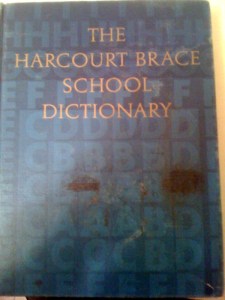
In the 10/15 post, I recalled the first dictionary I ever had, The Harcourt Brace School Dictionary, which I used in the fourth through sixth grades. I thought I had it around here somewhere but it was not be found among my childhood artifacts. I will say it again, I loved that dictionary. And yesterday I discovered that everything I know about grammar, spelling and word usage came from that primer. Which explains a lot.

My mother sent me the old dictionary for my birthday. It still smells the same as it did in 1970.

It seems that, when I went on to junior high, I passed the Harcourt Brace on to my younger brother, who wrote his name in it three times, along with a phone number and a note that said, “If not home, call back in 2 or 3 hours.”

Prior to that I had doodled all over the cover and inside pages. My friends had scribbled,  Monica loves XXX, several times, and I had crossed out all the XXXes. There were small illustrations near some of the definitions, where I had written the names of people I didn’t like. One illustration is of a peccary and, even today, I couldn’t have told you what a peccary is without consulting the definition: either of two wild animals of tropical America, like pigs with sharp tusks. I won’t say whose name I wrote under that.

The real nuggets are found on the first 65 pages, before the definitions of words beginning with A.

Pronunciation keys, spelling charts, abbreviations, basic dictionary skills, age-appropriate etymologies, parts of speech, idioms, they’re all in there, along with a section on Spotting the Troublemakers. There are sections on variant spellings and pronunciations, regional pronunciations and British and American spellings.

It’s good to know that during these years, I wasn’t spending all my time reading Tiger Beat and pinning Bobby Sherman and David Cassidy posters up on my walls.

So class, who can tell me what inflectional forms are? The inflectional forms of a word are forms changed by adding a morpheme. What’s a morpheme? I need a refresher myself. I can’t even make out Wikipedia’s explanation. Expect a post on morphemes soon. Perhaps you’d like to write it.

Leave a comment

Filed under All Things Wordish, Family and Friends, Reading

To the letter

I don’t know about you, but I sense an uncomfortable tension between traditional etiquette and contemporary reality. Nowhere is it more palpable to me than on a Christmas card envelope.

Every year I find different ways of reconciling my respect for proper etiquette with the realities of modern relationships. Last night, the tension kept me awake, as I revisited hundreds of envelopes in my head.

One of the virtues of etiquette is that it gives us clear rules and bright lines between what is proper and what isn’t. I do try to adhere to these, as it saves me from making erroneous judgment calls.

However, the rules were written at a time when households were composed of traditional relationships, typically, a mister and a missus and some children.

One rule I follow strictly is placing a prefix before a name. I’d never address a letter to “John and Mary Smith.” Never. Etiquette calls for “Mr. and Mrs. John Smith” and I follow that.

I’d also never address a birthday card to “Mary Smith.” But here’s where it gets a little dicey. In the old days, the proper way to address a letter to Mary would have been “Mrs. John Smith.” Nowadays, I’d be inclined to write “Ms. Mary Smith,” especially if Mary were on the younger side. But never “Mrs. Mary Smith,” though that has become accepted.

Our Christmas card list is made up of all sorts of exceptions to the rule. This is worth celebrating, because it shows the rich diversity of our friends, their professional accomplishments and living situations.

But therein lies the tension. What if the husband is a mister but his wife is a doctor? Or the wife uses her maiden name? Does one address a couple as “Mr. and Dr.?” No, because etiquette requires use of the husband’s name, so it doesn’t match up:  “Mr. and Dr. John Smith” is incorrect because John isn’t the doctor; Mary is. If the two went by the same last name, then it would be “Mr. John Smith and Dr. Mary Smith.” If Mary uses her maiden name, then it would be “Mr. John Smith and Dr. Mary Jones.” One line or two?

What about a same-sex couple? One wouldn’t say “Mr. and Mr. Baxter” if they don’t share a last name. Even so, whose first name would be used?  What I do is put one person’s name on the first line, usually the one I know better:  Mr. William Brown and Mr. Robert Green. Or both names on the first line if they fit. 

What if one member of the couple has a military title but the two have different last names? Or what if they share a last name but the woman is the military officer? Mr. and Captain? Who, the man or the woman? What if one is a judge?

When addressing a family, I typically address the envelope to “The Nelson Family” (even when the family is one parent and one child) and inside say “Dear Richard, Martha, Bobby, Billy and Betty, comma. Notice I said “Dear.” That’s how letters and cards are addressed. Not “Richard, Martha, Bobby, Billy and Betty.” Let’s not let “Dear” fade away. Please.

In addressing my cards, I encountered instances in which I did not know all the children’s names. Lacking clear guidance, I simply said, “Dear Richard, Martha and family.” Tacky, I know, but that’s all I knew to do.

As an empty-nester, I pondered whether or not to sign my son’s name to our card. I probably shouldn’t have, but I did. What if the addressees’ children have left the nest? Are their names included any longer?

These issues weighed heavily on my mind at three o’clock this morning. The cards are going in the mail today, so there’s not much I can do this year. Next year maybe I’ll keep the rules handy with the master list.

I don’t hear anyone else worrying about these issues. Am I alone in my tension? I suspect the people who wear white shoes and pants between Labor day and Memorial Day will say that times have changed and we should just do whatever is easier. And truly, dropping prefixes and titles is easier. But I can’t do it. I am conditioned for convention, predisposed toward politesse. And sleepy.

Thoughts?

4 Comments

Filed under All Things Wordish, Family and Friends, Holidays

High on music

When I started this blog, I set out to share periodically words of the good writers, including song writers.

Yesterday I heard an old favorite on the radio and, as I was alone in a well sealed car, I sang loudly along.

John Denver wasn’t among my favorite artists growing up–I don’t think he was much of a singer–but I have always admired him as a song writer. There are a few of his songs I’m not particularly fond of, but there are many more that are outstanding and have endured over the decades.

I do miss the guy. I wonder, if he hadn’t died so young, what inspiring works he might have created as he matured.

My favorite John Denver song is “Rocky Mountain High.” I can’t say why exactly, as I’m not as moved by the outdoors as many people are. I’ve seen the Rockies and they’re lovely. But it’s just not my scene. Either way, musically and poetically, it’s a beautiful song.

“Rocky Mountain High” came out about the time my good friend Cathy moved to Boulder. Cathy would be the first of us to see the Rockies, while the rest of us knew about them only from the song.

Each time I hear it, I hear something new in the lyrics. There was some controversy when the song first came out and the FCC tried to have it banned from the air for its possible drug reference. It has been written that Denver explained publicly—including in congressional hearings—that the “high” was simply the sense of peace he found in this mountain setting.

No matter, Denver can paint a picture with simple words and phrases that are easy to sing along to. I am a terrible singer, but don’t hold back in the car. Yesterday I was thrilled, after months of effort to heal my lungs, to be able to hold those long notes as long as John Denver did, even though I know I sounded awful. That’s the beauty of a Bose nine-speaker sound system that can drown out its owner.

Here, you try it. This isn’t the best version vocally, but the only other clip I found omitted my two favorite verses.

Rocky Mountain High
Words by John Denver; Music by John Denver and Mike Taylor

He was born in the summer of his 27th year
Comin’ home to a place he’d never been before
He left yesterday behind him, you might say he was born again
You might say he found a key for every door

When he first came to the mountains his life was far away
On the road and hangin’ by a song
But the string’s already broken and he doesn’t really care
It keeps changin’ fast and it don’t last for long

But the Colorado rocky mountain high
I’ve seen it rainin’ fire in the sky
The shadow from the starlight is softer than a lullaby
Rocky mountain high

He climbed cathedral mountains, he saw silver clouds below
He saw everything as far as you can see
And they say that he got crazy once and he tried to touch the sun
And he lost a friend but kept his memory

Now he walks in quiet solitude the forest and the streams
Seeking grace in every step he takes
His sight has turned inside himself to try and understand
The serenity of a clear blue mountain lake

And the Colorado rocky mountain high
I’ve seen it rainin’ fire in the sky
You can talk to God and listen to the casual reply
Rocky mountain high

Now his life is full of wonder but his heart still knows some fear
Of a simple thing he cannot comprehend
Why they try to tear the mountains down to bring in a couple more
More people, more scars upon the land

And the Colorado rocky mountain high
I’ve seen it rainin’ fire in the sky
I know he’d be a poorer man if he never saw an eagle fly
Rocky mountain high

It’s Colorado rocky mountain high
I’ve seen it rainin’ fire in the sky
Friends around the campfire and everybody’s high
Rocky mountain high

1 Comment

Filed under All Things Wordish, Music

Lest I stumble

My apologies for being late with the blog today. I got lost.

After hearing how much I’d been enjoying the Pandora app on my iPhone, my son suggested something else he thought I’d like: StumbleUpon.com.

For those who have not yet stumbled on it, this service takes subscribers to Web sites, blogs and videos based on what it knows about them. Like Pandora, what StumbleUpon knows about you is based on a little info you provide up front as well as the thumbs up or thumbs down rating you give each site. And, like Pandora, it’s free.

StumbleUpon is described as a discovery engine that uses collaborative filtering and smart recommendation technology. Okay, then.

When I signed up, I provided only some general information about my topics of interest but chose not to fill out a customized profile, detailing everything from my height (5’4”) and Myers Briggs personality type (ENFJ) to my astrological sign (Sagittarius) and political leaning (anarchist; just kidding but that was an option).

I decided I’d first put in only the general information and see where it took me.

The first place the service stumbled upon was a Flickr video of a kitten riding on a turtle.

After that, it directed me to:

  • A site called “belly bites” and specifically to a post on “29 healthiest foods on the planet” (Note to self: tell the system I don’t like titles appearing in lower case letters)
  • Naturopathyworks.com, and an article on food cravings, including a chart that tells you, “If you crave this…” then “What you really need is…” and “Healthy foods that have it”
  • A Flickr recipe for Warm Toasted Marshmallow S’more Bars
  • Another Flickr recipe for Mint Chocolate Chip Cookies. They’re green and look disgusting. Thumbs down.
  • An article in The Globe and Mail:  “Thinness—and female unhappiness—is big business”
  • A Wikipedia entry on the “Neuroscience of Free Will”
  • Quotes from Albert Einstein
  • 15 Palindromes
  • True Stories Told in One Sentence. Thumbs up; I shall return to this one.

Finally, while I discern what all these hits say about me, I will leave you with the last one. I had trouble figuring out where it came from. It simply told a story:

“Girls are like apples on trees. The best ones are at the top of the tree. The boys don’t want to reach for the good ones because they are afraid of falling and getting hurt. Instead, they just get the rotten apples from the ground that aren’t as good, but easy. So the apples at the top think something is wrong with them, when in reality, they’re amazing. They just have to wait for the right boy to come along, the one who’s brave enough to climb all the way to the top of the tree.”

If StumbleUpon makes me six hours late for posting my daily blog, some self discipline will be in order. Maybe Wikipedia has something on the Neuroscience of Will Power.

1 Comment

Filed under All Things Wordish, Food, Health, Technology and Social Media

How to write it

This is Part Three of a three-part series on writing. The series incorporates stated views of several well-known writers and their observations about the craft.

Over the last two days, we have commiserated with some of  the world’s noted writers in confronting the difficulties of writing and we have read their reasons for writing.

Today, we’ll wrap up the series by pretending to ask them for advice on what makes good writing. Here’s what they said:

Stephen King – “Write with the door closed, rewrite with the door open. Your stuff starts out being just for you, in other words, but then it goes out.”

King also said that, “In truth, I’ve found that any day’s routine interruptions and distractions don’t much hurt a work in progress and may actually help it in some ways. It is, after all, the dab of grit that seeps into an oyster’s shell that makes the pearl, not pearl-making seminars with other oysters.”

Mark Twain suggested, “Substitute ‘damn’ every time you’re inclined to write ‘very;’ your editor will delete it and the writing will be just as it should be.” 

Twain also said word choice is critical: “The difference between the right word and the almost right word is the difference between lightning and a lightning bug.”

Anton Chekhov  — “Don’t tell me the moon is shining; show me the glint of light on broken glass.” 

Baltasar Gracián – “A synonym is a word you use when you can’t spell the other one.”

Jean-Luc Godard – “A story should have a beginning, a middle and an end… but not necessarily in that order.”

I find this final quote relevant to modern day writing. In the following passage, substitute the word “diaries” with “blogs” and you’ll see what I mean:

Ann Beattie — “It seems to me that the problem with diaries, and the reason that most of them are so boring, is that every day we vacillate between examining our hangnails and speculating on cosmic order.”

Once again, would you care to share writing techniques that work for you?

See you Monday.

Leave a comment

Filed under All Things Wordish, Quotes, Reading