Tag Archives: writing

The ol’ stumble-and-whinge

The results are in. Most readers who commented on “To niggle or not to niggle?” expressed support for continuing to niggle and whinge over language misuse and abuse.

They said, “Continue to niggle.” “Niggle away.” “Niggle on.” “Go forth niggling boldly.”

I interpret this as a mandate and, hence, won’t declare Word Nymph a whinge-free zone just yet. I will, however, refrain from attributing poor communication to broad classes, including The Young People or These Kids Today, as some word blogs do, though I reserve the right to point out generational trends for instructional purposes only. (How’s that for a run-on sentence?) Besides, many of my readers are young people who are far more literate and articulate than I.

Thankfully, StumbleUpon.com, which knows my interest in writing, placed a timely post in my path. I not only stumbled on it, but nearly fell on my face upon reading it.

English teachers and fellow wordies:  take out your red pens and go to work on this one, from a blog called Stepcase Lifehack. Whinge away, my friends. Niggle on.

Fifty (50!) Tools which can help you in Writing – Roy Peter Clark from Poynter Institute has posted up 50 tools that can help you when you do any kinds of writing. This is a extensive list of writing tools, but by no mean you need to apply all of them when you do any writing.”

The writer follows this up with “Links of 50 Writing Tool.”

We might have to visit Stepcase Lifehack again.

6 Comments

Filed under All Things Wordish, Technology and Social Media

To niggle or not to niggle?

A recent glance at a language blog stopped me in my tracks as I contemplated where I’d like my own language blog to go in the New Year.

In his December 30 post, The Baltimore Sun’s John E. McIntyre, a language blogger, resolved to not nitpick when it comes to the grammatical missteps of others. In essence, he vowed to stop doing many of the things I and those who comment on Word Nymph do on a regular basis. This made me feel a little sheepish.

McIntyre said he’d no longer “whinge” about how young people speak and write these days or lament the decline of the English language. Further, he resolved to stop making or contributing to lists of grammatical pet peeves. Alas, he appears to be a bigger person than I. I just recently engaged my readers in contributing to piles of peeves.

There was one resolution that got my attention “I will not assume that everything Miss Thistlebottom or Sister Scholastica told me about grammar and usage when I was a mere tot is permanently and universally valid.”

I confess that, in my own writing, I often draw on rules I learned in grade school, lessons I seldom questioned and have forever heeded to the letter. I do consult other sources as needed, to verify my understanding of the rules, especially when I am discussing them here.

On one hand, McIntyre appears to be suggesting that we honor the English language as it continues to evolve and not revere ancient laws as ultimate truth. I’m not sure I’m ready to do this. I’m not ready to welcome into accepted practice those errors—many intentional—that have crept into our language so invasively that to oppose them is just too much of a burden. The path of least resistance, in a sense.

On the other hand, he appears to hold dear the virtues of proper speech and writing. I like his New Year’s toast: “Lift a brimming glass at midnight and drink to the hope that in the coming months we will all speak and write with more accuracy, clarity, force, and grace.”

Perhaps what he is saying is that, as writers and speakers, we should continue to uphold our personal standards, while exploring new and clever ways of expressing ourselves, but not judge those who do not.

I agree with this in theory. However, if I follow McIntyre’s worthy example, I am afraid I will have little left about which to write in the New Year.

I never intended to be the grammar police or a word Nazi; I prefer to have fun with language, pointing out interesting rules I am still learning and coming up with interesting ways of remembering them. At the same time, it’s also nice to have an outlet.

This is as much your blog as it is mine. Where do you think we should take it?

13 Comments

Filed under All Things Wordish, News, Reading, Technology and Social Media

Literary lunacy

I don’t read a lot of books. Maybe two a year, three at the most.

Don’t get me wrong. I love to read, but it takes me a long time to finish a book. For one thing, I read slowly and, when I am really enjoying a book, I go back and re-read sections, just to wallow in the setting or absorb the dialogue. I like to live in a book and, as with a good movie, I carry the story around with me a while before moving on to the next one.

Also, because I travel a good bit and don’t own a Kindle or a Nook, I find some books too bulky to carry on a plane.

This weekend, after three months, I finally finished The Help by Kathryn Stockett. It is her first novel, which is hard to believe, given the maturity of the story and the real-ness of the characters.

The story takes place in Jackson, Mississippi, in the early 1960s. It is about a community of maids and the women they serve. The chapters are written from the perspectives of different characters, so it took some skill to make the technique work as beautifully as it did.

I won’t say anything more because I want you to read the book, but I would like to share two sentences I especially liked and returned to several times. The character is describing an error she made in a newsletter, which resulted in widespread negative consequences but had reflected her true feelings, as if perhaps she had done it deliberately.

“…it was like something cracked open inside of me, not unlike a watermelon, cool and soothing and sweet. I always thought insanity would be a dark, bitter feeling, but it is drenching and delicious if you really roll around in it.”

I am going to miss those women, but they’ve left me with a whole new outlook on insanity – why fight it?

5 Comments

Filed under Reading, Travel

How to write it

This is Part Three of a three-part series on writing. The series incorporates stated views of several well-known writers and their observations about the craft.

Over the last two days, we have commiserated with some of  the world’s noted writers in confronting the difficulties of writing and we have read their reasons for writing.

Today, we’ll wrap up the series by pretending to ask them for advice on what makes good writing. Here’s what they said:

Stephen King – “Write with the door closed, rewrite with the door open. Your stuff starts out being just for you, in other words, but then it goes out.”

King also said that, “In truth, I’ve found that any day’s routine interruptions and distractions don’t much hurt a work in progress and may actually help it in some ways. It is, after all, the dab of grit that seeps into an oyster’s shell that makes the pearl, not pearl-making seminars with other oysters.”

Mark Twain suggested, “Substitute ‘damn’ every time you’re inclined to write ‘very;’ your editor will delete it and the writing will be just as it should be.” 

Twain also said word choice is critical: “The difference between the right word and the almost right word is the difference between lightning and a lightning bug.”

Anton Chekhov  — “Don’t tell me the moon is shining; show me the glint of light on broken glass.” 

Baltasar Gracián – “A synonym is a word you use when you can’t spell the other one.”

Jean-Luc Godard – “A story should have a beginning, a middle and an end… but not necessarily in that order.”

I find this final quote relevant to modern day writing. In the following passage, substitute the word “diaries” with “blogs” and you’ll see what I mean:

Ann Beattie — “It seems to me that the problem with diaries, and the reason that most of them are so boring, is that every day we vacillate between examining our hangnails and speculating on cosmic order.”

Once again, would you care to share writing techniques that work for you?

See you Monday.

Leave a comment

Filed under All Things Wordish, Quotes, Reading

Why write it?

This is Part Two of a three-part series on writing. The series incorporates stated views of several well-known writers and their observations about the craft.

If yesterday’s topic piqued your interest in coaxing out your inner writer—and especially if it didn’t—you might be inspired by the words of noted writers of the last few centuries.

Given the opportunity to ask them why they write or what they get out of the writing process, this is what they would say. Perhaps at least one of these will appeal to you:

E.L. Doctorow – “Writing is a socially acceptable form of schizophrenia.”

Lord Byron – “If I don’t write to empty my mind, I go mad.”

Kingsley Amis – “If you can’t annoy somebody, there is little point in writing.”

Jules Renard – “Writing is a way of talking without being interrupted.” 

Gloria Steinem – “I do not like to write – I like to have written.”

Apparently, writing isn’t always deliberate for songwriter Joan Baez. I suspect other writers can relate to the inspiration she describes: “It seems to me that those songs that have been any good, I have nothing much to do with the writing of them. The words have just crawled down my sleeve and come out on the page.” 

Tomorrow we will take tips from Mark Twain, Anton Chekhov, Stephen King and others as they describe their techniques for producing good written works.

In the meantime, I’ll ask anyone who cares to answer:  Why do you write?

1 Comment

Filed under All Things Wordish, Quotes, Reading

Just write it

This is Part One of a three-part series on writing. The series incorporates stated views of several well-known writers and their observations about the craft.

After 25 years of writing for business, I started Word Nymph as a place to practice writing for pleasure. You have been patient and gracious guinea pigs.

At key intervals—one month online or the 100th blog post—I have reflected on the lessons I’ve learned. The effort has been underway for about eight months now, with my 200th entry appearing this weekend.

I have never written a book, and likely never will, but I’ve often thought I’d like to give it a try. Nonetheless, I do pay attention to what authors, playwrights and songwriters have observed about the writing process.

American novelist Philip Roth (Goodbye Columbus) was interviewed recently while promoting his new novel, Nemesis. Vanity Fair’s John Heilpern asked Roth, “Do you find writing difficult?” Roth responded, “I find it arduous and un-doable. It’s laden with fear and doubt. It’s never easy—not for me.” I imagine that creative juices, a sharp personal discipline and handsome advances eventually help one over the hurdles.

Even as an amateur blogger, I find I can relate to the observations of a few of the writing maestros:

Stephen King, from his book On Writing: A Memoir of the Craft – “The scariest moment is always just before you start.”

Sharon O’Brien – “Writing became such a process of discovery that I couldn’t wait to get to work in the morning.  I wanted to know what I was going to say.”

James Michener – “I’m not a very good writer, but I’m an excellent rewriter.”

John Osborne“Asking a writer what he thinks about criticism is like asking a lamppost what it feels about dogs.”

Over the next couple of days, I’d like to share insights from other famous writers, including why they write and their techniques for good writing.

Perhaps you have thought of doing more writing. Have you been carrying around a novel idea in your head, or did you read or watch Julie & Julia and think to yourself, I could do that? There’s only one way to find out. Do it.

Don’t be daunted by the comments of Walter Wellesley “Red” Smith, who said, “There’s nothing to writing. All you do is sit down at a typewriter and open a vein.” Or  Gene Fowler, who said, “Writing is easy:  All you do is sit staring at a blank sheet of paper until drops of blood form on your forehead.” 

Just come back tomorrow and Saturday for goodies to put in your writer’s toolbox.

4 Comments

Filed under All Things Wordish, Quotes, Reading

’Tis taboo

If my September 25 post reminding you that you only have three months to write your holiday letter didn’t send you straight to the keyboard, that’s good—because I’ve found a great set of tips for how not to write your letter.

I am not biggest fan of Christmas letters, and yet I can’t refrain from writing them. What’s more, I can’t keep myself from slipping into what I know are bad habits. In my 2006 letter, I actually listed all the things I felt people shouldn’t say in a holiday letter, mostly because they are cliché or cover topics in which only the writer is interested. Then I turned around and used one.

In my opinion, the most cliché way to open a holiday letter is by asking, “Where has the time gone?” or “Where did the year go?” I also prefer to omit unseemly medical conditions that might spoil a reader’s cup of Christmas tea. A letter we received one year actually contained the words “rectal prolapse.”

I could go on and on but I will let John E. McIntyre of The Baltimore Sun do it for me – and more eloquently at that. In a recent blog piece, McIntyre offers tips for making a letter less cheesy than it might be. He suggests refraining from any and all holiday metaphors, analogies and parodies of the Twelve Days of Christmas. He also reminds us that the 12 days begin on Christmas and run through January 6th. This is especially important to me, not just as a Christian but also because my birthday falls 12 days before Christmas, and I’d like a little time to celebrate the occasion (and observe Advent) before the big day hits.

McIntyre also helpfully points out that, while Hanukkah comes close to Christmas, “they are not twins.” Nevertheless, is it still all right for me to use my holiday card to wish a happy Hanukkah to all my Jewish friends?

He advises letter writers to avoid ‘Tis and ‘Twas and to back away from the Dickensian: “No ghosts of anything past, present or future. Delete bah and humbug from your working vocabulary. Treat Scrooge as you would the Grinch, by ignoring him. Leave little Tiny Tim alone, too.”

If you’re interested in cutting the cheese from your holiday letter, then before you put pen to pad, or fingertips to keyboard, try heeding John McIntyre’s advice. I promise to do the same.

1 Comment

Filed under All Things Wordish, Family and Friends, Holidays

Hefty and handy

I don’t know how many will share my enthusiasm, but I just found something to really sink my teeth into—though if it were a sandwich, I’d have trouble getting my teeth around it. It’s that big.

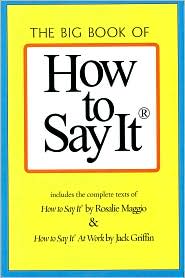
It practically jumped right out of the Border’s bargain bin into my welcoming arms. Nearly three pounds and 890 pages of meat. It’s called The Big Book of How to Say It. You may already know it; it’s been out for 12 years.

Of course, the title caught my eye. At first, I took it for another tome for word geeks. Actually, it’s two tomes, How to Say It by Rosalie Maggio and How to Say It At Work by Jack Griffin.

Cringe not; this book has little to do with grammar and everything to do with writing and speaking one’s mind in the most thoughtful, personal and effective way—under almost any practical social or business scenario.

The Big Book is also not an etiquette book. While offering suggestions on the most appropriate way to express one’s thoughts, the focus is on choosing the right words and tone for the occasion, customized for the addresser and addressee alike.

I immediately bought it for a special someone for Christmas. Now I’m reluctant to give it up. There are more than 60 chapters dealing with everything from expressing (and accepting) a simple condolence to applying for a job, and 58 topics in between. Each chapter includes several options for “How to Say It” as well as “What Not to Say.”  There’s also a mini-thesaurus in each chapter, along with handy writing tips to suit the situation.

Apologies. Holiday letters. Complaints. Job terminations. Negotiating a promotion. Renegotiating a deadline. Accepting a compliment. Taking criticism. Handling a snafu. Agreeing to a drug test. Announcing the cancellation of a wedding. It’s all there.

As a bonus , in one of the chapters dealing with getting a job, there’s a whole section on How to Say it with Clothes, including 28 tips for men and 23 for women. Just remember, the book was written in 1998.

If you’re looking for just the right gift for everyone on your shopping list this holiday season–word nerd, etiquette geek or lay person–then grab a forklift and head on over to Borders. You could order online but the shipping might cost more than the book.

4 Comments

Filed under All Things Wordish, Holidays, Marketing/Advertising/PR, Reading

A reaching offense

Adding to the growing commentary on the steady decline of the English language as we once knew it, The Washington Post Magazine’s Gene Weingarten has written one of the cleverest pieces to date.

Please read “Goodbye, Cruel Words” for yourself because I will most certainly fail to do it justice here. Readers, this figurative obituary of the language is right up our alley with real-life examples of ridiculous errors in grammar, usage and syntax committed by some of the most highly regarded newspapers.

Please note: the piece calls attention to a once-trendy, now overused phrase to which I ashamedly plead “Guilty.”

I probably picked it up 10 years ago in my corporate days; my dealings with corporate clients since that time have etched it ever more deeply into my lexicon. And, truthfully, I’ve always liked it.

As Weingarten introduces it, “[no] development contributed more dramatically to the death of the language than the sudden and startling ubiquity of the vomitous verbal construction ‘reach out to’ as a synonym  for ‘call on the phone,’ or ‘attempt to contact.’” He calls it “a jargony phrase bloated with bogus compassion – once the province only of 12-step programs and sensitivity training seminars…”

Bingo.

I wonder if “reach out” started with AT&T’s tear-inducing television commercials of the 1980s, “Reach out and touch someone.” As Weingarten points out, reaching out was a gesture of sensitivity or support. It probably derived from “outreach.”

Looking back on the countless meetings I’ve attended in the last 25 years, I can almost trace the phrase’s road to ubiquity, including a U-turn in its meaning. Reaching out has gone from a gesture of good will to one of asking a favor or, in the extreme, groveling.

Come to think of it, I have “reached out” quite a bit over the years.

“We need to get Sen. Smith on board with this.” “I’ll reach out to him.”

“I’ll reach out to XYZ Corp. for a $50,000 sponsorship.”

“I’ll reach out to Mary to see if she’ll be the closing speaker for the conference.”

Guilty as charged. Not because I’ve spent my career calling people to ask them for things, but because I’ve done so using a vomitous verbal construction.

2 Comments

Filed under All Things Wordish, Marketing/Advertising/PR, News

Holy @#$%*!

I thought today we would give a shout out to some of our friends on the second row of the computer keyboard.

Symbols seem to be used more and more, as we abbreviate in our instant messaging. Please allow me to indulge in a little review of symbols and how they are used—and often, misused–in writing.

!  The exclamation point is especially effective in writing dialogue—as in “Holy backslash, Batman!” Unfortunately, the exclamation point has become overused in most other types of writing, including e-mail; in fact, placing one in the subject line can land an e-mail in the recipient’s spam folder. Exclamation points are generally inappropriate in plain text and especially in business correspondence. If the sender is emotional enough to type an exclamation point, he or she would be wise to calm down before submitting anything. 

@  Today we use the “at” sign most commonly in e-mail addresses. Before the Internet, though, it was created as a symbol for “at the rate of,” such as 10 apples @ 10 cents each = $1.  The “at” symbol is permissible in instant messaging, but please don’t ask “where R U @?”

$  The dollar sign is used in tables and in text preceding a dollar value. In text, there is no need to also type the word “dollar” if you have used the symbol. It’s either/or.  For example, “if I had $1 million” or “if I had a million dollars.”

&  Use of the ampersand (please, it’s not “ampersign”) bears some attention here, as it has gotten out of control. The ampersand is commonly reserved for one purpose:  when it is part of a company’s formal name, such as Procter & Gamble or Barnes & Noble. Style authorities point out that ampersands may sometimes be used in citations, typically, bibliographies or statute citations. Occasionally we’ll see one in a movie or magazine title or product name (e.g., Kraft Macaroni & Cheese). Just remember – the ampersand should never be used in lieu of “and,” especially in a sentence, or even in bullet points. It might seem an easy way to save space but your readers will think it looks cheesy. Because it is.

%  Another symbol run wild is the percent (one word) sign. The percent symbol is only used in tables, not in text. If you are writing and using the word “percent,” use the word “percent.” The same goes for “greater than” and “less than,” whose symbols are also reserved for mathematical notation. As with practically everything in English, there are exceptions. For example, the percent symbol is sometimes permitted in certain scientific text. The American Medical Association Manual of Style permits either the word or the symbol, noting that, in the composition of a drug, the symbol is used: “containing 0.42% hydroxyethylcellulose and 1.67% povidone.” 

*  In my mind, the most important point is this: asterisk is pronounced just like it looks, as-ter-isk, not asterick or astrick. If this is hard for you, take it apart – the last syllable is risk. Just remember, if you use an asterisk to refer to something, it must have a mate somewhere on the page—typically at the bottom—or in the section. The symbol is also a star, as in, “press star on your telephone keypad.”

Incidentally, while we are talking about pressing star, isn’t it about time we stop instructing callers to “dial” zero for assistance? If anyone is indeed dialing anymore, dialing star probably won’t to do anything except maybe break a nail.

10 Comments

Filed under All Things Wordish, Technology and Social Media