Feed me

I’ve been at this blog experiment for almost 11 months now and I’ll be honest, there are times when utter panic sets in.

Within my six-days-a-week writing schedule, anxiety over coming up with a topic takes hold about three times a week. Usually, after taking a pause and deep breath, sometimes walking away, the light bulb comes on—sometimes a really dim bulb—and the writing flows.

One of my greatest concerns about writing so frequently is that the content will become diluted or seem forced. And often it does.

When Word Nymph was born in March of last year, it was fun. It was new. The ideas and the writing flowed effortlessly. Today, I’ve sat here for hours, staring at a blank screen, having scoured newspapers, magazines, my bookcase, my imagination and all my online sources. Nada.

Just as my palms got clammy and my heart raced to a frightening clip, I remembered a blog post my cousin pointed me to earlier in the week. It made me feel better and worse at the same time.

This remarkable blogger, writing under the name of The Digital Cuttlefish, articulated graphically the challenges of keeping up with a daily blog. In a post entitled The Care and Feeding of Dragons, the writer first puts forth an unattributed quote:  “A blog is like a dragon. You have to feed it all the time and sometimes you get burned.”

In the post, Mr. or Ms. Cuttlefish hit the nail on the head. Blogging is easy at first. But, like the dragon, this beast must be fed, preferably a meaty and steady diet, or it will eat you alive.

I took a tiny bit of comfort in Cuttlefish’s words because I no longer felt alone in my anxiety. Also, Cuttlefish put a face to my fear with this hungry dragon.

Once I finished reading the Dragon post and scrolled down to get a feel for Cuttlefish’s other writings, my jaw dropped. I could no longer put myself in the company of this blogger. Yes, he/she too posts about six days a week. But every post—every single post—is written in rhyme.

I must know: What does the Digital Cuttlefish eat for breakfast?
4 Comments

Filed under All Things Wordish, Reading, Technology and Social Media

It’s alive!

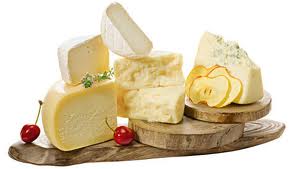
Yesterday we talked about the language of wine. It seems I left out half of the equation–the cheese. I wrote about oenophiles but ignored the poor turophiles.

Readers commented to me on and off line that cheese descriptions can be just as confusing or haughty as ones pertaining to wine.

Upon waking this morning, I pulled my copy of The Cheese Course off the shelf. This book is mostly about the preparation of cheese dishes, but there’s an introductory section I found amusing. Author Janet Fletcher wrote in 2000 that “We Americans are clearly in the midst of a cheese revolution.” How did I miss that? Also, I’m fairly certain, if I were editing this book, that I’d have found a better place for the discussion about cutting the cheese than in the Cheese Etiquette section.

I then embarked on some further exploration of online cheese glossaries. What struck me about the descriptions of cheese flavors was how many are human traits. One cheese might be “mild-mannered” while another “assertive.” One might be “weeping” while another “gassy.” And don’t we all know at least one human, maybe old Uncle Cletus, whom everyone in the family regards as “barnyardy?”

Sorry, I know that was cheesy.

3 Comments

Filed under All Things Wordish, Food, Reading

Château de prétense

I take some risks in raising today’s topic.

First, I fear I may offend readers who take their wine language seriously. Second, I may reveal too much about how little I really know about it.

I enjoy wine. I have a fairly sharp palate that can distinguish among varietals and detect flavors to a reasonable degree. I know what I like and what I don’t and, generally, which wines go well with what foods.

This said, I tread lightly into the language of wine. This might be because I have not been exposed to the business of wine.

I’ve never set foot in a vineyard, never taken a winery tour. I went to a tasting once. In 1982.

Restaurant tasting menus are a rare indulgence, as much for the dining as for the descriptions of the wine pairings. I trust a sommelier and find the pairings are always suitable. The real entertainment, though, comes in his or her descriptions of the wine. Keeping a straight face during the performance is always a challenge. I almost had to excuse myself at Babbo in New York when the sommelier assured us that the wine wouldn’t bully our mushrooms.

Once I was having dinner with a friend at Zaytinya, which had just opened in Washington, D.C. The server had recommended a wine to go with our meal. She said, “I think you’ll find it approachable.” I had to turn my head so that I could roll my eyes.

We ordered this approachable wine and, when the server began to open it, the cork broke off in the bottle. My friend said, “I guess it’s not so approachable.” Our server was not amused.

Call me a bumpkin or call me a cynic, but call me up to here with ridiculous wine descriptions.

One of my favorite pokes at pretension comes from the movie Sideways. On a trip to Napa Valley with a friend, wine aficionado Miles, played by Paul Giamatti, sips, closes his eyes, plugs one ear and observes, “There’s the faintest soupçon of asparagus and just a flutter of Edam cheese.” (Impressive. I’d need at least 20 minutes to detect asparagus in my wine.)

Coco Krumme wrote a piece for Slate this week, separating expensive wines from inexpensive ones based on the language used to describe them. This sent me on an oenophilic cyber-journey, where I tried—honestly I did—to gain an understanding and appreciation of wine language.

But I stumbled upon a host of nouns and adjectives that I found a little hard to swallow.

I understand tannins. I understand finish. I’m willing to accept personality. But, while asparagus and Edam cheese, I hope, are satirical, any food stuffs beyond fruit or maybe chocolate are just silly. Tones of underbrush, animal or briar? Not particularly approachable.

Then, there are the adjectives. In an effort to be an earnest student, I consulted E. Robert Parker’s wine glossary.

Angular?  A wine that lacks roundness. Duuuuh.

Chewy, brawny and spiny? I think not.

Care to decant your favorite bogus wine descriptions?

15 Comments

Filed under All Things Wordish, Family and Friends, Food, Movies, Television and Radio, Rants and Raves

Tropical depression

Thirty days hath September,
April, June and November.
All the rest have thirty-one,
Except February, which lasts forever.

Another batch of snow fell on us yesterday. Not a deal-breaker, by any means; just enough to ugly up the landscape and annoy commuters. The sun has been scarce for way too long and there’s a piercing chill in the air.
Dreary doesn’t begin to describe it. What does?

I spent yesterday in a snit over having to wait at home all day for a county inspector who never showed. A hostage in my own home between 8:00 and 5:00, I was forced to confront an unsavory build-up of mundane tasks.

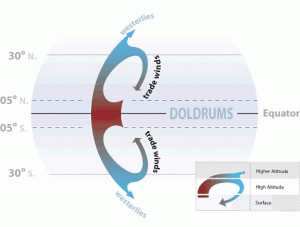
Inside was depressing; outside even more so. I didn’t want to be in either place. I was in the doldrums. Or did I have the doldrums? Which is it?

I looked up “doldrums” and was surprised to learn that it’s actually an oceanographic term. It seems that doldrums are regions of light ocean currents within the inter-tropical convergence zone near the equator. I didn’t know this. My husband, an oceanographer who specializes in ocean currents, didn’t either. I learned that the doldrums give rise to converging trade winds that produce clusters of convective thunderstorms.

In contrast, the doldrums are also defined as a period of stagnation, a slump, a period of depression or unhappy listlessness. This is what I had all right. Funny how the two definitions seem to be at odds, like hot and cold.

Still, I could sense how both meanings were descriptively apt. If you could have seen me yesterday, storming over the delinquent inspector, wanting to leave the house, yet fearing the February chill. A prisoner of bureaucratic breakdown and paralyzed by inertia. I was doldrums incarnate—a convective tempest trapped in a cross current of a stubborn winter and seasonal listlessness.

One word. Two meanings, both appropriate.

This storm too shall pass. It’s 21 degrees, but the sun has made an appearance.

3 Comments

Filed under All Things Wordish, Health, Hearth and Home, Rants and Raves

Tattered and torn

It’s 2011 and it seems a lot of hackneyed business jargon from the 1990s is still hanging around needlessly. I’m not clever enough to coin any replacements at the moment, but maybe if we clean out the closet we’ll have room for something new.

Like those short overalls from 1999 that were in for a summer and then vanished rapidly for their hideousness, or those jeans that still feel comfortable but are frayed along the bottom, so it goes with jargon.

A recent visit to a marketing firm’s blog got me thinking about this, though the topic has been on my mind for some time. The blogger laid out several business buzz words—some still fairly new—and invited suggested additions. I posted a comment:  “‘paradigm,’ ‘radar screen’ and ‘taking anything to the next level.’”

In the meantime, further exploration of a number of individual and company websites surfaced business lingo that, like those overalls, was cute for a while but is long out of style–and just won’t seem to die.

In previous blog conversations we’ve talked about empty phrases (“I’m just saying” and “it is what it is,” though let’s not re-ignite debate on the latter) and phrases that serve no purpose (“you know what?” and “at the end of the day”).

There are countless more plaguing business language. Surely I am not the only one who cringes to hear intelligent executives still throwing out tired phrases in hopes of sounding professionally hip.

In addition to paradigm, radar screen and taking it to the next level, here are my top nominations for 20th Century words that need to be pulled off the hanger and retired from circulation:

“Space,” when used to describe a market segment, industry sector or area of expertise

“Leverage,” when used as a verb

“Synergy” and any form thereof, such as synergistic

For businesses aiming to stand out as fresh thinkers, I’d further vote for phasing out any business metaphors that ran their course in the last millennium, including “picking low-hanging fruit” and “moving the needle.”

Oh, and “sweet spot.” Any others?

7 Comments

Filed under All Things Wordish, Marketing/Advertising/PR, Technology and Social Media

Forefather festivities

Today Americans are observing Presidents’ Day. How will you celebrate?

I cannot tell a lie. I baked a cherry pie last night. Whether or not the father of our country ever cut down a cherry tree and owned up to it isn’t really known, but it served as a good lesson for school children about the importance of telling the truth. And a darn good excuse to make cherry pie.

I imagine tours of the nation’s Presidential libraries are full today, and there are events going on here in the nation’s capital to mark the holiday.

A Facebook friend put out an invitation for favorite presidential quotes.

The Huffington Post posted 22 Ridiculous things You Didn’t Know About U.S. Presidents and The 10 Funniest Presidential Impressions.

Morning news programs ran interesting pieces about presidents, including one on the discovery of a collection of books belonging to Thomas Jefferson.

One might say that presidents, dead and alive, are doing their part to stimulate the U.S. economy. Clearance sales of everything from mattress sets to Jeep Grand Cherokees are happening all across our proud land.

Suddenly I have an urge make a rudimentary cherry tree out of red, green and brown construction paper and have cherry pie for breakfast.

Happy Presidents’ Day. Now express your patriotism and go buy a mattress.

52 Comments

Filed under Food, Holidays, Marketing/Advertising/PR, Movies, Television and Radio

Card shark

What’s your shopping obsession?

After shoes and accessories, I’d have to say my greatest shopping pleasure is picking out greeting cards. I’ve spent upwards of $60 at a whack at places where they offer good cards. I buy hundreds every year.

What are good cards? I lean toward humor, so I go for the cards that have me laughing out loud right there at the rack. I’ve been a spectacle at the airport news stand, where they often carry my favorite line of cards, Avanti.

I think the reason so many people no longer send greeting cards is that they’re under the impression it takes a separate trip to the card store for each acknowledgement.

In fact, like the airport gift shops, the best cards can be found at places where we already are. I often buy cards at FedEx Kinko’s, where I browse the racks while waiting for a print job. If you like cards and live near where I do, Bertram’s Inkwell at White Flint Mall and Knowles Apothecary in Kensington will hook you up.

When I’m traveling and have a little time, I seek out the local card shops. I found Boulder, Colorado, to be a greeting card Mecca, and Gidget’s Gadgets in Rehoboth Beach, Delaware, can’t be beat.

I wish I could be like my friend Sheree, who makes her own cards, or my friend Jeuli, who had her own line in stores some years ago, or my friend Carla, who wrote for Hallmark’s humor lines. I just don’t have that kind of talent.

I am good, though, at buying and sending. And I have a kind of a system for managing my habit.

I buy all year long because, after all, I enjoy the hunt. Most cards remind me of friends and family members, so I select cards with specific people in mind, rather than just stocking up. Even if you’ve just had a birthday or anniversary, chances are I’ve already bought your next year’s card, affixed a Post-it with your name on it, made a note on my calendar a week before your occasion that there’s a card for you in my pile and then put it in the pile.

I do stock up on things like graduation cards, so that I’m ready when those announcements starting rolling in, and I keep other cards on hand just in case.

Recently, my pile became so unruly that I extended the system. I now have a box with purchased, assigned cards sorted by occasion, sitting by my stock of notecards and personalized stationery. If you stepped into my office, you might mistake it for the Hallmark store.

When people see my various “systems,” they often tell me I have too much time on my hands. Perhaps that’s because I’m so organized.
6 Comments

Filed under Beauty and Fashion, Family and Friends, Holidays, Travel

A capital getaway

We just got in from a mini-getaway in our state capital of Annapolis, so close in distance from our home, yet so far away in atmosphere.

The occasion blended a rhythm and blues show, a friend’s birthday party and a gift certificate for a local bed and breakfast into a 16-hour vacation.

To sketch a picture of Annapolis for those who haven’t been there, it sits on the shore of the Chesapeake Bay and, in addition to being the state capital, it is home to the United States Naval Academy. Its narrow streets are lined with restaurants, crab houses, craft shops, taverns and trendy boutiques. It also hosts an impressive 500-seat music venue, the Ram’s Head Tavern, where we attended a superb performance by the Tom Principato Band.

Our base of operations for this 16-hour vacation was a local inn, sadly, the kind of place you want to stay for no longer than the time between putting your tired head on the pillow and going downstairs for breakfast. I don’t mean to be unkind, but camping might have been cleaner and more comfortable. There’s no lobby; you come in through the kitchen of the deli below, to the cash register, which serves as the front desk. If you come back after 11:30 p.m., which we did, you have to climb what is essentially their fire escape to the third floor.

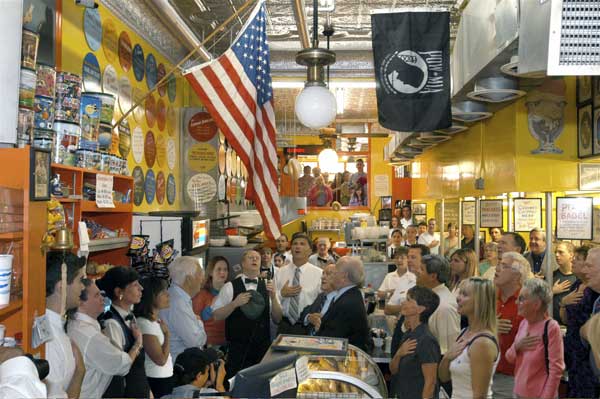
The real treasure, however, was the deli, rather, delly, below the inn. It turns out that Chick & Ruth’s Delly is a well known, family-run Annapolis landmark that’s been in business 45 years. And, while it’s very much a local hangout, I now recall it was featured recently in The Washington Post magazine recently as a favorite for brunch.

“Here you go, sweetie pie,” was how my husband’s crab omelet was served. ‘Nuff said.

We bought fresh crab cakes to cook at home tonight, just to extend the delly experience. I just hope no one expects a side of “sweetie pie” with those.

Do take a minute to peruse their website. Who knows, you might be interested in one of their Colossal Challenges, involving a three-pound deli (er, delly) sandwich, a three-pound hamburger or a six-pound milkshake. Read about the family who started and still runs the place and how the kids got started serving behind the counter, standing on milk crates. And don’t miss the web page that highlights all the couples who got engaged at the Delly.

Best of all, go to Chick & Ruth’s at 8:30 a.m. on any weekday, 9:30 any weekend day, and join your fellow patrons in the Pledge of Allegiance.

God bless America, the great state of Maryland and Chick & Ruth’s Delly.

3 Comments

Filed under Food, Music, Travel

Cool, calm and collected computer

Last night, after a two-month build-up, Watson, IBM’s newest supercomputer, competed against two top champions on Jeopardy! and won.

I don’t know if Watson was favored to win the IBM Challenge. When I wrote about the tournament in December, the 89 comments I received represented a diverse mix of opinions and forecasts.

At the end of the final match, Watson had won $77,147, beating former champions Ken Jennings and Brad Rutter, who racked up $24,000 $21,600, respectively. Because it was a special event, these amounts were jacked up to nice round numbers and donated to charity.

The reason this competition piqued my interest in the first place was the project’s aim to enable a computer to recognize, interpret and respond to language subtleties, including irony and sarcasm. In the end, Watson did fairly well with these. I was impressed.

Some have said that Watson had a competitive advantage because a computer can hit the buzzer more quickly than humanly possible. I’d add that, as was pointed out on the first night, Watson knows what it knows and what it doesn’t know, perhaps better, or with more certainly than humans do.

I know nothing about supercomputing technology but, as a human, I do know a little about human nature. If I had to add one more advantage Watson might have had over his human competitors, I might say lack of nerves. It might be argued that Watson has nerves a-plenty in the artificial neural networks running through 90 IBM POWER 750 servers. But not human nerves. Not the kind of nerves that cause rapid heart rate, sweaty palms and ringing in the ears and, ultimately, affect the retrieval of data.

Even though Jennings and Rutter have proven themselves accustomed to functioning well under pressure, they are human.

I don’t know about you, but whether it’s taking an important exam or speaking to a room full of people, I can be as prepared as anyone, having read, studied, tested myself, drilled, practiced and rehearsed in front of a mirror. When the moment comes and the pressure is on, those nerves kick in, the rooms starts to spin and I can draw a complete blank.

Watson didn’t have to take deep breaths or do positive visualizations or whatever else nervous people do to overcome stage fright. Or did he?

Maybe he was picturing Alex Trebek in his underwear.

7 Comments

Filed under All Things Wordish, Movies, Television and Radio, Technology and Social Media

Save the subplot

Among the season’s sitcoms debuting recently is one I will keep my eye on with high hope.

You already know how I feel about sitcoms—that good ones are a dying breed, and the best ones can provide enough laughter therapy to last through the week.

I can’t say just yet that Mad Love will fulfill my therapeutic requirement, but I do know there’s a gleam of potential. The premise isn’t anything special. However, in addition to a strong lead cast and some mildly decent writing, the creators have also written in a character who is prone to mutilating common words and expressions. What’s especially funny is that her gaffes are corrected boldly by the one character who seems least likely to know enough to do so.

Dim-witted characters aren’t uncommon sitcom material. However, I can’t readily recall any having this particular trait. There are so many ways the writers could go with Erin. They could shape her into a modern day Mrs. Malaprop, which would be hilarious. Haven’t we all worked with one person who just couldn’t seem to get straight a simple figure of speech? I’m tempted to send in a few real-life ideas.

The problem is, it looks as though Erin’s character could be short-lived, as she was dumped by her boyfriend, one of the main characters, in the first episode. I can only hope they at least remain colleagues at the law firm in which the story takes place.

It seems that Chicago Sun-Times TV critic Paige Wiser agrees with me. In fact, her review took the words right out of my mouth: “The other bright spot is Ben’s ex-girlfriend Erin, played by Alexandra Breckenridge. She’s given to mangled expressions like “taken for granite” and “an escape goat,” and I hope to God that Ben’s new relationship doesn’t mean we’ve seen the last of her. Come back, Erin. Please.”

Erin’s calling a fabric swatch a “snatch” was just a tease.

1 Comment

Filed under All Things Wordish, Movies, Television and Radio