
A very wise man—my late father-in-law—was known to say, “He who talks often is seldom heard.”
He also used to ask, “Is all that talking really necessary?”
For someone to whom words are a profession, a hobby, a love, even half a moniker, this Word Nymph has been thinking a lot about silence.
Perhaps it’s the time of year, or the signs appearing before me in recent days. The Sounds of Silence playing on the radio. References to the evils of loquaciousness in my daily horoscope. A favorite hymn in church yesterday, Let All Mortal Flesh Keep Silence, stirred me to wordlessness. Message from the universe: Shut yer yap.
 In my faith tradition, the upcoming season of Advent is much ado about silence. Many kick off the season with a silent retreat, followed by three weeks of quiet reflection, listening, expectation, focus outside oneself. Regardless of our traditions, this isn’t a bad discipline to follow.
Modern humans have spurred a society that abhors dead air and assaults it with voices. While others speak we are already thinking of what we will say next—and, ever impatient, we interrupt them mid-sentence with our treasured views. As a child whose report cards often reported that “Monica talks too much in class,” I plead talkative as charged.
Modern media have ignited an explosion of expression. Talk radio, talking heads, talk-talk-talk. Tap-tap-tap a 2,500-word Christmas letter and a 750-word status update.
Enough already.
It seems a good time to undertake a new social discipline. While word count is a key metric in my work as an editor, it never occurred to me that I could put it to use elsewhere. What if I followed the Twitter theory and kept my utterances to fewer than 140 characters?
As an experiment, I pledge to do my best for the rest of this year to use my words more judiciously. To the best of my ability I will:
- Listen first, speak second. After all, there’s a reason we were given two ears and only one mouth.
- Not feel compelled to fill silence with talking. Silence can create an opening to ideas, energy and more thoughtful words–while excessive talking can suck the energy out of the room and everyone in it.
- Not overestimate others’ interest in what I have to say. That story, that memory, that dream I find so fascinating? Others, not so much.
- Not consume more than my share of the airwaves, leaving plenty open for others.
- Begin fewer sentences with I and My.
Join me, won’t you?
One final comment: Some of the most stirring renditions of Let All Mortal Flesh Keep Silence are the ones without lyrics.
Word Count: 439 (still too many)
 If you and I travel in the same social media sphere, then you may recently have witnessed my (very polite) outburst over the way people speak about one another online. While I’ve since made peace with a number of my offenders, this provides occasion to reinforce a simple courtesy: Never say (or mime) anything from behind a wall that you wouldn’t say to someone’s face.
 The predominant adjective was stupid, with a few “idiots” sprinkled in. “How can people be so stupid?” “Well, that just proves you can’t fix stupid.” “50 percent of the country just showed us that stupid is as stupid does.” “The idiots who re-elected our current president…”
 The first: More than a few of us were reading A Time to Kill, John Grisham’s first novel. The book had come out three years earlier, but it had gotten little attention until Grisham’s next legal suspense thriller, The Firm, came out in ’92. Jury selection was a central part of A Time to Kill and those of us who arrived with paperback in hand were dying to be selected. The second thing I remember: Even though I wasn’t selected, I felt sequestered. A full work day at the courthouse without any contact with my office was nerve-wracking.
 I listened in on my fellow jurors’ cell phone conversations, rolling my eyes as they overstated the drama to their loved ones and colleagues. I could only imagine their exaggerated tweets.
 A poll of social media aficionados:
 My friends and contacts are embracing Google+, which I assume is Facebook’s latest competitor. I’m aware of the dynamic between the two companies and find it no surprise that Google has stepped onto the mat to give Facebook a run for its members.
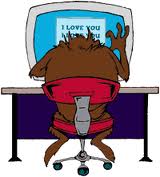 It took two or three times of clicking into the underbelly of the Internet before I got smart. A post in Facebook’s news feed tempting me with “OMG, here’s a site that will tell you who’s been looking at your photos.” An e-mail from a (hijacked) friend, warning me that “hey someone is posting really NASTY tweets about you and linking to your Twitter account, profile is …” The next thing I knew, the things are spreading and the tweets appearing on my blog are corrupted. All because I wanted to know who was looking at my profile and who was saying bad things about me. For my supposedly mature ego, it’s 1973 all over again.
 Over the years I’ve seen Katie Couric mature as a newswoman; I consider her one of the best. Her assignment to the CBS anchor post was well deserved, even if she ultimately doesn’t feel it suits her interests. I think she does a terrific job with her 60 Minutes segments. Her interviewing skills have come a long way. Just ask Sarah Palin.
 Word Nymph