
One of the first subjects I wrote about on this blog was anthropology.
I asked you to consider what social scientists would learn about you if they happened upon your magazine rack.
Now and again we have a chance to learn about each other, as households of humans, through our recycling bins.
We know quite a bit about our neighbors—their dietary habits and how they spend their weekends—on recycling day. They also get a glimpse into who we are, that is, unless we’ve mastered the art of burying clues, as I do when necessity dictates.
Doesn’t every family stash its Little Debbie cartons or otherwise-telling proof of vice beneath the Kashi Go Lean?
What do we know about people based on what’s on their curb?
A bin brimming with dead PBR soldiers might reveal a group house of twenty-somethings, while a heavier load of Shiraz bottles and brie rinds is a sure sign of a girls’ weekend.
Walking down my street, you’d envision from this curbside container an adoring aunt who spoils her visiting nephews:

You’d also know that neighbors aren’t rushing to party with the empty nesters who left this blue bin behind.

Quick, take a look, what’s in your trash tub? Do tell: What’s buried beneath those Evian empties?
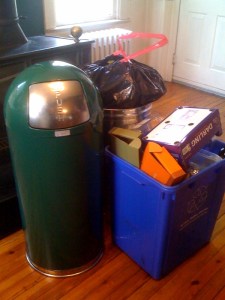 I’m a little ashamed of our household’s size 16 carbon footprint. We are the antithesis of the Johnsons. I’m not sure exactly how two humans and two felines can generate enough weekly waste to fill the Johnsons’ bins for more than a year. See for yourself. Not counting the bags of yard waste that already await pick-up at the curb, we’ve filled a 20-gallon can and an even larger sized Hefty bag in less than a week. Plus this large recycling bin and a paper bag’s worth of newspapers joining the yard waste at the curb as we speak.
 Word Nymph