Work stoppage

Here is a suggestion for office managers all over the United States. You might as well close up shop this week because little is going to get done.

I admit it has been a while since I worked in a traditional office setting. But for the 20 or so years that I did, what I remember about the week before Thanksgiving—except for the occasional harried lame-duck Congressional session—is the fervent exchange of information pertaining to food for three full days preceding the holiday.

I predict that, for the next two and a half days, the majority of office computers will be connected to Epicurious.com or the Food Network and that cookbooks will be pressed against the glass of copiers churning out recipes to be shared among staff members. Conversations normally confined to the lunch room will spill generously into working hours, as colleagues seek other’s advice for the best way to satisfy Aunt Minnie’s taste for goose liver pâté.

Just walk down the hall and you’ll hear the great debates—stuffing cooked inside the turkey or out? Roast turkey or deep fried? Giblets in the gravy or not? Pumpkin pie or pecan? How many fruits and vegetables can be slipped into stuffing without the children tightening their lips? (In my house, the answer is zero.)

More e-mail will be generated between employees and their families than within the company, so as to make expectations clear about arrival times, covered dishes and football schedules.

One person (there’s one in every office) will be attempting the latest Martha Stewart centerpiece and individual place decorations and feeling the need to draw her colleagues into the challenge.

A worker or two will try not to get caught missing of an afternoon, while dashing out to buy napery.

Okay, so the word is out. But am I wrong?
4 Comments

Filed under Family and Friends, Food, Holidays, Technology and Social Media

How to write it

This is Part Three of a three-part series on writing. The series incorporates stated views of several well-known writers and their observations about the craft.

Over the last two days, we have commiserated with some of  the world’s noted writers in confronting the difficulties of writing and we have read their reasons for writing.

Today, we’ll wrap up the series by pretending to ask them for advice on what makes good writing. Here’s what they said:

Stephen King – “Write with the door closed, rewrite with the door open. Your stuff starts out being just for you, in other words, but then it goes out.”

King also said that, “In truth, I’ve found that any day’s routine interruptions and distractions don’t much hurt a work in progress and may actually help it in some ways. It is, after all, the dab of grit that seeps into an oyster’s shell that makes the pearl, not pearl-making seminars with other oysters.”

Mark Twain suggested, “Substitute ‘damn’ every time you’re inclined to write ‘very;’ your editor will delete it and the writing will be just as it should be.” 

Twain also said word choice is critical: “The difference between the right word and the almost right word is the difference between lightning and a lightning bug.”

Anton Chekhov  — “Don’t tell me the moon is shining; show me the glint of light on broken glass.” 

Baltasar Gracián – “A synonym is a word you use when you can’t spell the other one.”

Jean-Luc Godard – “A story should have a beginning, a middle and an end… but not necessarily in that order.”

I find this final quote relevant to modern day writing. In the following passage, substitute the word “diaries” with “blogs” and you’ll see what I mean:

Ann Beattie — “It seems to me that the problem with diaries, and the reason that most of them are so boring, is that every day we vacillate between examining our hangnails and speculating on cosmic order.”

Once again, would you care to share writing techniques that work for you?

See you Monday.

Leave a comment

Filed under All Things Wordish, Quotes, Reading

Why write it?

This is Part Two of a three-part series on writing. The series incorporates stated views of several well-known writers and their observations about the craft.

If yesterday’s topic piqued your interest in coaxing out your inner writer—and especially if it didn’t—you might be inspired by the words of noted writers of the last few centuries.

Given the opportunity to ask them why they write or what they get out of the writing process, this is what they would say. Perhaps at least one of these will appeal to you:

E.L. Doctorow – “Writing is a socially acceptable form of schizophrenia.”

Lord Byron – “If I don’t write to empty my mind, I go mad.”

Kingsley Amis – “If you can’t annoy somebody, there is little point in writing.”

Jules Renard – “Writing is a way of talking without being interrupted.” 

Gloria Steinem – “I do not like to write – I like to have written.”

Apparently, writing isn’t always deliberate for songwriter Joan Baez. I suspect other writers can relate to the inspiration she describes: “It seems to me that those songs that have been any good, I have nothing much to do with the writing of them. The words have just crawled down my sleeve and come out on the page.” 

Tomorrow we will take tips from Mark Twain, Anton Chekhov, Stephen King and others as they describe their techniques for producing good written works.

In the meantime, I’ll ask anyone who cares to answer:  Why do you write?

1 Comment

Filed under All Things Wordish, Quotes, Reading

Just write it

This is Part One of a three-part series on writing. The series incorporates stated views of several well-known writers and their observations about the craft.

After 25 years of writing for business, I started Word Nymph as a place to practice writing for pleasure. You have been patient and gracious guinea pigs.

At key intervals—one month online or the 100th blog post—I have reflected on the lessons I’ve learned. The effort has been underway for about eight months now, with my 200th entry appearing this weekend.

I have never written a book, and likely never will, but I’ve often thought I’d like to give it a try. Nonetheless, I do pay attention to what authors, playwrights and songwriters have observed about the writing process.

American novelist Philip Roth (Goodbye Columbus) was interviewed recently while promoting his new novel, Nemesis. Vanity Fair’s John Heilpern asked Roth, “Do you find writing difficult?” Roth responded, “I find it arduous and un-doable. It’s laden with fear and doubt. It’s never easy—not for me.” I imagine that creative juices, a sharp personal discipline and handsome advances eventually help one over the hurdles.

Even as an amateur blogger, I find I can relate to the observations of a few of the writing maestros:

Stephen King, from his book On Writing: A Memoir of the Craft – “The scariest moment is always just before you start.”

Sharon O’Brien – “Writing became such a process of discovery that I couldn’t wait to get to work in the morning.  I wanted to know what I was going to say.”

James Michener – “I’m not a very good writer, but I’m an excellent rewriter.”

John Osborne“Asking a writer what he thinks about criticism is like asking a lamppost what it feels about dogs.”

Over the next couple of days, I’d like to share insights from other famous writers, including why they write and their techniques for good writing.

Perhaps you have thought of doing more writing. Have you been carrying around a novel idea in your head, or did you read or watch Julie & Julia and think to yourself, I could do that? There’s only one way to find out. Do it.

Don’t be daunted by the comments of Walter Wellesley “Red” Smith, who said, “There’s nothing to writing. All you do is sit down at a typewriter and open a vein.” Or  Gene Fowler, who said, “Writing is easy:  All you do is sit staring at a blank sheet of paper until drops of blood form on your forehead.” 

Just come back tomorrow and Saturday for goodies to put in your writer’s toolbox.

4 Comments

Filed under All Things Wordish, Quotes, Reading

’Tis taboo

If my September 25 post reminding you that you only have three months to write your holiday letter didn’t send you straight to the keyboard, that’s good—because I’ve found a great set of tips for how not to write your letter.

I am not biggest fan of Christmas letters, and yet I can’t refrain from writing them. What’s more, I can’t keep myself from slipping into what I know are bad habits. In my 2006 letter, I actually listed all the things I felt people shouldn’t say in a holiday letter, mostly because they are cliché or cover topics in which only the writer is interested. Then I turned around and used one.

In my opinion, the most cliché way to open a holiday letter is by asking, “Where has the time gone?” or “Where did the year go?” I also prefer to omit unseemly medical conditions that might spoil a reader’s cup of Christmas tea. A letter we received one year actually contained the words “rectal prolapse.”

I could go on and on but I will let John E. McIntyre of The Baltimore Sun do it for me – and more eloquently at that. In a recent blog piece, McIntyre offers tips for making a letter less cheesy than it might be. He suggests refraining from any and all holiday metaphors, analogies and parodies of the Twelve Days of Christmas. He also reminds us that the 12 days begin on Christmas and run through January 6th. This is especially important to me, not just as a Christian but also because my birthday falls 12 days before Christmas, and I’d like a little time to celebrate the occasion (and observe Advent) before the big day hits.

McIntyre also helpfully points out that, while Hanukkah comes close to Christmas, “they are not twins.” Nevertheless, is it still all right for me to use my holiday card to wish a happy Hanukkah to all my Jewish friends?

He advises letter writers to avoid ‘Tis and ‘Twas and to back away from the Dickensian: “No ghosts of anything past, present or future. Delete bah and humbug from your working vocabulary. Treat Scrooge as you would the Grinch, by ignoring him. Leave little Tiny Tim alone, too.”

If you’re interested in cutting the cheese from your holiday letter, then before you put pen to pad, or fingertips to keyboard, try heeding John McIntyre’s advice. I promise to do the same.

1 Comment

Filed under All Things Wordish, Family and Friends, Holidays

Tale of two cities

This is a tale of two movies.

Last weekend, like many Washingtonians, I rushed to see Fair Game, the tale of an investigation into the existence of weapons of mass destruction in Iraq which, through a series of political and media responses, led to the outing of covert CIA officer Valerie Plame. International intrigue. Political power plays. Criminal charges against a White House official. It’s a true story set in the nation’s capital and cities around the world.

Washingtonians like movies set in our back yard. We are eager to see if the movie-makers got it right—the geography, the photography, the historiography.

 I wonder whether, in other cities, Fair Game is getting as much love at the box office as, oh, I don’t know, anything else.

Saturday night, I arrived at the theater 35 minutes before show time to find the movie already sold out. I envied my fellow wonks who would be nestled comfortably in their stadium seats, taking in the talent of Sean Penn in the role of former Ambassador Joseph C. Wilson, Plame’s husband, who played a pivotal role in this historic real-life drama. I immediately got tickets for Sunday.

In the meantime, though, I was already in a movie mood. So I drove to my local shopping mall and saw Morning Glory, about a fictitious national morning news show. I’ve always thought it would be fun to work in broadcast news so, for me, this movie was a fantasy. Obviously, it takes place in New York, a city I love but know only as an outsider. A fantasy story taking place in a fantasy city.

For this reason, I didn’t concern myself with believability or accuracy or geography for that matter. I didn’t wonder if a taxi transporting a character six blocks can drive from Point A to Point B without crossing three boroughs, or whether or not a station can deviate from its scheduled programming to air a live feed from an hour away on three seconds’ notice. It’s fantasy; I don’t care.

So Morning Glory was amusing and entertaining—because all I had to do was sit back, get an artificial glimpse into the TV news business and munch popcorn. And try not to wonder whether the message was a lampoon or defense of what network morning programs have become.

Sunday it was back to Washington and back to reality with Fair Game. I found the movie to be very well done, the acting superb. There was one little geographic inaccuracy.

Joe Wilson hopped in a cab and asked to be taken to The Palisades. Before long, an overly chatty cab driver got on Wilson’s nerves and Wilson asked the driver to pull over. “I’ll walk,” he said. As he got out of the cab, we see that he is at the U.S. Capitol–seven miles from The Palisades.

It wasn’t fun to relive such an unfortunate event in U.S. history and I left feeling uncomfortable. But at least it was about something real. Two thumbs up.

Leave a comment

Filed under Movies, Television and Radio, News, Politics

Woof it down

If a book is ever written about my life, it should be entitled, “Only You.”

That’s because whenever I do something extraordinarily stupid, the person I am with says, “Only you…”

This past weekend, a friend and I met at the Washington, D.C., convention center for the Metropolitan Cooking and Entertaining Show. Or as featured celebrity chef Paula Deen called it in the TV promos, Metropolitan Cookin’ and Entertainin’ Show.

I didn’t see Paula, or Bobby Flay or Rachael Ray, because I didn’t want to shell out the hundreds of dollars their personal demos and book signings commanded.

Instead, I went on a General Admission ticket, which got me into the exhibit hall, along with the rest of the masses, who stood in long lines to taste a piece of cheese the size of a pinky nail.

It turns out that General Admission was where I belonged. You can’t take me anywhere nice.

My first mistake was to go into the hall hungry. My second mistake was to walk up to the first booth without a long line, take what looked like a delicious peanut butter cookie, and pop it in my mouth.

Just then I heard the voice of the exhibitor. “Ma’am, that’s a dog biscuit.”

9 Comments

Filed under Foibles and Faux Pas, Food, Movies, Television and Radio

Who that?

Here’s a little quiz for anyone who is interested in relative pronouns.

Please jot down which sentence in the following sequence you believe is correct. 

1(a)  I am grateful for all the friends that came to my birthday party.
1(b)  I am grateful for all the friends who came to my birthday party.

2(a)  Thanks to all the veterans that served our country.
2(b)  Thanks to all the veterans who served our country.

3(a)  Everyone that has a pet should shop at PetSmart.
3(b)  Everyone who has a pet should shop at PetSmart.

4(a)  I know a lot of people that use “that” when “who” is the better choice.
4(b)  I know a lot of people who use “that” when “who” is the better choice.

If you chose (b) in each set of choices, you get an A. Perhaps I should say, you’d get an A if I were grading the quiz. It turns out that some authorities are more lax than others on this issue.

Before issuing a premature refresher, I did some research on relative pronouns and, in this case, restrictive relative pronouns, where the antecedent happens to be a person rather than a thing.

I was taught that people—and nouns that represent people—should be followed by “who” rather than “that.” In the examples above, friends, veterans and everyone refer to people.

However, a couple of sources maintain that both “that” and “who” are correct and are a matter of preference rather than rule.

But wouldn’t you agree that, in reference to a person, “who” is more polished, more personal and more exact?

Feel free to disagree; you can be the reader who stood up for “that.”

You’ll notice I haven’t yet addressed “that” versus “which.” Even though I know the rule on restrictive and non-restrictive clauses, it is one that trips me up frequently. Or is it which? I know, it’s that.

3 Comments

Filed under All Things Wordish

Clay pigeon

While on a plane this week, I finished up my November issue of Vanity Fair. Having read all the good stuff, I swept back through my less favorite features, including one called “My Stuff.” Each month this feature asks a celebrity to list his or her favorite clothing items, household furnishings and gadgets.

November’s celeb is Amy Sedaris, author, actress and comedian. In case you were dying to know, her favorite dessert is angel food cake stuffed with ice cream. Another item on her list caught my eye.

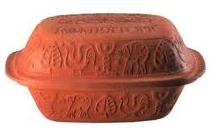
Favorite Discovery: Romertopf Clay Pot.

This evoked tremors in me, going back decades, when my parents made their foray into the realm of health food, 10 years before anyone else did. While everyone else was eating Charles Chips and Twinkies, we were eating alfalfa sprouts and carob. Our family swore off salt, refined sugar, bleached flour and any grain that wasn’t in its whole form.

For me, the most dismal piece of this lifestyle was the dreaded Romertopf. Any role this godforsaken pot played in dinner guaranteed a nearly inedible meal—one I thought (but did not dare say) should immediately be Fed Ex’ed to the starving children in Bangladesh.

The Romertopf remains immensely popular to this day, though I can’t imagine why. The pot is designed scientifically to eliminate the need to cook one’s chicken or vegetables in fat, salt or any seasoning for that matter. Purportedly, the clay cooking method brings out the natural flavor of the food. The meal gets its moisture not from butter or olive oil, but by immersing the pot in water before cooking, so that it releases steam while in the oven. Basically, your meal tastes like chicken and/or vegetables and water. Mmmm.

According to the Romertopf’s official website, “If you intend baking bread or sponges, then lining the base with foil or parchment paper will aid easy removal.”

I thought that eggplant tasted like something out of the sink.

6 Comments

Filed under Family and Friends, Food, Health

Bring’em back

I just heard about a new book about which I could get pretty excited. My dilemma is whether to go ahead and order now it or hope I get it for Christmas.

It’s called Let’s Bring Back: An Encyclopedia of Forgotten-Yet-Delightful, Chic, Useful, Curious, and Otherwise Commendable Things from Times Gone By and it was written by the Huffington Post’s Lesley M.M. Blume.

By how you know I am quite nostalgic;  just the mention of a blast from the past lifts my spirits.

According to the product description on Amazon.com, the book “invites you to consider whatever happened to cuckoo clocks? Or bed curtains? Why do we have so many “friends” but have done away with the much more useful word “acquaintance”? All of these things, plus hot toddies, riddles, proverbs, corsets, calling cards, and many more, are due for a revival. Throughout this whimsical, beautifully illustrated encyclopedia of nostalgia, Blume breathes new life into the elegant, mysterious, and delightful trappings of bygone eras, honoring the timeless tradition of artful living along the way. Inspired by her much loved column of the same name and featuring entries from famous icons of style and culture, Let’s Bring Back leads readers to rediscover the things that entertained, awed, beautified, satiated, and fascinated in eras past.” Are you aquiver?

Learning about Let’s Bring Back reminded me of another book that evokes similarly fond memories.

American Greats was edited by Stanley Marcus (of Neiman Marcus) and Robert A. Wilson. It too revisits innovations and events that made a significants on American life. For example, the Corvette, the ticker tape parade and Strunk and White’s The Elements of Style, among 280. American Greats is more of a coffee table book, which makes leafing through the photos and commentary all the more fun.

Stanley Marcus has since passed away, but I’d like to share a little story about Robert Wilson, if I might.

Bob Wilson and I worked for the same company about 20 years ago, though our paths crossed only a few times. He was far more senior than I. I admired him as one of the brightest and most creative minds in the company–and one of the humblest. Ten years later, in 2000, I was delighted to have our paths cross again. We had both gone in different directions but found ourselves working on a video shoot for a day. At the end of the day, I was driving him to the train and was looking to make polite conversation. I had remembered he had young children when we knew each other before. So I asked, “How are your boys doing?” Bob replied, “Very well, thanks. Luke and Andrew just finished filming Charlie’s Angels and Owen is in a movie called Meet the Parents.” It didn’t compute.

About a week later, I received an autographed copy of American Greats, with a note thanking me for my work on the project. It wasn’t until I was watching the closing credits of The Royal Tenenbaums—starring Owen Wilson and Luke Wilson and co-written by Owen–that it clicked.

Serious digression, I know. The point was to do three things:

  1. Tell you how intrigued I am about Let’s Bring Back
  2. Encourage you to pick up your own copy of  American Greats
  3. Ask you, what treasures or American greats would you like to bring back?

2 Comments

Filed under Marketing/Advertising/PR, Movies, Television and Radio, Reading