All or Nothing

Over the years, I’ve come to learn that I operate at two levels, All or Nothing.

I prefer All. All gives me the energetic mindset to pursue a goal, get a job done, live my life. Nothing? That drives me insane. I don’t relax well; it’s just not my nature. Even when I’m in a rocking chair, I’m rocking at full throttle, my mind in overdrive. Remember that I call myself word nymph, after the purple-headed wood nymph, which can flap its wings insanely fast.

Every once in a while, I get an unwelcome visit from Nothing. Sometimes, it just pounds on the door until I open it.

A few days ago, I felt a bug coming on. My approach to illness is to beat it down with a club. So I kept working, then through the weekend, I kept all of my volunteer and social commitments, as Nothing nipped at my heels. By Sunday night, Nothing had beaten me into submission.

As I lay in bed with a high fever, feeling like thousands of bees were stinging my epidermis, I worried about my Monday morning blog. But, as Nothing took over my brain, I couldn’t have cared less about the blog. By Monday, it didn’t have a chance, nor did anything else I had hoped to accomplish. I am going to be fine and am so confident of this that I have made new commitments for the latter part of this week and into the weekend. I’m giving Nothing a two-day pass; after that, it’s back from whence it came.

I have learned that I can go from zero to sixty in eight seconds. Deceleration must be forced upon me.

For now, I’ll give in to sleep. But I’ll dream of dangling participles.

See you tomorrow.

Is it “from whence it came” or just “whence it came?” “Whence” means “from where.” Wouldn’t “from whence” be redundant?

6 Comments

Filed under Health

For real

The City of Buffalo has long been the butt of jokes. Even my father, who’s from there, used to say that Buffalo came into being when “they cloned Cleveland.”

This week, there are new jokes as Buffalo—The City of Good Neighbors, The Queen City, The City of No Illusions, The Nickel City, Queen City of the Lakes, City of Light—takes on a new motto: “Buffalo For Real.”

I learned about this not from the city’s own announcement, which includes a new tourism video, but from the swell of snickers and criticisms from within Western New York and around the country. The blogosphere bubbles with mockery while Twitter tee-hees abound.

Advertising Age slammed the slogan, calling it meaningless. (But do check out their map of the most absurd city slogans in the United States.) Buffalonians don’t appear to be crazy about it either, but they’ve been quick to come to the defense of their city, as they are often called to do, pointing to the depth of Buffalo’s history and culture. One commenter suggested “Buffalo: Leave for the weather, come back for everything else.” Commenters from other cities were cruel (“Denver: at least it’s not Buffalo”), while others were happy to be out of the spotlight for their own cities’ inane slogans.

But back to Buffalo For Real. If the city’s marketeers had consulted me, I’d have suggested some punctuation. Mabye a comma or a colon following Buffalo. On the surface, “Buffalo For Real” does sound a little meaningless. But if you look at the campaign, there’s a broader theme: Buffalo for art, Buffalo for architecture, Buffalo for families, Buffalo for food, for nature, for history, for shopping, for sports, for performing arts. The tourism video addresses the “real” part. The narration holds the city’s past troubles and blemishes up to the light and assures visitors of the vast rejuvenation taking place. “We’ve had our share of hard knocks.” “Some might say that time has left our town behind.” “Neighborhoods given up for dead are being given new life.” Even the snow has an honored place in the script.

Juxtaposed against tourist destinations in which weather is the draw, with little authenticity behind sun and spa, Buffalo stands out as real. Blue collar and white collar workers alike have withstood decades of economic devastation and year after year of bone-chilling temperatures. The people remain ever cheerful, trust me. The city by Niagara Falls has a lot to be proud of.

I like the new slogan. I just wish the video had been narrated by someone with a Buffalo accent.

Now that would be real.

3 Comments

Filed under All Things Wordish, Marketing/Advertising/PR, Technology and Social Media, Travel

100 proof pure poison

It doesn’t matter how often or how extensively we clean our house. We still uncover the oddest things and collections of things under the layers of dust that have been accumulating for 20 years.

Oh, the things we find in bags, bowls, bins, buckets and baskets.

Yesterday, I dared to peek into an old brass bin on a shelf above the basement stairs. Most of the contents were minute—paper clips, safety pins, tiny pieces of broken toys, a few rusty screws and a small paperback book entitled Jesse Helms “quoted”: 100 Proof Pure Old Jess.

I’m glad I have the opportunity to clean out my things before strangers come in to organize a sale of my so-called estate. This find would be hard to explain.

The source of this relic is a little fuzzy to me; It must have been a gag gift from someone who knew that neither my husband nor I was ever a big supporter of the late North Carolina senator. Quite possibly, it was a re-gift. No matter.

I looked the book up online to see if I could get a little background. I found only a used book site, where several owners were selling their copies. The site did tell me that, if I liked this book, I might also like 2000 Foreign Policy Overview and the President’s Fiscal Year 2001 Foreign Affairs Budget Request: Congress hearing. I think I’ll pass. Maybe I’ll wait for the movie.

For some reason, I expected to find humor in the 67 pages of the book that contain direct quotes from Sen. Helms, who lived from 1921 to 2008. If anyone who lived only during the last two decades of Helms’ life gazed upon these quotes, they’d be shocked—barely more than I was, though—to realize that such flagrant bigotry was expressed so freely and publicly in the late 20th century and into the 21st.

The last section of the book is devoted to political cartoons about the man, but these provided little relief for my sour stomach.

There was only one quote I found worthy to excerpt in this blog; it’s the first one printed in the book:

“Well there are a lot of number one problems in America. But let me boil it down to two…”

Don’t make me share the rest.

6 Comments

Filed under Hearth and Home, Politics, Reading

Sunny in Orlando

We know someone who tells people he meets that he’s from “Orlando, Florida.” I always wonder to myself why he doesn’t just say “Orlando.” I mean, are people going to think he’s from Orlando, Oklahoma? It turns out that they might. Or Orlando, Kentucky, or Orlando, West Virginia.

I snicker when I hear people—usually ones who don’t travel very much—refer to “Paris, France,” or “London, England,” or places where the country is implied. Everyone knows Paris is in France; you really don’t need to say it. Or do you? There are at least 10 cities in the United States called Paris.

I do travel a lot, and I consult Weather.com before I go anywhere. The Weather Channel’s website has an auto-search feature that, when the name of a city is typed in, offers a choice of the top cities bearing that name.

Going to Philadelphia? Don’t mis-click, or you’ll get the weather for Philadelphia, Missouri, or Mississippi or New York or Tennessee.

Just a little trivia for geography buffs from some of my recent searches (or perhaps geography buffs already know this):

Charlotte: In addition to North Carolina, Charlotte is in Arkansas, Vermont, Iowa, Michigan, New York, Tennessee and Texas.

Dallas: Georgia, Iowa, North Carolina, Oregon, Pennsylvania, South Dakota, Wisconsin and West Virginia

Atlanta: Idaho, Illinois, Indiana, Kansas, Louisiana, Michigan, Missouri, Nebraska and New York

Sacramento: Kentucky, New Mexico and Pennsylvania

Detroit: Alabama, Maine, Oregon and Texas

Phoenix: Maryland, New York and Oregon

Denver: Iowa, Indiana, Kentucky, Missouri, North Carolina, New York and Pennsylvania

Raleigh: Illinois, Mississippi, North Dakota and West Virginia

Miami: Arizona, Indiana, Missouri, New Mexico, Oklahoma, Texas and West Virginia

Richmond: California, Illinois, Indiana, Kansas, Kentucky, Massachusetts, Maine, Michigan and Minnesota

Minneapolis: Kansas and North Carolina

Syracuse: North Dakota, Kansas, Missouri, Nebraska, Ohio and Utah

Well, I’d better go check the weather in San Antonio. Oops, not New Mexico.

6 Comments

Filed under Technology and Social Media, Travel

Gold in the freestyle

Did you hear? The United States took six gold medals over the weekend.

No, I’m not a year early for the Olympics. The event to which I’m referring didn’t take place in London but rather, in Trondheim, Norway: the biennial World Beard & Mustache Championships, considered to be the premier competition of the world’s facial hair elite.

Following last weekend’s competitions, organizers announced that Keith Haubrich “completed the three-peat in Freestyle Moustache. Newcomers to the world stage Bill Mitchell from Georgia and Giovanni Dominice from Arizona won in Partial Beard Freestyle and Imperial Moustache respectively.” For an interpretation of what this means, and to get a sense of the hairy-ness of the competition, do spend time on your lunch hour today combing through the organization’s website, which is translated into 19 languages.

In case you were wondering, I didn’t happen on the news by trolling obscure sources for blog topics. This world event was covered by CNN, which ran a pre-event story online last Friday and used up all the good hair puns (e.g., the competition has its roots in a 1990 event).

A couple of quotes CNN ran caught my eye. Ole Skibnes, the president of the host Norwegian Moustache Club, said, “You can’t just judge the size of the moustache — you have to see if the hair is well-groomed, see if it suits the person, see if it makes them look good.” Notice Skibnes uses “they” in lieu of a masculine pronoun. Interesting. Could it be that the games aren’t Just for Men?

CNN also reported: “It was at the Anchorage games that the United States emerged as the ‘premier power in world bearding,’ according to Beard Team USA captain Phil Olsen, who predicts that America will net a staggering eight out of 17 possible gold medals at the games.” Olsen’s prediction fell short by two, but I’m giving him points for using “bearding” as a verb as though it were an Olympic sport. 

By the way, Team USA will hold its next national competition this fall in the Amish country of Lancaster, Pennsylvania. Be there or be without hair.

Leave a comment

Filed under All Things Wordish, News, Sports and Recreation

Corrective conundrum

A few weeks ago, my husband left a calling card of sorts on my desk. It was a clip from an advice column in The Washington Post, in which a man complained about his girlfriend’s correcting his grammar and pronunciation. I never asked my husband whether he intended this to be an idea for my blog or a hint that he was relating to the poor bloke whose girlfriend corrected him—and only him—in front of others.

In the meantime, over the weekend, an opinion piece by Slate writer Michael Agger appeared in the Washington Post Business section. The piece cited instances in which companies receiving online reviews of their products and services corrected the spelling and grammar of their posting customers. Agger questioned the ethics of such practices, raising the issue of altering the authenticity of the online review process. Companies argue that sloppy posts, including favorable ones about their products or services, make the company look bad and, hence, impede sales.

When I wrote a piece about correcting others and being corrected  last February, I got a sense of how my readers feel about it. But correcting what is posted as an online review is different. Or is it?

I must confess here that I occasionally do the same thing with this blog. Sometimes when a reader posts a comment and makes an inadvertent mistake in spelling, grammar or punctuation, I go in and make a minor correction. Not all the time, and not drastically. And I never alter the content.

Unlike text-tweaking online retailers, I don’t correct mistakes because they make me look bad. I do it to save commenters from potential embarrassment. You might say that I edit their comments to help them make their points more effectively. For example, if someone is preaching about the importance of good grammar, and misspells “grammar,” I don’t believe it’s a sin to go in and correct the spelling. Or if there’s a simple typo, I might go in and fix it.

This said, it doesn’t mean I don’t bristle when I see a comment lacking any upper case letters or essential punctuation, but I give benefit of the doubt when I suspect comments are generated on a mobile device. Occasionally, however, this has precipitated sidebar conversations with my loved ones, suggesting they reacquaint themselves with their friend, the apostrophe.

Where to draw the line with a red pen? Discuss.

1 Comment

Filed under All Things Wordish, Technology and Social Media

Monkee business

Oh, for heaven’s sake. Has it really been 45 years?

I just heard that tomorrow The Monkees will launch a reunion tour of the United Kingdom and the United States. Bickering among members of the foursome has abounded, over the years and recently, so only three-quarters of the quartet will be performing—sans Mike Nesmith (or as we used to know him, the one in the knit cap).

Seeing my childhood heart-throb and his buddies prompted a whirlwind of free association in my head this morning.

I won’t even try to connect the dots, but I will share my top memories and what The Monkees meant to me.

In 1967, a year after The Monkees made the scene, I was in second grade and living outside Cleveland. A good bit younger than their target base, I was a huge fan.

I remember watching their comedy TV show on our 13-inch black and white television every week, I think it was on Saturdays.

One bittersweet memory: Christmas 1967, it was a Monkees album that confirmed for me a certain truth about the existence of one S. Claus. I had come across an album hidden in our house days before it appeared under the tree. Today, whenever I hear “I’m a Believer,” I have flashbacks.

The following year, I joined The Monkees Fan Club and wrote a love letter to Davy, hoping to get one in return. I’m still waiting.

Six years after that, a girl moved into our Virginia neighborhood from California. We were hanging out in her basement one day and she told me she had Davy Jones’ ring. She said she had been in the front row at a concert and, as Davy bounced energetically about the stage, the ring slipped off his finger and she caught it. She said she tried several times to return it but never got a response.

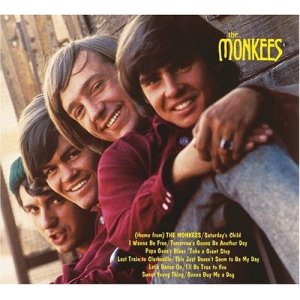
I was skeptical.  She pulled out her copy of The Monkees album and showed me the ring on the cover. She also showed me other pictures in which the ring was visible in detail, revealing some sort of engraving. Then she reached into her jewelry box and pulled out the ring. I swear it was a perfect match. I’ve since lost touch with my friend Chris; maybe I’ll search for the ring on eBay.

Anyway, for better or for worse, they’ll be back on stage. In a TV news interview this morning, Davy said he was looking forward to getting back out there—because he just spent $14,000 on his teeth.

3 Comments

Filed under Movies, Television and Radio, Music

A disparaging word

Recently we discussed, in two separate posts, the use of euphemisms, or words used to make something sound better than it is.

Did you know that the euphemism has an opposite? It’s the dysphemism. A dysphemism is a word that is used to make something sound worse—or harsher or more crude—than it is.

I can’t confirm this anywhere, but I wonder if that is where the modern slang “dis” comes from, as in to insult someone. Does anyone know?

The examples I’ve come across in my research aren’t very polite; I suppose that’s why they are what they are. There are countless dysphemisms for using the restroom. My son used an ugly one recently, so ugly I must have put it out of my mind. I remember only that he used it in front of his grandfather.

About.com’s Grammar & Composition site has an interesting take. Here English professor Richard Nordquist points out that dysphemisms, also called cacophemisms, are used to refer to people often take from animal images. Someone is a pig or an old bat or a chicken. Most of their other examples have to do with death, dying and burial.

Do you have any interesting dysphemisms that can be shared in polite company?

2 Comments

Filed under All Things Wordish, Family and Friends

One man’s treasure

As I’ve been sharing with you lately, my husband and I have begun a process of simplifying our possessions. We spent the first half of our lives collecting; that’s the fun part. I think I told you that my husband collected many things, from antique vegetable and snuff cans to old cameras and photographs, and much in between. I don’t collect anything per se. I just buy stuff. Over 25 years, there has been a lot of accumulation.

We’ve had a lot of fun recently, passing our collections along to others, though we’re not sure if those who receive our surprise packages find it as fun. But it does feel good to weed out our belongings and work toward having fewer things to dust.

Yesterday, I went to an estate sale for the first time. A neighbor of ours, who died recently at the age of a hundred and something, was a collector. Yesterday morning I received notice that the sale would be happening at his house, two doors up, all day, every day for four days. I viewed the items for sale online. There were thousands.

Cars jammed our tiny street and through traffic came to a standstill. A long line formed in front of the house, while a bouncer representing the estate sale company regulated admittance.

I stood in line nearly 45 minutes to get in. I’m not sure why. Perhaps it’s human nature to want some of what so many are rushing to acquire. Mostly, I was curious—curious to see what a hundred-year-old man and his late wife might have amassed over eight or nine decades.

Everything that was ever made in silver and brass. Beautiful antique furniture. Crystal and glass in red, blue and green. Hundreds and hundreds of lamps, atop bases of ceramic roosters, cherubs, fruits and vegetables. Hundreds of candlesticks, salt and pepper shakers and bookends, and the usual trays, bowls and vases but enough of them to fill an outlet store many times over. A two-story, three car garage was full of furniture. And right in the middle of everything, amongst the vast collection of artwork, in a three-foot by four-foot frame, a portrait of John Wayne with an American flag, painted on black velvet.

I left the sale on sensory overload and without making a purchase. I began to wonder, though, why the man’s children weren’t taking all these treasures. Then I realized his children are probably in their eighties.

It seemed a little macabre to be perusing and judging my neighbor’s belongings, and I hope I’ll be forgiven for that. I wish him peace in a world without material possessions, and I hope the family benefits nicely from abundant proceeds. I do know the buyers who’ve been storming our neighborhood will go home satisfied that they’ve gotten some goodies at a bargain. So I guess it’s a win all around.

It does make me all the more motivated to straighten up around here and pass on, selectively and methodically, the treasures we’ve been blessed to enjoy for so many years, while we’re still alive.

And, if clearing out around here gives me a little leeway to purchase new treasures occasionally, say from an estate sale, then all the better. Maybe an objet d’art for the new kitchen.

1 Comment

Filed under Family and Friends, Hearth and Home, Uncategorized

Curse of writing

It was disheartening for me to read recently in the New York Times that cursive writing is fading away, as it is practiced less and emphasized less in schools.

You may be thinking that cursive wasn’t of any use to begin with, that your handwriting has declined and that you never use it any more. I really hope that’s not the case.

We all use computers, there’s no argument there. We rely on our typing and keyboarding skills to do our work and communicate with our friends. Still, there is plenty of room—and utility—for cursive.

I’m a big fan of the handwritten thank you note and the sympathy card. Those occasions call for personal comments written in our own handwriting, which is as much a part of us as our personalities.

Not printing. Printing is for filling out forms and making signs. It might be for writing out a Christmas gift tag or recipes. Printing is not for writing letters. The Post Office may disagree, but printing is also not for addressing envelopes into which we place personal correspondence. Written in ink, thankyouverymuch.

We all know people who print personal notes and, I know, I know, it’s better to have a printed note than none at all. I have one friend who is great at sending hand-written notes, always timely and thoughtful. But hers are not only printed, but printed in all caps—just like she talks.

Here’s the well kept secret. Cursive writing allows us to write faster and more efficiently because, but for dotting an “i” or crossing a “t,” we needn’t lift pen from paper and plunk it back down again. Just think how much energy we waste bobbing that pen up and down when we print. Cursive allows the hand to move in steady, rhythmic motions, like waves in the sea.

You say your cursive is illegible? I’ve got a reasonable amount of sympathy if you have arthritis or another debilitating condition. Consider this: cursive demands fewer movements and a more relaxed hand than printing. An NYT commenter points out that practicing our cursive is one way to preserve our fine motor abilities.

If your hand is still relatively young and able, though, I dare say you’d benefit from a bit of practice. It’s worth it.

As a child, learning cursive was one of the most intimidating things I learned to do. I remember at the beginning of second grade, looking up at the banner that spanned the top of classroom’s front wall and trying to figure out what it all meant. Why a capital Q was formed like the number 2. How the creators of cursive got from a block letter to its swirly cousin. I doubted that I’d ever master it. I struggled. I got D’s in handwriting. I worked at it and finally got it right. Where I went to school, we were given no choice. But, oh, how rewarding to have gained this important skill. I still think it’s the most valuable thing I learned in Catholic school.

Yep; etiquette and utility. Two good reasons to save this dying art by keeping up our practice.

Who’s with me (she says, anticipating resistance)?

6 Comments

Filed under All Things Wordish, Technology and Social Media