Category Archives: Reading

Books, magazines, newspapers

Morpheme drip

On October 15, National Dictionary Day Eve, I came out with my confessions of being a dictionary dweeb. Since then I have received a variety of dictionaries from some thoughtful readers. One day soon, we will get into A Dictionary of Slang and Unconventional English, which I received from a reader in Alaska (make of that what you may; we’ll need to see if “refudiate” is listed).

In the 10/15 post, I recalled the first dictionary I ever had, The Harcourt Brace School Dictionary, which I used in the fourth through sixth grades. I thought I had it around here somewhere but it was not be found among my childhood artifacts. I will say it again, I loved that dictionary. And yesterday I discovered that everything I know about grammar, spelling and word usage came from that primer. Which explains a lot.
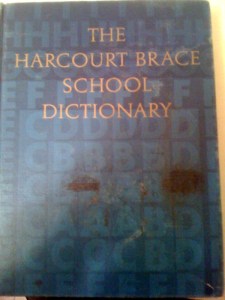
My mother sent me the old dictionary for my birthday. It still smells the same as it did in 1970.

It seems that, when I went on to junior high, I passed the Harcourt Brace on to my younger brother, who wrote his name in it three times, along with a phone number and a note that said, “If not home, call back in 2 or 3 hours.”

Prior to that I had doodled all over the cover and inside pages. My friends had scribbled,  Monica loves XXX, several times, and I had crossed out all the XXXes. There were small illustrations near some of the definitions, where I had written the names of people I didn’t like. One illustration is of a peccary and, even today, I couldn’t have told you what a peccary is without consulting the definition: either of two wild animals of tropical America, like pigs with sharp tusks. I won’t say whose name I wrote under that.

The real nuggets are found on the first 65 pages, before the definitions of words beginning with A.

Pronunciation keys, spelling charts, abbreviations, basic dictionary skills, age-appropriate etymologies, parts of speech, idioms, they’re all in there, along with a section on Spotting the Troublemakers. There are sections on variant spellings and pronunciations, regional pronunciations and British and American spellings.

It’s good to know that during these years, I wasn’t spending all my time reading Tiger Beat and pinning Bobby Sherman and David Cassidy posters up on my walls.

So class, who can tell me what inflectional forms are? The inflectional forms of a word are forms changed by adding a morpheme. What’s a morpheme? I need a refresher myself. I can’t even make out Wikipedia’s explanation. Expect a post on morphemes soon. Perhaps you’d like to write it.
Leave a comment

Filed under All Things Wordish, Family and Friends, Reading

Time capsule in the news

In case you missed them, here are some headlines from Sunday’s Washington Post:

“Twining Criticism Stirs NATO Clash”
“Bulgaria Reds Shift Politburo”
“Nixon Committee to Organize in District”
“Gay Clothes Put Sparkle in Young Eyes”
“Cosmopolitan Tehran Lacks Middle East Table: Hardest place to find a Middle Eastern restaurant in”
“Electronic Gadgets Shrinking to Specks”
An op-ed piece on “Wall Street Money and Politics”
“The Federal Diary: Efficiency Rises in 3 Agencies”

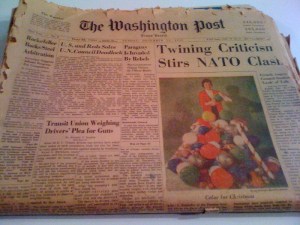
Confused? I pulled these headlines from the Sunday paper that was printed on December 13, 1959, the day I was born. I still have the actual paper my father bought at the Hilton at 16th and K Streets after he dropped my mother off at Georgetown University Hospital. That’s how things were done back then. 

Fifty-one years later, that newspaper is all yellow and crackly around the edges, as am I. Still, I pull it out every year and marvel at how things have changed—and how they haven’t—since 1959.

Debbie Reynolds graced the cover of Parade, while Ann Sothern appeared on the cover of TV Week.

What is now the Style section was “For and About Women.”

One could buy a completely redecorated row house in Georgetown for $28,000 or rent a furnished luxury apartment at 2400 Pennsylvania Avenue for $160 a month. A house in Kensington, Md., where I live, went for $18,900.

District residents were enticed to do their shopping at Julius Garfinkel & Co., Woodward & Lothrop, Kann’s, Raleigh Haberdasher, Best & Co., Stein’s, G.C. Murphy Company and People’s Drug.

IBM took out a want ad for machine operators, offering complete training in Key Punch and Tab and Wiring. Another company advertised openings for “Ambitious Men (white).” Egads.

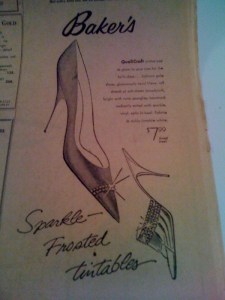
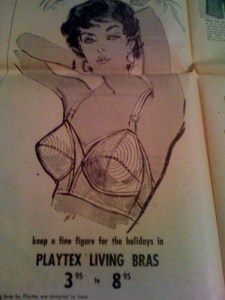
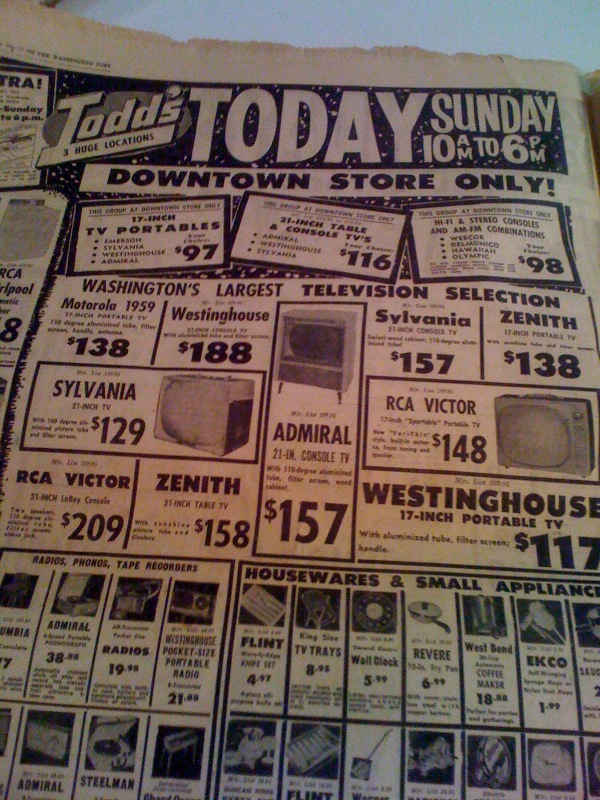
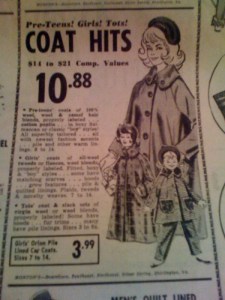
Before I put away this paper time capsule until next year, I thought you might enjoy a few images.


I’m betting many of you recall Washington in the 1950s. Does any of this stir a memory?

9 Comments

Filed under Beauty and Fashion, Family and Friends, Marketing/Advertising/PR, News, Politics, Reading

Literary lunacy

I don’t read a lot of books. Maybe two a year, three at the most.

Don’t get me wrong. I love to read, but it takes me a long time to finish a book. For one thing, I read slowly and, when I am really enjoying a book, I go back and re-read sections, just to wallow in the setting or absorb the dialogue. I like to live in a book and, as with a good movie, I carry the story around with me a while before moving on to the next one.

Also, because I travel a good bit and don’t own a Kindle or a Nook, I find some books too bulky to carry on a plane.

This weekend, after three months, I finally finished The Help by Kathryn Stockett. It is her first novel, which is hard to believe, given the maturity of the story and the real-ness of the characters.

The story takes place in Jackson, Mississippi, in the early 1960s. It is about a community of maids and the women they serve. The chapters are written from the perspectives of different characters, so it took some skill to make the technique work as beautifully as it did.

I won’t say anything more because I want you to read the book, but I would like to share two sentences I especially liked and returned to several times. The character is describing an error she made in a newsletter, which resulted in widespread negative consequences but had reflected her true feelings, as if perhaps she had done it deliberately.

“…it was like something cracked open inside of me, not unlike a watermelon, cool and soothing and sweet. I always thought insanity would be a dark, bitter feeling, but it is drenching and delicious if you really roll around in it.”

I am going to miss those women, but they’ve left me with a whole new outlook on insanity – why fight it?

5 Comments

Filed under Reading, Travel

How to write it

This is Part Three of a three-part series on writing. The series incorporates stated views of several well-known writers and their observations about the craft.

Over the last two days, we have commiserated with some of  the world’s noted writers in confronting the difficulties of writing and we have read their reasons for writing.

Today, we’ll wrap up the series by pretending to ask them for advice on what makes good writing. Here’s what they said:

Stephen King – “Write with the door closed, rewrite with the door open. Your stuff starts out being just for you, in other words, but then it goes out.”

King also said that, “In truth, I’ve found that any day’s routine interruptions and distractions don’t much hurt a work in progress and may actually help it in some ways. It is, after all, the dab of grit that seeps into an oyster’s shell that makes the pearl, not pearl-making seminars with other oysters.”

Mark Twain suggested, “Substitute ‘damn’ every time you’re inclined to write ‘very;’ your editor will delete it and the writing will be just as it should be.” 

Twain also said word choice is critical: “The difference between the right word and the almost right word is the difference between lightning and a lightning bug.”

Anton Chekhov  — “Don’t tell me the moon is shining; show me the glint of light on broken glass.” 

Baltasar Gracián – “A synonym is a word you use when you can’t spell the other one.”

Jean-Luc Godard – “A story should have a beginning, a middle and an end… but not necessarily in that order.”

I find this final quote relevant to modern day writing. In the following passage, substitute the word “diaries” with “blogs” and you’ll see what I mean:

Ann Beattie — “It seems to me that the problem with diaries, and the reason that most of them are so boring, is that every day we vacillate between examining our hangnails and speculating on cosmic order.”

Once again, would you care to share writing techniques that work for you?

See you Monday.

Leave a comment

Filed under All Things Wordish, Quotes, Reading

Why write it?

This is Part Two of a three-part series on writing. The series incorporates stated views of several well-known writers and their observations about the craft.

If yesterday’s topic piqued your interest in coaxing out your inner writer—and especially if it didn’t—you might be inspired by the words of noted writers of the last few centuries.

Given the opportunity to ask them why they write or what they get out of the writing process, this is what they would say. Perhaps at least one of these will appeal to you:

E.L. Doctorow – “Writing is a socially acceptable form of schizophrenia.”

Lord Byron – “If I don’t write to empty my mind, I go mad.”

Kingsley Amis – “If you can’t annoy somebody, there is little point in writing.”

Jules Renard – “Writing is a way of talking without being interrupted.” 

Gloria Steinem – “I do not like to write – I like to have written.”

Apparently, writing isn’t always deliberate for songwriter Joan Baez. I suspect other writers can relate to the inspiration she describes: “It seems to me that those songs that have been any good, I have nothing much to do with the writing of them. The words have just crawled down my sleeve and come out on the page.” 

Tomorrow we will take tips from Mark Twain, Anton Chekhov, Stephen King and others as they describe their techniques for producing good written works.

In the meantime, I’ll ask anyone who cares to answer:  Why do you write?

1 Comment

Filed under All Things Wordish, Quotes, Reading

Just write it

This is Part One of a three-part series on writing. The series incorporates stated views of several well-known writers and their observations about the craft.

After 25 years of writing for business, I started Word Nymph as a place to practice writing for pleasure. You have been patient and gracious guinea pigs.

At key intervals—one month online or the 100th blog post—I have reflected on the lessons I’ve learned. The effort has been underway for about eight months now, with my 200th entry appearing this weekend.

I have never written a book, and likely never will, but I’ve often thought I’d like to give it a try. Nonetheless, I do pay attention to what authors, playwrights and songwriters have observed about the writing process.

American novelist Philip Roth (Goodbye Columbus) was interviewed recently while promoting his new novel, Nemesis. Vanity Fair’s John Heilpern asked Roth, “Do you find writing difficult?” Roth responded, “I find it arduous and un-doable. It’s laden with fear and doubt. It’s never easy—not for me.” I imagine that creative juices, a sharp personal discipline and handsome advances eventually help one over the hurdles.

Even as an amateur blogger, I find I can relate to the observations of a few of the writing maestros:

Stephen King, from his book On Writing: A Memoir of the Craft – “The scariest moment is always just before you start.”

Sharon O’Brien – “Writing became such a process of discovery that I couldn’t wait to get to work in the morning.  I wanted to know what I was going to say.”

James Michener – “I’m not a very good writer, but I’m an excellent rewriter.”

John Osborne“Asking a writer what he thinks about criticism is like asking a lamppost what it feels about dogs.”

Over the next couple of days, I’d like to share insights from other famous writers, including why they write and their techniques for good writing.

Perhaps you have thought of doing more writing. Have you been carrying around a novel idea in your head, or did you read or watch Julie & Julia and think to yourself, I could do that? There’s only one way to find out. Do it.

Don’t be daunted by the comments of Walter Wellesley “Red” Smith, who said, “There’s nothing to writing. All you do is sit down at a typewriter and open a vein.” Or  Gene Fowler, who said, “Writing is easy:  All you do is sit staring at a blank sheet of paper until drops of blood form on your forehead.” 

Just come back tomorrow and Saturday for goodies to put in your writer’s toolbox.

4 Comments

Filed under All Things Wordish, Quotes, Reading

Bring’em back

I just heard about a new book about which I could get pretty excited. My dilemma is whether to go ahead and order now it or hope I get it for Christmas.

It’s called Let’s Bring Back: An Encyclopedia of Forgotten-Yet-Delightful, Chic, Useful, Curious, and Otherwise Commendable Things from Times Gone By and it was written by the Huffington Post’s Lesley M.M. Blume.

By how you know I am quite nostalgic;  just the mention of a blast from the past lifts my spirits.

According to the product description on Amazon.com, the book “invites you to consider whatever happened to cuckoo clocks? Or bed curtains? Why do we have so many “friends” but have done away with the much more useful word “acquaintance”? All of these things, plus hot toddies, riddles, proverbs, corsets, calling cards, and many more, are due for a revival. Throughout this whimsical, beautifully illustrated encyclopedia of nostalgia, Blume breathes new life into the elegant, mysterious, and delightful trappings of bygone eras, honoring the timeless tradition of artful living along the way. Inspired by her much loved column of the same name and featuring entries from famous icons of style and culture, Let’s Bring Back leads readers to rediscover the things that entertained, awed, beautified, satiated, and fascinated in eras past.” Are you aquiver?

Learning about Let’s Bring Back reminded me of another book that evokes similarly fond memories.

American Greats was edited by Stanley Marcus (of Neiman Marcus) and Robert A. Wilson. It too revisits innovations and events that made a significants on American life. For example, the Corvette, the ticker tape parade and Strunk and White’s The Elements of Style, among 280. American Greats is more of a coffee table book, which makes leafing through the photos and commentary all the more fun.

Stanley Marcus has since passed away, but I’d like to share a little story about Robert Wilson, if I might.

Bob Wilson and I worked for the same company about 20 years ago, though our paths crossed only a few times. He was far more senior than I. I admired him as one of the brightest and most creative minds in the company–and one of the humblest. Ten years later, in 2000, I was delighted to have our paths cross again. We had both gone in different directions but found ourselves working on a video shoot for a day. At the end of the day, I was driving him to the train and was looking to make polite conversation. I had remembered he had young children when we knew each other before. So I asked, “How are your boys doing?” Bob replied, “Very well, thanks. Luke and Andrew just finished filming Charlie’s Angels and Owen is in a movie called Meet the Parents.” It didn’t compute.

About a week later, I received an autographed copy of American Greats, with a note thanking me for my work on the project. It wasn’t until I was watching the closing credits of The Royal Tenenbaums—starring Owen Wilson and Luke Wilson and co-written by Owen–that it clicked.

Serious digression, I know. The point was to do three things:

  1. Tell you how intrigued I am about Let’s Bring Back
  2. Encourage you to pick up your own copy of  American Greats
  3. Ask you, what treasures or American greats would you like to bring back?

2 Comments

Filed under Marketing/Advertising/PR, Movies, Television and Radio, Reading

Closing the cover

It’s the end of an era. That’s what people my age and older say about practically everything as it passes.

This week U.S. News & World Report announced that its December issue would be the last to hit newsstands, following 62 years in print circulation. The magazine will continue to live online.

As with many periodicals, U.S. News has been struggling to adapt to dwindling print ads and consumers’ overall shift to the Web, by publishing less often and making other cutbacks.

I am not a regular reader of the magazine. I paid a lot of attention to its famed rankings of U.S. colleges and universities when our son was applying to college five years ago. Otherwise, I read an occasional copy in a doctor’s office, or perhaps on a plane.

However, I remember vividly a year in which I read it consistently.

In my senior year of high school, all students taking Mr. Henretty’s U.S. Government class at Annandale High were required to subscribe to—and read—U.S. News & World Report every week.

Carrying around my copy of U.S. News made me feel more adult than turning 18 did that year. I read U.S. News before I began reading the newspaper regularly. In fact, reading the magazine and discussing it in class might have given rise to the news addiction I developed shortly thereafter. There’s no doubt Mr. Henretty knew what he was doing.

I suspect high school seniors are reading as much news online as we read in print in 1978, if not more. But I can’t imagine their feeling the same pride and excitement that we did, pulling U.S. News & World Report out of our book bags.

As soon as the December issue is on the newsstands, you can bet I’ll be picking up a souvenir copy at an airport near me.

3 Comments

Filed under News, Politics, Reading, Technology and Social Media

Desperate times

I just activated my emergency Snickers bar.

You might be saying to yourself, I thought she was forced to give up chocolate. Well, desperate times call for desperate measures.

I made it through Halloween without a single piece of chocolate, which took great will power; but I was committed to good health and respectful of my dietary restrictions. However, I did stash one Snickers bar, perhaps as a measure of security, where I could get to it in an emergency.

Recently, some minor yet frustrating annoyances have graced our doorstep, which have called for generous amounts of patience and flexibility. The first was October’s fender bender and the various inconveniences that ensued.

I fully appreciate that the flies in my ointment are mere gnats compared to what the world’s poor, sick and homeless face every day. All the more reason to face one’s irritations with proper perspective.

So, as my gnats began to reproduce and mutate, I consulted my handy new manual, How to Say It, to be sure I addressed each inconvenience—and the person behind it—appropriately. Chapter 13 on Complaints offered a wealth of tips and techniques for airing one’s grievances, firmly but politely. I drew upon the insights offered in Chapter 13 to respond to statements like, We’re sorry, Mrs. Welch, but the rug you ordered in August, that was to be delivered in September, might (but we cannot offer any guarantee) be delivered in mid-January, and We’re sorry, Mrs. Welch, but the home project that was to be done in October is delayed indefinitely. We hope to start before Christmas (but we cannot offer any guarantee).

Chapter 13 gave me the right words but it provided no guarantee. Or result. I was on the edge.

With the ointment now full of horse flies, the only weapon I had left was an illegal, fun-sized Snickers bar.

Now, following a Snickers breakfast and paying the piper for it, I will leave  to catch an early flight with an impossibly tight connection. I will be optimistic about not hearing your flight is delayed, your flight has been cancelled or you missed your connection. (Heaven knows, the airlines offer no guarantee.)

Either way, I know the newsstand sells grown-up sized Snickers bars. And extra strength Tums.

Optimism aside, is it an omen that an enormous fly is buzzing overhead as I write this?

3 Comments

Filed under Food, Health, Holidays, Rants and Raves, Reading, Travel

Hefty and handy

I don’t know how many will share my enthusiasm, but I just found something to really sink my teeth into—though if it were a sandwich, I’d have trouble getting my teeth around it. It’s that big.

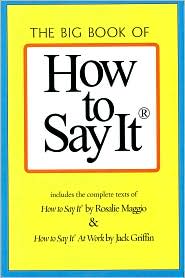
It practically jumped right out of the Border’s bargain bin into my welcoming arms. Nearly three pounds and 890 pages of meat. It’s called The Big Book of How to Say It. You may already know it; it’s been out for 12 years.

Of course, the title caught my eye. At first, I took it for another tome for word geeks. Actually, it’s two tomes, How to Say It by Rosalie Maggio and How to Say It At Work by Jack Griffin.

Cringe not; this book has little to do with grammar and everything to do with writing and speaking one’s mind in the most thoughtful, personal and effective way—under almost any practical social or business scenario.

The Big Book is also not an etiquette book. While offering suggestions on the most appropriate way to express one’s thoughts, the focus is on choosing the right words and tone for the occasion, customized for the addresser and addressee alike.

I immediately bought it for a special someone for Christmas. Now I’m reluctant to give it up. There are more than 60 chapters dealing with everything from expressing (and accepting) a simple condolence to applying for a job, and 58 topics in between. Each chapter includes several options for “How to Say It” as well as “What Not to Say.”  There’s also a mini-thesaurus in each chapter, along with handy writing tips to suit the situation.

Apologies. Holiday letters. Complaints. Job terminations. Negotiating a promotion. Renegotiating a deadline. Accepting a compliment. Taking criticism. Handling a snafu. Agreeing to a drug test. Announcing the cancellation of a wedding. It’s all there.

As a bonus , in one of the chapters dealing with getting a job, there’s a whole section on How to Say it with Clothes, including 28 tips for men and 23 for women. Just remember, the book was written in 1998.

If you’re looking for just the right gift for everyone on your shopping list this holiday season–word nerd, etiquette geek or lay person–then grab a forklift and head on over to Borders. You could order online but the shipping might cost more than the book.

4 Comments

Filed under All Things Wordish, Holidays, Marketing/Advertising/PR, Reading