
Wow, I have this craving for some good bird’s tongue. How about you?
This post is another in the series in which I pull a book out of the stacks and write about it. I hope you’re game.
Fourteen years ago, long before the word nymph in me emerged, or so I thought, a friend and former colleague gave me a book entitled Ladyfingers & Nun’s Tummies: A Lighthearted Look at How Foods Got Their Names, by Martha Barnette, who was once a reporter with The Washington Post. I remember my friend saying he thought the book suited me because of my love of food and words.
Barnette grabs readers of my type with the first sentence of the introduction: “Sometimes the very name of a food tickles our taste buds before a bite of it ever reaches our mouths. Saltimbocca, tiramisu, teriyaki, shabu-shabu, passion fruit, angel hair, soubise, bubble and squeak, chimichanga, couscous – rolling any of these words around on our tongues is a sensory experience all its own.”
Bubble and squeak? Come again? Bubble and squeak comes from the chapter on foods named for what they do while cooking. It’s a potato and cabbage dish that apparently makes noise when it’s frying.
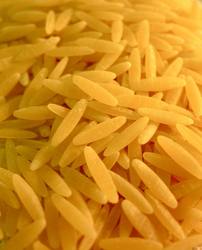
Bird's tongue (orzo)
There are chapters on foods named for what they look like (e.g., bare buttocks in the grass); food names associated with religion or the supernatural (no surprise that there are lots of angels and devils, but also Judas’ ear); foods named by mistake, often as a result of goofs in translation (including German chocolate cake and Jordan almonds); foods named for people and places (the chapter is called “Edible Eponyms and Tasty Toponyms,” surely a topic for another day); foods named for what’s done to them or what they do to us; and words deriving from other words about food and drink.
Did you know that, In Lebanon, the long rolled pastry known as zunuud as-sitt translates from “woman’s upper arms?” It’s in there.
The book contains hundreds more little-known facts about food names and where they come from. I could stretch this out over several days, and maybe I’ll regret it if I don’t. In the meantime, maybe I’ll give you a little homework assignment.
See if you know—or can find—the recognized food names for the following:
- Apple in its bathrobe
- Angel’s breasts
- Boudoir biscuits
- Dad’s beard
- Dead fingers
- Friar’s balls
- Naughty children’s toes
- Tipsy parson
- Spicy bishop
- Whore’s pasta
Want to have some more fun? Look up the origin of pumpernickel.
One final note: my father recently suggested I address the origin of the word “bedlam,” and he traced its origin for me. What I learned from Ladyfingers & Nun’s Tummies, though, is that the word goes back even farther, with its origin in food. Maybe tomorrow?

 I looked the book up online to see if I could get a little background. I found only a used book site, where several owners were selling their copies. The site did tell me that, if I liked this book, I might also like 2000 Foreign Policy Overview and the President’s Fiscal Year 2001 Foreign Affairs Budget Request: Congress hearing. I think I’ll pass. Maybe I’ll wait for the movie.
 I received many blessings this Easter, including SweeTarts and other goodies. One gift is something you and I will be able to enjoy together in weeks and months to come.
 Some 40 days have passed and we are now at the Holy Triduum—the three days preceding Easter, beginning today with Maundy Thursday, which commemorates, among other significant happenings, the Last Supper.
 As I glance at my bookcase, I count more than a dozen books about the first years of life. Were those really needed, when what we focused on at that stage was putting food in one end and cleaning up at the other? The loving came naturally.
 We’ve all had that dream about going into a final exam after forgetting to go to class for a whole semester. Or being out in public without a stitch of clothing. I also have one in which I’ve neglected a pet too long. Gruesome, I know, but it reflects the depth of this fear I share with Jeter.


 This isn’t because I’m not enjoying Wicked. On the contrary, it’s because I am.
 Word Nymph