Category Archives: All Things Wordish

grammar, punctuation, usage, spelling, speech

Gold in the freestyle

Did you hear? The United States took six gold medals over the weekend.

No, I’m not a year early for the Olympics. The event to which I’m referring didn’t take place in London but rather, in Trondheim, Norway: the biennial World Beard & Mustache Championships, considered to be the premier competition of the world’s facial hair elite.

Following last weekend’s competitions, organizers announced that Keith Haubrich “completed the three-peat in Freestyle Moustache. Newcomers to the world stage Bill Mitchell from Georgia and Giovanni Dominice from Arizona won in Partial Beard Freestyle and Imperial Moustache respectively.” For an interpretation of what this means, and to get a sense of the hairy-ness of the competition, do spend time on your lunch hour today combing through the organization’s website, which is translated into 19 languages.

In case you were wondering, I didn’t happen on the news by trolling obscure sources for blog topics. This world event was covered by CNN, which ran a pre-event story online last Friday and used up all the good hair puns (e.g., the competition has its roots in a 1990 event).

A couple of quotes CNN ran caught my eye. Ole Skibnes, the president of the host Norwegian Moustache Club, said, “You can’t just judge the size of the moustache — you have to see if the hair is well-groomed, see if it suits the person, see if it makes them look good.” Notice Skibnes uses “they” in lieu of a masculine pronoun. Interesting. Could it be that the games aren’t Just for Men?

CNN also reported: “It was at the Anchorage games that the United States emerged as the ‘premier power in world bearding,’ according to Beard Team USA captain Phil Olsen, who predicts that America will net a staggering eight out of 17 possible gold medals at the games.” Olsen’s prediction fell short by two, but I’m giving him points for using “bearding” as a verb as though it were an Olympic sport. 

By the way, Team USA will hold its next national competition this fall in the Amish country of Lancaster, Pennsylvania. Be there or be without hair.

Leave a comment

Filed under All Things Wordish, News, Sports and Recreation

Corrective conundrum

A few weeks ago, my husband left a calling card of sorts on my desk. It was a clip from an advice column in The Washington Post, in which a man complained about his girlfriend’s correcting his grammar and pronunciation. I never asked my husband whether he intended this to be an idea for my blog or a hint that he was relating to the poor bloke whose girlfriend corrected him—and only him—in front of others.

In the meantime, over the weekend, an opinion piece by Slate writer Michael Agger appeared in the Washington Post Business section. The piece cited instances in which companies receiving online reviews of their products and services corrected the spelling and grammar of their posting customers. Agger questioned the ethics of such practices, raising the issue of altering the authenticity of the online review process. Companies argue that sloppy posts, including favorable ones about their products or services, make the company look bad and, hence, impede sales.

When I wrote a piece about correcting others and being corrected  last February, I got a sense of how my readers feel about it. But correcting what is posted as an online review is different. Or is it?

I must confess here that I occasionally do the same thing with this blog. Sometimes when a reader posts a comment and makes an inadvertent mistake in spelling, grammar or punctuation, I go in and make a minor correction. Not all the time, and not drastically. And I never alter the content.

Unlike text-tweaking online retailers, I don’t correct mistakes because they make me look bad. I do it to save commenters from potential embarrassment. You might say that I edit their comments to help them make their points more effectively. For example, if someone is preaching about the importance of good grammar, and misspells “grammar,” I don’t believe it’s a sin to go in and correct the spelling. Or if there’s a simple typo, I might go in and fix it.

This said, it doesn’t mean I don’t bristle when I see a comment lacking any upper case letters or essential punctuation, but I give benefit of the doubt when I suspect comments are generated on a mobile device. Occasionally, however, this has precipitated sidebar conversations with my loved ones, suggesting they reacquaint themselves with their friend, the apostrophe.

Where to draw the line with a red pen? Discuss.

1 Comment

Filed under All Things Wordish, Technology and Social Media

A disparaging word

Recently we discussed, in two separate posts, the use of euphemisms, or words used to make something sound better than it is.

Did you know that the euphemism has an opposite? It’s the dysphemism. A dysphemism is a word that is used to make something sound worse—or harsher or more crude—than it is.

I can’t confirm this anywhere, but I wonder if that is where the modern slang “dis” comes from, as in to insult someone. Does anyone know?

The examples I’ve come across in my research aren’t very polite; I suppose that’s why they are what they are. There are countless dysphemisms for using the restroom. My son used an ugly one recently, so ugly I must have put it out of my mind. I remember only that he used it in front of his grandfather.

About.com’s Grammar & Composition site has an interesting take. Here English professor Richard Nordquist points out that dysphemisms, also called cacophemisms, are used to refer to people often take from animal images. Someone is a pig or an old bat or a chicken. Most of their other examples have to do with death, dying and burial.

Do you have any interesting dysphemisms that can be shared in polite company?

2 Comments

Filed under All Things Wordish, Family and Friends

Curse of writing

It was disheartening for me to read recently in the New York Times that cursive writing is fading away, as it is practiced less and emphasized less in schools.

You may be thinking that cursive wasn’t of any use to begin with, that your handwriting has declined and that you never use it any more. I really hope that’s not the case.

We all use computers, there’s no argument there. We rely on our typing and keyboarding skills to do our work and communicate with our friends. Still, there is plenty of room—and utility—for cursive.

I’m a big fan of the handwritten thank you note and the sympathy card. Those occasions call for personal comments written in our own handwriting, which is as much a part of us as our personalities.

Not printing. Printing is for filling out forms and making signs. It might be for writing out a Christmas gift tag or recipes. Printing is not for writing letters. The Post Office may disagree, but printing is also not for addressing envelopes into which we place personal correspondence. Written in ink, thankyouverymuch.

We all know people who print personal notes and, I know, I know, it’s better to have a printed note than none at all. I have one friend who is great at sending hand-written notes, always timely and thoughtful. But hers are not only printed, but printed in all caps—just like she talks.

Here’s the well kept secret. Cursive writing allows us to write faster and more efficiently because, but for dotting an “i” or crossing a “t,” we needn’t lift pen from paper and plunk it back down again. Just think how much energy we waste bobbing that pen up and down when we print. Cursive allows the hand to move in steady, rhythmic motions, like waves in the sea.

You say your cursive is illegible? I’ve got a reasonable amount of sympathy if you have arthritis or another debilitating condition. Consider this: cursive demands fewer movements and a more relaxed hand than printing. An NYT commenter points out that practicing our cursive is one way to preserve our fine motor abilities.

If your hand is still relatively young and able, though, I dare say you’d benefit from a bit of practice. It’s worth it.

As a child, learning cursive was one of the most intimidating things I learned to do. I remember at the beginning of second grade, looking up at the banner that spanned the top of classroom’s front wall and trying to figure out what it all meant. Why a capital Q was formed like the number 2. How the creators of cursive got from a block letter to its swirly cousin. I doubted that I’d ever master it. I struggled. I got D’s in handwriting. I worked at it and finally got it right. Where I went to school, we were given no choice. But, oh, how rewarding to have gained this important skill. I still think it’s the most valuable thing I learned in Catholic school.

Yep; etiquette and utility. Two good reasons to save this dying art by keeping up our practice.

Who’s with me (she says, anticipating resistance)?

6 Comments

Filed under All Things Wordish, Technology and Social Media

Mother matters

Two of my favorite sitcoms this season are The Middle on ABC and Raising Hope on Fox. Perhaps it’s because they’re as real life as can be, especially when it comes to the mother roles. I also like ABC’s Modern Family and NBC’s Parenthood because they reflect the humorous imperfections alive in families.

This morning I pulled the Parade magazine out of the cellophaned supplements and smiled to find featured the four mothers on these shows. In “The Mom Squad,” the actresses playing popular TV mothers give their takes on motherhood.

Whether or not you’re a mother, I think you’ll see a little bit of yourself in one or more of the characters the actresses portray. I know I did.

“A type A anxious mother . . . a little nuts, a little stubborn.”

“She likes to eat. She likes to drink. She loves her kid, but she’s not focused on being the World’s Greatest Mom . . . She’s not reading the mommy blogs, but she has this gooey center.”

“Works because her family needs the money. But in other ways she’s a lot like Lucy in I Love Lucy—she freaks out about stuff, tries to overcontrol situations, and does harebrained things. And her husband is this calming, sensible force who says, ‘Let’s chill.’”

“A stay-at-home mom, but the kids are getting older and she’s trying to work out who she is now that they don’t need her so much.”

(Another favorite quote from the article is one in which actress Martha Plimpton describes the twins who play her granddaughter on Raising Hope. She says, “the little fat behind the neck is like a fine foie gras.”)

So which modern TV mother are you? Or maybe you’re more of a traditional TV mother like June Cleaver or Edith Bunker. Or a mod 1960s or ‘70s mother like Samantha Stevens or Shirley Partridge. Which one do you wish you were and why?

While we’re on the subject, notice I said TV “mother,” and not “mom.” I have a little peeve about this and what better day to air it than on the eve of Mother’s Day? Notice it’s not Mom’s Day. Mom is a name. Mom is not a noun. In my view, someone is not a mom. She’s a working mother, a stay-at-home mother, a single mother or simply, a mother. Madison Avenue is the worst offender, often producing ad copy that says a product is “preferred by moms.” (Such a claim is also backward for this day and age.)

Some dictionaries have acquiesced a bit, but most define “mom” as informal for “mother.”

In my opinion, it’s all right to refer to “my Mom,” but to use “mom” to refer to any woman with children is sloppy speech. Same goes for “dad.”

Why? Because I said so.

3 Comments

Filed under All Things Wordish, Holidays, Marketing/Advertising/PR, Movies, Television and Radio

Chesapeake speak

Yesterday I had another occasion to call into a help desk. This time, my computer virus protection package was expiring and I had a question about the renewal.

No grammatical goofs came through this time but, if they did, they were overshadowed by something else. When I inquired as to whether there had been a problem with my subscription renewal, the young woman said, “There’s no problem, Hon.”

Hon?

Immediately, I suspected this didn’t roll off the tongue the way most terms of endearment do, say by a salty diner waitress or an avuncular car salesman.

Call me a cynic, but I’ll bet you anything that my call came in with some sort of tag saying I was dialing in from Maryland. “Hon” is Maryland’s trademark pet name; the closer you are to Baltimore, the more likely you’ll hear it.

Perhaps it was a case of life imitating art imitating life.

Here’s what I mean. Last fall, NBC debuted a sitcom called Outsourced. Based on a film of the same name, the show is set in a call center in India. The American manager trains Indian help desk operators to seem American by teaching them about the U.S. culture and speech. Here, have a look:

It’s no secret many U.S. companies run business operations out of India and other countries, where it’s cheaper and more efficient to do so. And it’s true that these customer service personnel have become adept at communicating seamlessly with American customers. Maybe that’s why they all seem to be named Julie.

I gather help desk operators, regardless of where they’re based, work off a pretty tight script and they stick to it. I already know they have key data about me. What’s to say they the script doesn’t weave in a geo-specific colloquialism or two for effect?

Are ya with me, Hon?

Leave a comment

Filed under All Things Wordish, Movies, Television and Radio, Technology and Social Media

The point being

Three weeks ago, I wrote about the dreaded double-is, as in “the problem is is,” which so many people say, most likely because they misheard it somewhere, picked it up and absorbed it into their speech, thinking it sounded sophisticated. In my post that day, I explained why it is redundant and incorrect to use “is” twice in a row when not preceded by a clause.

I should have thought to bring up a related error while I was on the subject. It wasn’t until I was on the phone with a help desk employee that I remembered it.

Upon making a hotel reservation recently, I discovered that my Hilton Honors membership had lapsed. The nice lady on the line explained it this way: “The reason being is that you haven’t stayed in a Hilton since 2008.”

Well, I stayed at a Hilton just six weeks ago, but that’s beside the point. The issue is “being is…” One verb, used twice, once as a gerund, the other in the present tense. Right next to each other.

I don’t intend to be snooty or judgmental (maybe a little), but I think people believe they sound intelligent when they say “the reason being is…,” just as they do when they say “the reason is is…”

The help desk lady could have explained the membership lapse at least two ways and been grammatically correct. She could have said, “The reason is that guests who do not stay with us for one year lose their membership statuses.” Alternatively, she could have said, “Your membership has lapsed, the reason being that you have not stayed with us since 2008” (subordinate adverbial clause). One may use either “being” or “is,” one or the other, not both.  Or the lady could have left the verb “to be” out of it altogether and thrown in a simple “because.”

But never “the reason is because.” That’s a subject for a whole other day (not “a whole nother day”).

5 Comments

Filed under All Things Wordish, Travel

Candy coating

There wasn’t as much time as I had hoped yesterday to read my new Euphemisms book; however, euphemisms continued to play in my mental background as I went about my business.
At one point during the day, my mind wandered back to my days working for a Fortune 100 company, employed in what my new dictionary calls “legislative advocacy leadership.” Large corporations are masters at euphemistic technique, a talent that serves them well when applied artfully. I am betting there are readers who have worked in corporate America who have examples to share. Please?

We had “resource realignment,” translation: layoffs. When competing for business that we didn’t win, we were “deselected.” When we made one of the cuts preceding final selection, we were “down selected.”  We also had an “appearance policy,” which was a dress code. Oh, the good old days.

It’s been a while since I worked directly for a corporate concern, but yesterday I received notice of a seminar on “Capture Management.” At the risk of revealing a pinhole in my skill set, I trust this has something to do with sales.

Government uses euphemisms too. They have “revenue enhancements” and “quantitative adjustments.” The financial industry refers to “correction” when the market falls. Every sector has its rose-colored lingo.

I’ll close today with a list excerpted from comments posted on an article on Education World’s website. It’s been around the block but never ceases to amuse me. I might award first prize to our nation’s hardworking teachers for euphemistically finding the bright spot in every trying situation:

Molly demonstrates problems with spatial relationships.
It’s November and she still hasn’t found her cubby.

Paul’s leadership qualities need to be more democratically directed.
He’s a bully.

Jonathan accomplishes tasks when his interest is stimulated.
He has the attention span of a gnat.

Alfred demonstrates some difficulty meeting the challenges of information retention.
He’d forget his name if it wasn’t taped to his desk.

Bunny needs encouragement in learning to form lasting friendships.
Nobody likes her.

Joel appears to be aware of all classroom activities.
He just can’t focus on the one we’re involved in.

David frequently appears bored and restless. You might want to consider placing him in a more challenging environment.
Prison, perhaps?

3 Comments

Filed under All Things Wordish, Marketing/Advertising/PR

Pretty it up

Call me one lucky word nymph. I say how much I love words and how they’re used and people send give me their treasured dictionaries. I say how I much I love SweeTarts and people think of me when they see the candies in stores. I publicly fear coming up dry and people send me suggestions for topics.

I received many blessings this Easter, including SweeTarts and other goodies. One gift is something you and I will be able to enjoy together in weeks and months to come.

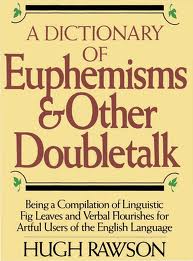
Get ready to enjoy picks from Hugh Rawson’s A Dictionary of Euphemisms & Other Doubletalk: Being a Compilation of Linguistic Fig Leaves and Verbal Flourishes for Artful Users of the English Language, a treasure that came my way thanks to a very special Easter Bunny.

I’ve wanted to write about euphemisms for some time; in fact, I noticed that I had jotted it down on a pad where I park blog ideas, just before I received the book. I had been separating euphemisms from political correctness in my mind in hopes of sharing some subtleties. I’ll do this later, after I’ve had time to delve into 312 pages of euphemisms A to Z. Already I’ve come upon some gems. Doubletalk merits its own discussion altogether. It’s an art often disparagingly attributed to politicians but made famous by comedic greats Carl Reiner and Sid Caesar. Or maybe that’s doublespeak. I’ll look into that.

This dictionary might be my favorite yet; I see great utility. There’s another one out there that looks interesting: A Dictionary of Euphemisms: How Not To Say What You Mean by R.W. Holder, which could be of value to those practicing in the field of crisis communications.

While I’m at work on this, what are some of your favorite euphemisms?

(So far, mine might be “embroider the truth.”)

Leave a comment

Filed under All Things Wordish, Reading

Ape for annuities

Let’s see. How long is the list of companies whose commercials contain grammatical errors? I can count Boniva, Honey Bunches of Oats, Miller Genuine Draft and a few more I can’t recall at the moment. Today I am adding Honda for its recent tagline: “To each their own.” Sheesh.

Another one has been bugging me, not for its grammar but for its mixed metaphor. What has me puzzled is—as is often the case—how it escaped the smart and well paid execs who craft and place television ads.

Take a look at one of Axa Equitable Life Insurance Company’s most recent spots and tell me if you notice it.

“What do I know? I’m just the 800-pound gorilla in the room.”

Pick one, guys. It’s either “the 800-pound gorilla” or “the elephant in the room.” These expressions mean two different things, the latter being more apt for Axa’s campaign. Perhaps the elephant failed the audition.

Just before Axa Equitable launched the campaign during the 2007 Super Bowl, the company said in a press release that it sought to encourage the approximately 77 million baby boomers in America to “stop ignoring the 800-pound gorilla in the  room” and buy their variable annuities.

 Four years later, the campaign continues. The commercials have won numerous industry awards and still, no one is challenging their metaphorical duplicity. Naturally, retirement planning and life insurance are important subjects that many prefer to ignore; in this vein, the commercials are hitting the intended demographic target. It’s just that Axa has picked the wrong spokesmammal.

Do we need a refresher?

“The elephant in the room” represents a sizeable subject that everyone is aware of but no one wants to talk about. It might be a looming crisis or a relative’s drinking problem. Everyone knows it’s there—it’s too big to ignore—but we pretend not to notice it. 

An “800-pound gorilla” is a bully, a goliath, a behemoth. Just think of the old riddle.

“Where does an 800-pound gorilla sleep?”
“Anywhere he wants.”

7 Comments

Filed under All Things Wordish, Marketing/Advertising/PR