Category Archives: All Things Wordish

grammar, punctuation, usage, spelling, speech

Why write it?

This is Part Two of a three-part series on writing. The series incorporates stated views of several well-known writers and their observations about the craft.

If yesterday’s topic piqued your interest in coaxing out your inner writer—and especially if it didn’t—you might be inspired by the words of noted writers of the last few centuries.

Given the opportunity to ask them why they write or what they get out of the writing process, this is what they would say. Perhaps at least one of these will appeal to you:

E.L. Doctorow – “Writing is a socially acceptable form of schizophrenia.”

Lord Byron – “If I don’t write to empty my mind, I go mad.”

Kingsley Amis – “If you can’t annoy somebody, there is little point in writing.”

Jules Renard – “Writing is a way of talking without being interrupted.” 

Gloria Steinem – “I do not like to write – I like to have written.”

Apparently, writing isn’t always deliberate for songwriter Joan Baez. I suspect other writers can relate to the inspiration she describes: “It seems to me that those songs that have been any good, I have nothing much to do with the writing of them. The words have just crawled down my sleeve and come out on the page.” 

Tomorrow we will take tips from Mark Twain, Anton Chekhov, Stephen King and others as they describe their techniques for producing good written works.

In the meantime, I’ll ask anyone who cares to answer:  Why do you write?

1 Comment

Filed under All Things Wordish, Quotes, Reading

Just write it

This is Part One of a three-part series on writing. The series incorporates stated views of several well-known writers and their observations about the craft.

After 25 years of writing for business, I started Word Nymph as a place to practice writing for pleasure. You have been patient and gracious guinea pigs.

At key intervals—one month online or the 100th blog post—I have reflected on the lessons I’ve learned. The effort has been underway for about eight months now, with my 200th entry appearing this weekend.

I have never written a book, and likely never will, but I’ve often thought I’d like to give it a try. Nonetheless, I do pay attention to what authors, playwrights and songwriters have observed about the writing process.

American novelist Philip Roth (Goodbye Columbus) was interviewed recently while promoting his new novel, Nemesis. Vanity Fair’s John Heilpern asked Roth, “Do you find writing difficult?” Roth responded, “I find it arduous and un-doable. It’s laden with fear and doubt. It’s never easy—not for me.” I imagine that creative juices, a sharp personal discipline and handsome advances eventually help one over the hurdles.

Even as an amateur blogger, I find I can relate to the observations of a few of the writing maestros:

Stephen King, from his book On Writing: A Memoir of the Craft – “The scariest moment is always just before you start.”

Sharon O’Brien – “Writing became such a process of discovery that I couldn’t wait to get to work in the morning.  I wanted to know what I was going to say.”

James Michener – “I’m not a very good writer, but I’m an excellent rewriter.”

John Osborne“Asking a writer what he thinks about criticism is like asking a lamppost what it feels about dogs.”

Over the next couple of days, I’d like to share insights from other famous writers, including why they write and their techniques for good writing.

Perhaps you have thought of doing more writing. Have you been carrying around a novel idea in your head, or did you read or watch Julie & Julia and think to yourself, I could do that? There’s only one way to find out. Do it.

Don’t be daunted by the comments of Walter Wellesley “Red” Smith, who said, “There’s nothing to writing. All you do is sit down at a typewriter and open a vein.” Or  Gene Fowler, who said, “Writing is easy:  All you do is sit staring at a blank sheet of paper until drops of blood form on your forehead.” 

Just come back tomorrow and Saturday for goodies to put in your writer’s toolbox.

4 Comments

Filed under All Things Wordish, Quotes, Reading

’Tis taboo

If my September 25 post reminding you that you only have three months to write your holiday letter didn’t send you straight to the keyboard, that’s good—because I’ve found a great set of tips for how not to write your letter.

I am not biggest fan of Christmas letters, and yet I can’t refrain from writing them. What’s more, I can’t keep myself from slipping into what I know are bad habits. In my 2006 letter, I actually listed all the things I felt people shouldn’t say in a holiday letter, mostly because they are cliché or cover topics in which only the writer is interested. Then I turned around and used one.

In my opinion, the most cliché way to open a holiday letter is by asking, “Where has the time gone?” or “Where did the year go?” I also prefer to omit unseemly medical conditions that might spoil a reader’s cup of Christmas tea. A letter we received one year actually contained the words “rectal prolapse.”

I could go on and on but I will let John E. McIntyre of The Baltimore Sun do it for me – and more eloquently at that. In a recent blog piece, McIntyre offers tips for making a letter less cheesy than it might be. He suggests refraining from any and all holiday metaphors, analogies and parodies of the Twelve Days of Christmas. He also reminds us that the 12 days begin on Christmas and run through January 6th. This is especially important to me, not just as a Christian but also because my birthday falls 12 days before Christmas, and I’d like a little time to celebrate the occasion (and observe Advent) before the big day hits.

McIntyre also helpfully points out that, while Hanukkah comes close to Christmas, “they are not twins.” Nevertheless, is it still all right for me to use my holiday card to wish a happy Hanukkah to all my Jewish friends?

He advises letter writers to avoid ‘Tis and ‘Twas and to back away from the Dickensian: “No ghosts of anything past, present or future. Delete bah and humbug from your working vocabulary. Treat Scrooge as you would the Grinch, by ignoring him. Leave little Tiny Tim alone, too.”

If you’re interested in cutting the cheese from your holiday letter, then before you put pen to pad, or fingertips to keyboard, try heeding John McIntyre’s advice. I promise to do the same.

1 Comment

Filed under All Things Wordish, Family and Friends, Holidays

Who that?

Here’s a little quiz for anyone who is interested in relative pronouns.

Please jot down which sentence in the following sequence you believe is correct. 

1(a)  I am grateful for all the friends that came to my birthday party.
1(b)  I am grateful for all the friends who came to my birthday party.

2(a)  Thanks to all the veterans that served our country.
2(b)  Thanks to all the veterans who served our country.

3(a)  Everyone that has a pet should shop at PetSmart.
3(b)  Everyone who has a pet should shop at PetSmart.

4(a)  I know a lot of people that use “that” when “who” is the better choice.
4(b)  I know a lot of people who use “that” when “who” is the better choice.

If you chose (b) in each set of choices, you get an A. Perhaps I should say, you’d get an A if I were grading the quiz. It turns out that some authorities are more lax than others on this issue.

Before issuing a premature refresher, I did some research on relative pronouns and, in this case, restrictive relative pronouns, where the antecedent happens to be a person rather than a thing.

I was taught that people—and nouns that represent people—should be followed by “who” rather than “that.” In the examples above, friends, veterans and everyone refer to people.

However, a couple of sources maintain that both “that” and “who” are correct and are a matter of preference rather than rule.

But wouldn’t you agree that, in reference to a person, “who” is more polished, more personal and more exact?

Feel free to disagree; you can be the reader who stood up for “that.”

You’ll notice I haven’t yet addressed “that” versus “which.” Even though I know the rule on restrictive and non-restrictive clauses, it is one that trips me up frequently. Or is it which? I know, it’s that.

3 Comments

Filed under All Things Wordish

Hefty and handy

I don’t know how many will share my enthusiasm, but I just found something to really sink my teeth into—though if it were a sandwich, I’d have trouble getting my teeth around it. It’s that big.

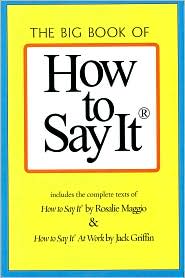
It practically jumped right out of the Border’s bargain bin into my welcoming arms. Nearly three pounds and 890 pages of meat. It’s called The Big Book of How to Say It. You may already know it; it’s been out for 12 years.

Of course, the title caught my eye. At first, I took it for another tome for word geeks. Actually, it’s two tomes, How to Say It by Rosalie Maggio and How to Say It At Work by Jack Griffin.

Cringe not; this book has little to do with grammar and everything to do with writing and speaking one’s mind in the most thoughtful, personal and effective way—under almost any practical social or business scenario.

The Big Book is also not an etiquette book. While offering suggestions on the most appropriate way to express one’s thoughts, the focus is on choosing the right words and tone for the occasion, customized for the addresser and addressee alike.

I immediately bought it for a special someone for Christmas. Now I’m reluctant to give it up. There are more than 60 chapters dealing with everything from expressing (and accepting) a simple condolence to applying for a job, and 58 topics in between. Each chapter includes several options for “How to Say It” as well as “What Not to Say.”  There’s also a mini-thesaurus in each chapter, along with handy writing tips to suit the situation.

Apologies. Holiday letters. Complaints. Job terminations. Negotiating a promotion. Renegotiating a deadline. Accepting a compliment. Taking criticism. Handling a snafu. Agreeing to a drug test. Announcing the cancellation of a wedding. It’s all there.

As a bonus , in one of the chapters dealing with getting a job, there’s a whole section on How to Say it with Clothes, including 28 tips for men and 23 for women. Just remember, the book was written in 1998.

If you’re looking for just the right gift for everyone on your shopping list this holiday season–word nerd, etiquette geek or lay person–then grab a forklift and head on over to Borders. You could order online but the shipping might cost more than the book.

4 Comments

Filed under All Things Wordish, Holidays, Marketing/Advertising/PR, Reading

Bass ackwards

Earlier this week a reader requested a piece on spoonerisms.

Spoonerisms are words in phrases in which the first letters or syllables are switched, often inadvertently. They can be simple slips of the tongue or deliberate plays on words.

The spoonerism is named for the Reverend William Archibald Spooner (1844-1930), Warden of New College, Oxford, who was famous for his slips, perhaps the most storied of which was a toast he made at a University event, in which he proposed, “Three cheers for our queer old dean!” Another account of that story has Rev. Spooner having said, “Let us glaze our asses and toast the queer dean.”

As I have worked through the many word plays for this blog, I’ve skipped over spoonerisms quite a few times. I can think of two possible reasons.

One, I don’t find spoonerisms as funny as many people do. And they’re often associated with inebriation, as in “tee martoonis.” Two, I once committed such an offensive, yet inadvertent spoonerism that it was intensely traumatic, both for me and a waiter, and nearly got me thrown out of a restaurant in 1994. I didn’t have the courage to go back until 2007.

However, for those who do find amusement in spoonerisms, there are far more examples out on the Internet than on any word plays we’ve covered here. So, please, go forth and giggle.

According to a website called The Straight Dope (caution, it’s addictive, you’ll lose an entire afternoon): There is some difference of opinion about what constitutes a true spoonerism. Some authorities view that a spoonerism can only involve an exchange of initial sounds (usually consonants); thus, “peas and carrots” becomes “keys and parrots.” Others allow transposition of syllables (“Don’t put all your Basques in one exit”) or word parts (“When I throw rocks at seagulls, I leave no tern unstoned.”). And others allow the transposition of entire words (“The cows sent into orbit became known as the first herd shot round the world.”)

I bet you have spoonerisms to share. Feel free to leave as many as you like here, but you won’t catch me milling spine.

1 Comment

Filed under All Things Wordish, Foibles and Faux Pas, Quotes

Empty phrases

Last spring, I wrote a couple of blog posts on useless words. One was on phrases that mean nothing in which I referenced a list of 10 Annoying Phrases That Serve No Purpose. The other was on verbal pauses, you know, words like, “you know” and “like.” Based on comments I received, I learned that some people have emotional or habitual attachments to certain phrases or verbal patterns and don’t share my opinion that, while some expressions may be clever upon their arrival on the language scene, it eventually becomes time to move on from them.

At the risk stepping out on another flimsy limb, I’d like to add two more to the list.

The first happens to occupy second place on the list of 10 Annoying Phrases That Serve No Purpose: “at the end of the day.”

I first took notice of “at the end of the day” in 1991. I was working with a Harvard-educated consultant who used it in just the perfect context:  when all is said and done, when everything else has been taken into consideration. I noted how descriptive—and original—it sounded. I may have even picked it up and used it a few times. Not too long after that, I heard about an industry executive from the Gulf Coast region who, when testifying on Capitol Hill, used the phrase to sum up his testimony. He had the creativity to follow it up with something even more descriptive:  “At the end of the day, when the gumbo boils down . . .”

Almost 20 years later, I believe “at the end of the day” has become stale and overused. It has lost its punch. Unless, of course, it is followed by a clever colloquialism.

The second phrase, while innocuous enough, has come to be spoken without thought. Still, it precedes a great preponderance of sentences these days. “You know what?” Pay attention and you will really begin to notice. Again, there’s technically nothing wrong with it, but it is way overused. “You know what? I am going to have eggs over easy.”

These two sayings hit me in the face yesterday morning as I watched former JetBlue flight attendant Steven Slater being interviewed on the major morning news programs—NBC’s Today, ABC’s Good Morning America and CBS’ The Early Show

As a refresher, Slater was the airline employee who had a colossal meltdown on a flight from Pittsburgh to New York, cursed out a plane full of passengers over the intercom and, when the plane landed at JFK, grabbed two beers, popped open the emergency exit door and slid down the escape ramp. He parted ways with JetBlue and pled guilty to two criminal charges.

In three network interviews, he told his side of the story, using “at the end of the day” and “you know what?” collectively at least 10 times. My favorite, though, was on GMA, when he was asked how his notoriety has affected him. He said, “At the end of the day, I still put my pants on one leg at a time.”

Don’t people usually take their pants off at the end of the day? Maybe he was referring to his PJs, in which he probably spends a lot of time these days.

6 Comments

Filed under All Things Wordish, Movies, Television and Radio, News, Travel

Anger management

As I was ranting yesterday about the careless Cadillac driver who hit my car and then lied about it, I realized I used a phrase that I didn’t fully understand.

I said that something stuck in my craw. I made a mental note to investigate the origin of the phrase and then never got back to it. I was so steaming mad at myself for being so steaming mad.

I don’t want to be an angry blogger. So I packaged up all the anger I’ve expressed on this blog and filed it under a new Category called “Rants and Raves.” This way, maybe my toxic tantrums can stay tucked tightly away where they can’t infect the other posts.

Eventually I looked up “stick in one’s craw” and confirmed that it meant what I thought: to cause one to feel abiding discontent and resentment.

One source said the phrase comes from something you can’t swallow, based on the literal meaning of craw, which refers to the throat of a bird.

Another source claims “sticks in my craw” is incorrect. She said, “The correct phrase is ‘sticks in my crow.’ ‘Craw’ is a modern corruption of the word ‘crow,’ as in the frequent use of ‘craw’ as verb to describe the sound of crows.” She cited the Oxford English Dictionary.

A blog called Phrase Finder also likened the phrase to having difficulty swallowing something, but elaborated. Citing the Encyclopedia of Word and Phrase Origins by Robert Hendrickson, the site explained that “The craw is the crop or preliminary stomach of a fowl, where food is predigested. Hunters centuries ago noticed that some birds swallowed bits of stone that were too large to pass through the craw and into the digestive tract. These stones, unlike the sand and pebbles needed by birds to help grind food in the pouch, literally stuck in the craw, couldn’t go down any farther. This oddity became part of the language of hunters and the phrase was soon used figuratively.” 

So many blogs, so many perspectives on one issue.

Then of course, the Urban Dictionary contained an entry or two that aren’t suitable for polite company.

I got to thinking of other sayings that express anger. For example, “This really steams my clams.” “That really burns my biscuits.” “This really grinds my gears.”

Do you have any good ones? Once I rant a good litany, we can move on. I can move on.

Tomorrow I’ll clear my craw and be so cheerful you won’t even recognize me.

5 Comments

Filed under All Things Wordish, Reading, Technology and Social Media

Lest we become urban rubes

At the risk of stirring the good Mr. Webster to spin in his grave, I thought today we might observe his birthday—and National Dictionary Day—with a visit to a more unconventional resource, the online Urban Dictionary.

Given that the Urban Dictionary exercises very few quality standards, I realize this might offend lexicographic purists. Even so, for the sake of balance, we might consider it beneficial, while remaining true to our values, to also remain current with the popular language and slang of our times.

I perused a sampling of the definitions contained within the online Urban Dictionary and immediately came upon one I related to. Post block syndrome (PBS): Similar to writer’s block, only in the context of social networking sites. Unable to come up with post-worthy content.

Here are a few more I found amusing:

Pre-festive: The state of premature holiday celebration by means of decorations, singing, or costume. You might say my blog post of yesterday was pre-festive.

Tongue typo:  What happens when you know perfectly well what you want to say but it comes out wrong. Not to be confused with a tongue taco, the ability to twist one’s tongue into the shape of a taco shell.

Auto incorrect: When the auto-correct feature on your iPhone tries to correct your spelling, but instead changes it to words that just don’t make sense with what you’re typing.

Lap flaps: The flaps found inside magazines that fall out onto your lap.

Finally, here’s one that went over my head for years. My son says it sometimes when we’re talking (or, I suppose, when I’m talking). That’s crazy: The perfect response when you haven’t been listening at all. It works whether the other person has been saying something funny, or sad, or infuriating, or boring….

Well, those are just half a dozen of 5 million definitions contained in the Urban Dictionary. If you have a few spare minutes after properly fêting Noah Webster, check it out. Or go in and add a definition of your own. That’s allowed. Obviously.

Please remember, Word Nymph doesn’t post on Sundays. She’ll be overcoming a bad case of PBS. See you Monday (maybe).

Leave a comment

Filed under All Things Wordish, Holidays, Reading, Technology and Social Media

Confessions of a dictionary dweeb

Allow me to be the first to wish you a Happy Dictionary Day Eve.

Yes, tomorrow is National Dictionary Day, the occasion on which we celebrate the birthday of American lexicographer Noah Webster. I’m giving you advance notice so you’ll have a chance to buy all your Dictionary Day decorations before the party stores run out.

Noah Webster was born October 16, 1758, on a farm in West Hartford, Connecticut. At age 15, he entered Yale College, graduated in 1778 and later studied law. He also fought in the American Revolution.

Having learned mostly from text books produced in England, Noah believed American students should learn from American text books.  In 1783, he wrote his own textbook, A Grammatical Institute of the English Language, which was used for more than 100 years in U.S. schools. It is believed Benjamin Franklin used this book to teach his granddaughter to read.

In 1806, Webster published A Compendious Dictionary of the English Language, the first truly American dictionary. He then wrote his famous An American Dictionary of the English Language, for which he learned 26 languages.

There is so much more to know about Noah Webster. I encourage you to devote part of your Saturday to learning more about him.

You already know I like dictionaries. Here on the blog we’ve taken lessons from The Highly Selective Dictionary for the Extraordinarily Literate and A Classical Dictionary of the Vulgar Tongue. Somewhere I have the first dictionary I remember owning. It was a big fat Harcourt Brace that I was required to purchase in fourth grade, the first year I attended public school. I loved that dictionary. Here in my office I have a two-volume Funk & Wagnalls. I am not so sure I even own a Webster; I have gotten so accustomed to looking up words online.

In college, before the board games Pictionary or Dictionary Dabble were invented, we played our own version. One person would choose an obscure word at random from the dictionary, write down the definition on a slip of paper, while the other players made up their own definitions and wrote those on slips of paper. The person who was “it” would read all the definitions aloud and the group would try and guess the real definition. Good times.

Okay, so I’m a dictionary geek. I’m the one you’ll see camping out at the party store, buying up all the Word of the Day toilet paper.

1 Comment

Filed under All Things Wordish, Family and Friends, Holidays