Monthly Archives: June 2011

Glaring cast of characters

We’ve talked before about collective nouns. Recently I got thinking about the vast variety of verbiage assigned to collections of animals and insects.

We know that there are herds of cattle, elephants, caribou, antelope (or is it antelopes?) and zebras. We know that are prides of lions.

Did you that a group of rhinos is a crash? How about a troop of baboons, a sleuth of bears or a pod of walruses?

I didn’t know it at the time, but I’ve seen grists of bees and, appropriately, intrusions of cockroaches.

My son sees rafters of turkeys and bales of turtles on the roads where he lives.

I hope that I shall never encounter an ambush of tigers. But while we’re talking felines: What got me thinking about these words was a recent episode of one of my favorite TV shows, The Big Bang Theory. In fact, this whole blog post was a pretext for sharing a clip from this video, the first 50 seconds of which focus on the collective nouns pertaining to large numbers of my favorite domestic creature.

Because I currently have most of my faculties, I have only two, Lucy and Ricky. Who knows, one day I might assemble a full cast: Fred, Ethel, Little Ricky, Carolyn Applebee and Mrs. Trumbull.

4 Comments

Filed under All Things Wordish, Hearth and Home, Movies, Television and Radio

Bedlam

Often when I return from a trip to the grocery store, I report to my husband that the store was “Bedlam.” Bedlam is the most apt descriptor on a Saturday morning, which often is when parents give their spouses a break by taking the kids to the supermarket, parking their carts in the middle of the aisles, ignoring the indoor traffic conventions and letting their young kids run around in circles and climb the cereal shelves. It’s Bedlam, I tell you.

It wasn’t until I reviewed the origins of food names for yesterday’s blog post that I realized how appropriate the term is for the supermarket. Okay, that might be a stretch. But maybe for the bakery.

According to Martha Barnette’s book,  Ladyfingers & Nun’s Tummies: A Lighthearted Look at How Foods Got Their Names, Bedlam has its roots in food; specifically, in bread.

She tells the story in the chapter on Places Named for Foods, right after how Topeka, Kansas, takes its name from “good place to dig potatoes.”

She explains:

From the Hebrew words beth, “house,” and lechem, “bread,” comes from the name of the little town of Bethlehem, or “house of bread,” which, in turn, eventually gave rise to an English word for “crazed confusion and uproar.” In medieval London, the Hospital of Saint Mary of Bethlehem was converted into an asylum for the insane. Over time this grim institution came to be known simply as Bethlehem, then Bethlem and Bedlem, and eventually, Bedlam, which in turn led to today’s term for crazed noisiness and clamor.

She then explains how the word marathon comes from the ancient Greek word for fennel, but I’ve got to end this somewhere.

2 Comments

Filed under All Things Wordish, Food, Reading

Who’s hungry?

Wow, I have this craving for some good bird’s tongue. How about you?

This post is another in the series in which I pull a book out of the stacks and write about it. I hope you’re game.

Fourteen years ago, long before the word nymph in me emerged, or so I thought, a friend and former colleague gave me a book entitled Ladyfingers & Nun’s Tummies: A Lighthearted Look at How Foods Got Their Names, by Martha Barnette, who was once a reporter with The Washington Post. I remember my friend saying he thought the book suited me because of my love of food and words.

Barnette grabs readers of my type with the first sentence of the introduction: “Sometimes the very name of a food tickles our taste buds before a bite of it ever reaches our mouths. Saltimbocca, tiramisu, teriyaki, shabu-shabu, passion fruit, angel hair, soubise, bubble and squeak, chimichanga, couscous – rolling any of these words around on our tongues is a sensory experience all its own.”

Bubble and squeak? Come again? Bubble and squeak comes from the chapter on foods named for what they do while cooking. It’s a potato and cabbage dish that apparently makes noise when it’s frying.
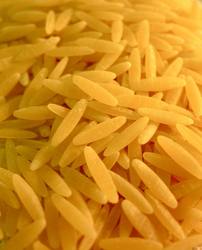
Bird's tongue (orzo)

There are chapters on foods named for what they look like (e.g., bare buttocks in the grass); food names associated with religion or the supernatural (no surprise that there are lots of angels and devils, but also Judas’ ear); foods named by mistake, often as a result of goofs in translation (including German chocolate cake and Jordan almonds); foods named for people and places (the chapter  is called “Edible Eponyms and Tasty Toponyms,” surely a topic for another day); foods named for what’s done to them or what they do to us; and words deriving from other words about food and drink.

Did you know that, In Lebanon, the long rolled pastry known as zunuud as-sitt translates from “woman’s upper arms?” It’s in there.

The book contains hundreds more little-known facts about food names and where they come from. I could stretch this out over several days, and maybe I’ll regret it if I don’t. In the meantime, maybe I’ll give you a little homework assignment.

See if you know—or can find—the recognized food names for the following:

  1. Apple in its bathrobe
  2. Angel’s breasts
  3. Boudoir biscuits
  4. Dad’s beard
  5. Dead fingers
  6. Friar’s balls
  7. Naughty children’s toes
  8. Tipsy parson
  9. Spicy bishop
  10. Whore’s pasta

Want to have some more fun? Look up the origin of pumpernickel.

One final note: my father recently suggested I address the origin of the word “bedlam,” and he traced its origin for me. What I learned from Ladyfingers & Nun’s Tummies, though, is that the word goes back even farther, with its origin in food. Maybe tomorrow?

6 Comments

Filed under All Things Wordish, Food, Reading

Not so gym-dandy

What’s the temperature in your gym? Yesterday mine was 98 degrees.

Once, when I said something in a post about going to the gym, my son chimed in. “Don’t lie, Mom. You don’t go to the gym.”

Rude accusations aside, he was wrong. I do go to the gym. I don’t go to a health club or a fitness center or a recreation facility. I go to a gym.

Remember gym? Big room, wood floor, retractable bleachers and a basketball hoop at each end?

Yeah, the gym. I happen to exercise at one owned by a local Boys & Girls Club. It’s not air conditioned; typically it’s about 10 degrees warmer than the temperature outside. Not only that, when I work out really hard, it spins around.

This is a pivotal time in my workout cycle. My current eight-week session is about to expire, hopefully before I do. My cue is, when I start to see spots, it’s time to back off.

I dragged myself back there yesterday after recovering from a bout with my respiratory illness. The air was like melting Jell-O. I made it though my one-hour class, motivated by knowing I’ll need to put on a swimsuit and a party dress within days. As if one workout were going to do magic. So I plowed through, periodically stepping outside into the 90-degree heat to take a breath.

I need to find a summer exercise alternative that isn’t going to cost me a flabby arm and leg.

6 Comments

Filed under Health, Sports and Recreation